Enzymes and the factors that affect them
What this lesson covers
- Enzymes are proteins that act as biological catalysts: they lower the activation energy of a reaction and are not used up.
- The active site has a shape that fits one substrate, explained by the lock and key and induced fit models.
- Low temperature slows an enzyme by reducing collisions; high temperature and extreme pH change the active site's shape and denature it.
- Raising substrate or enzyme concentration speeds the reaction until something else limits the rate.
- Competitive and non-competitive inhibitors slow enzymes in different ways, and many enzymes need a cofactor or coenzyme to work.
What an enzyme is
- An enzyme is a protein: a long chain of amino acids folded into one exact three-dimensional shape, held in place by bonds between parts of the chain.
- Enzymes are biological catalysts, so they speed up reactions in living things without being used up, and one enzyme molecule can be used again and again.
- They work by lowering the activation energy, the energy a reaction needs to get started, so reactions happen quickly at body temperature.
- Some enzymes break large molecules into smaller ones, such as amylase breaking starch into sugar; others join small molecules into larger ones, such as the enzymes that build DNA or make glucose in photosynthesis.
- Fresh kiwifruit contains an enzyme called actinidin that breaks down proteins, which is why raw kiwifruit stops a gelatine jelly from setting.
The active site: lock and key, and induced fit
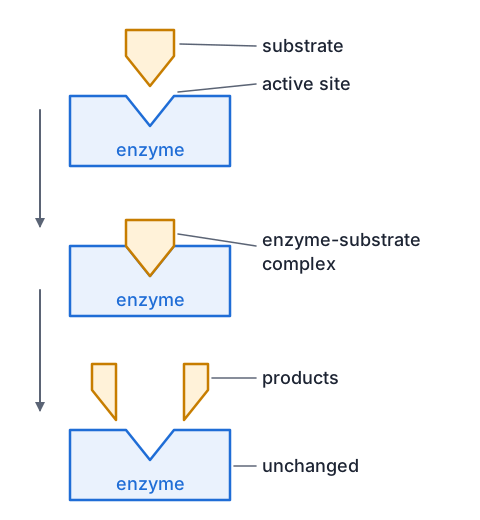
- The active site is a small region of the enzyme with a shape that matches its substrate, the molecule it acts on.
- When the substrate collides with the active site in the right way, it binds and forms an enzyme-substrate complex; the reaction happens and the products are released, leaving the enzyme free for the next substrate.
- Lock and key model: the active site is a rigid shape that only the right substrate fits, like one key in one lock, which explains why each enzyme is specific to one substrate.
- Induced fit model: the active site is flexible and moulds itself tightly round the substrate as it binds, which strains the substrate's bonds and helps the reaction happen.
- Induced fit is the better model because it explains how the enzyme lowers activation energy, and why some enzymes can act on a few similar substrates.
Temperature
- At low temperature, enzyme and substrate molecules have little kinetic energy, so they collide less often and the rate is slow; the enzyme is not damaged and works again once it warms up.
- As temperature rises, the molecules move faster and collide more often with enough energy, so more enzyme-substrate complexes form each second; up to the optimum, the rate roughly doubles with each 10 °C rise.
- The optimum temperature is where the rate is highest; for most human enzymes it is close to body temperature, 37 °C.
- Above the optimum, the extra energy breaks the bonds that hold the enzyme's shape, so the active site changes shape and the substrate no longer fits; the enzyme is denatured, and this is permanent.
- That is why the rate falls steeply above the optimum, and why bacteria living in geothermal pools, such as those around Rotorua, have enzymes with much higher optimum temperatures.
Example: catalase at different temperatures
- Catalase is an enzyme in potato cells that breaks down hydrogen peroxide into water and oxygen.
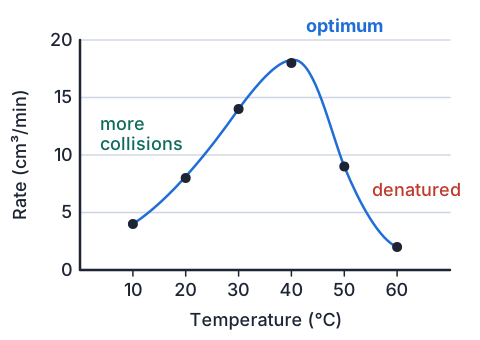
- A Year 12 class added potato discs to hydrogen peroxide at six temperatures and collected the oxygen for 2 minutes each time.
- Calculate each rate, then describe and explain the shape of the graph.
| Temperature (°C) | Oxygen in 2 min (cm³) | Rate (cm³/min) |
|---|---|---|
| 10 | 8 | 4 |
| 20 | 16 | 8 |
| 30 | 28 | 14 |
| 40 | 36 | 18 |
| 50 | 18 | 9 |
| 60 | 4 | 2 |
- rate = volume of oxygen ÷ timehow much product forms each minute
- at 40 °C: 36 cm³ ÷ 2 min = 18 cm³/minthe highest rate, so the optimum is near 40 °C
- 10 to 40 °C: rate rises from 4 to 18 cm³/minmore collisions between catalase and hydrogen peroxide each second
- 40 to 60 °C: rate falls from 18 to 2 cm³/mincatalase is denatured, so fewer active sites fit the substrate
- optimum about 40 °C; the rate rises with collisions, then falls as the enzyme denatures
- the class only tested every 10 °C, so the true optimum could be anywhere from about 35 to 45 °C
pH
- Each enzyme has an optimum pH: pepsin in the stomach works best near pH 2, salivary amylase near pH 7 and trypsin in the small intestine near pH 8.
- Changing the pH changes the number of hydrogen ions, which alters the charges on the amino acids in the active site and breaks some of the bonds that hold the enzyme's shape.
- A small change from the optimum makes the substrate fit less well, so the rate drops, and this is usually reversible.
- A large change denatures the enzyme permanently, so a pH graph is a narrow peak with the rate falling on both sides.
Substrate and enzyme concentration
- With more substrate there are more collisions with active sites each second, so the rate rises.
- Once every active site is busy all the time, adding more substrate cannot speed things up and the graph levels off; the enzyme concentration is now the limiting factor.
- With plenty of substrate, doubling the enzyme concentration doubles the number of active sites, so the rate doubles.
- On a graph of product against time, the rate is the gradient: steepest at the start, then flattening as the substrate is used up.
| Graph | Shape | Reason |
|---|---|---|
| Rate against substrate concentration | rises, then levels off | all active sites become occupied |
| Rate against enzyme concentration | straight line up (substrate in excess) | more active sites available |
| Product against time | steep at first, then flat | substrate is used up |
Inhibitors and cofactors
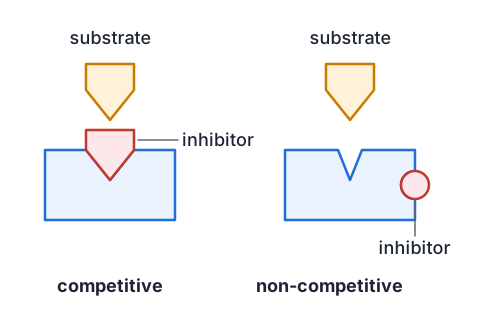
- An inhibitor is a molecule that slows or stops an enzyme.
- A competitive inhibitor has a shape similar to the substrate, so it sits in the active site and blocks it; adding more substrate wins more of the collisions, so the effect can be overcome.
- A non-competitive inhibitor binds to another part of the enzyme and changes the shape of the active site, so adding more substrate does not help; heavy metals such as lead and mercury act this way.
- A cofactor is a non-protein helper that some enzymes need for the active site to work: inorganic ions such as zinc, iron or magnesium, or organic coenzymes, many of which are made from vitamins.
Describing and explaining a rate graph
- Split the graph into sections where the shape changes, and deal with each in turn.
- Describe first, with numbers from the graph: the rate rises from 4 to 18 cm³/min between 10 and 40 °C.
- Then explain with biology: faster particles, more collisions, more enzyme-substrate complexes, or a denatured active site that no longer fits the substrate.
- Name what is limiting in each section: temperature on the way up, and the number of working enzyme molecules once it is past the optimum.
What Achieved, Merit and Excellence look like
- Achieved describes the effect or gives a definition; Merit explains why with the active site, collisions or denaturing; Excellence links the effects of high and low temperature and compares them.
- The words enzyme-substrate complex and active site are what move an answer from Achieved to Merit.
| Grade | A model answer |
|---|---|
| Achieved | Enzymes work best at their optimum temperature, about 37 °C. At 60 °C the enzyme is denatured. |
| Merit | At 10 °C the molecules move slowly, so the substrate collides with the active site less often and fewer enzyme-substrate complexes form. At 60 °C the bonds holding the enzyme's shape break, the active site changes shape and the substrate can no longer fit. |
| Excellence | Both temperatures slow the reaction, but for different reasons. At 10 °C the enzyme keeps its shape; there are simply fewer collisions with enough energy, so warming it up restores the rate. At 60 °C the active site has lost its shape, so even though the particles collide more often, no enzyme-substrate complexes can form, and cooling it down does not help because denaturing is permanent. |
Common mistakes
- At low temperatures the enzyme is denatured, so it stops working.Low temperature only slows the enzyme by reducing collisions; it is not denatured and works again once warmed.
- The enzyme dies at high temperatures.Enzymes are proteins, not living things: they are denatured, meaning the active site changes shape so the substrate cannot fit.
- The enzyme is used up in the reaction, so the rate slows down.The enzyme is unchanged and reused; the rate slows because the substrate is being used up.
- The active site and the substrate are the same shape.They are complementary shapes that fit together, like a key and its lock, not identical ones.
Yeast enzymes at three temperatures
You need: 3 clear glasses, 1 sachet of dried baker's yeast, 3 teaspoons of sugar, water from the fridge, warm tap water and the hottest tap water, a ruler, a teaspoon
- Put 1 teaspoon of sugar and one third of the yeast into each glass.
- Add half a cup of fridge-cold water to the first glass, half a cup of warm tap water that feels just warm on your wrist to the second, and half a cup of the hottest tap water to the third, then stir each.
- Leave them side by side for 15 minutes.
- Measure the height of the foam on each glass with the ruler.
- Look for: the warm glass foams most, because the yeast's enzymes break down the sugar fastest near their optimum; the cold glass is slow because there are fewer collisions, and the hottest glass may barely foam because its enzymes are denatured.
Safety: Hot tap water can scald, so run it carefully, pour it slowly and carry the glass with both hands; do not drink any of the mixtures.
Your turn
An enzyme reaction gives off 30 cm³ of oxygen in 2 minutes. What is the average rate?
An enzyme is kept at 5 °C for an hour, then warmed to 37 °C. What happens to its activity, and why?
The rate has levelled off at a high substrate concentration. What happens to the rate if you double the substrate concentration again?
Which kind of inhibitor can be overcome by adding more substrate?
In the class's catalase results, how many times faster was the rate at 30 °C than at 10 °C?
Show answer
1. Rate = 30 cm³ ÷ 2 min = 15 cm³/min. 2. Its activity returns: low temperature only slowed the molecules down and did not change the active site's shape. 3. No change, because every active site is already occupied, so the enzyme concentration is limiting. 4. A competitive inhibitor, because more substrate molecules win more of the collisions with the active site. 5. 14 ÷ 4 = 3.5 times faster.
Exam-style question: kiwifruit in jelly
- Mere makes two jellies with gelatine, which is a protein. She stirs fresh kiwifruit into the first and canned kiwifruit into the second. Canning heats the fruit to a high temperature. The jelly with canned fruit sets, but the jelly with fresh fruit stays runny.
Describe what an enzyme is.
Explain why the jelly with fresh kiwifruit does not set, using the idea of the active site.
Explain why the jelly with canned kiwifruit does set.
Mere keeps fresh kiwifruit in the fridge at 4 °C for a week, then puts it in a jelly. Discuss whether this jelly will set, comparing the effects of low and high temperature on the enzyme.
Show answer
1. An enzyme is a protein that acts as a biological catalyst, speeding up a reaction by lowering its activation energy without being used up (Achieved). 2. Fresh kiwifruit contains actinidin, an enzyme whose active site fits the gelatine protein; the gelatine binds to form an enzyme-substrate complex and is broken into smaller pieces that cannot form the network that sets the jelly (Merit). 3. The high temperature of canning broke the bonds holding actinidin's shape, so its active site changed shape and the gelatine can no longer fit; the enzyme is denatured, so the gelatine stays whole and sets (Merit). 4. The jelly will not set (Excellence for linking the ideas). At 4 °C the enzyme molecules moved slowly and collided with substrate less often, but their shape was not changed, so actinidin was not denatured; once the fruit is in the warm jelly mixture, the molecules collide more often and the active site still fits the gelatine, so the gelatine is broken down. The canned fruit's enzyme is different: denaturing changed its active site permanently, so it cannot recover even when cooled.
Recap
- Enzymes are protein catalysts that lower activation energy and are reused.
- The substrate binds to the active site to form an enzyme-substrate complex; lock and key and induced fit explain the fit.
- Cold slows collisions but does no damage; heat and extreme pH denature the active site for good.
- More substrate or enzyme speeds the reaction until something else becomes limiting.
- Competitive inhibitors block the active site; non-competitive inhibitors change its shape from somewhere else.
| Factor | Effect on the rate | Why |
|---|---|---|
| Low temperature | slow | fewer collisions; the enzyme is undamaged |
| High temperature | falls steeply past the optimum | active site denatured, substrate no longer fits |
| pH away from the optimum | falls on both sides | charges and bonds in the active site change |
| More substrate | rises, then levels off | active sites become fully occupied |
The maths behind it
How is NCEA Level 2 maths going?
See the NCEA Level 2 maths guide