DNA, transcription and translation
What this lesson covers
- Nucleotides, the sugar-phosphate backbone, complementary base pairing and the antiparallel strands of DNA.
- How DNA, mRNA and tRNA differ, and how DNA copies itself by semi-conservative replication.
- The genetic code: triplets, codons, anticodons, start and stop codons, and degeneracy.
- Transcription in the nucleus and translation at the ribosome, with the role of enzymes.
- One gene, one polypeptide: how the base sequence sets a protein's shape and its structural or catalytic job.
- Why the cell copies a gene into mRNA rather than translating the DNA itself.
The structure of DNA
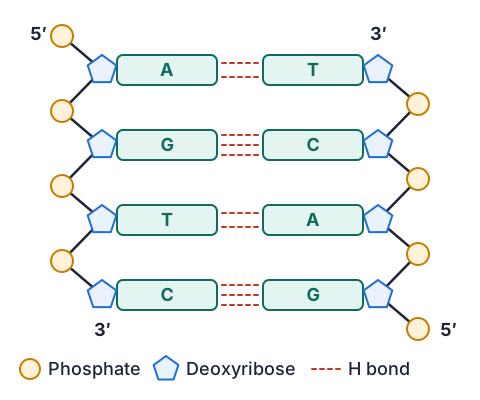
- DNA is a polymer of nucleotides; each nucleotide is a phosphate, a deoxyribose sugar and one of four nitrogenous bases: adenine (A), thymine (T), guanine (G) or cytosine (C).
- Sugars and phosphates join into a backbone, and the bases of two strands pair across the middle, held by hydrogen bonds, then twist into a double helix.
- Pairing is complementary: A pairs with T by two hydrogen bonds and G pairs with C by three. A and G are large double-ring bases and T and C are small single-ring bases, so each pair is the same width.
- The two strands are antiparallel: one runs 5′ to 3′ and its partner runs 3′ to 5′, named after the carbon atoms of the sugar.
- Because the pairing is fixed, one strand predicts the other: if a molecule is 20% A, it is also 20% T, and the remaining 60% splits into 30% G and 30% C.
DNA, mRNA and tRNA
- RNA differs from DNA in three ways the exam often asks for: ribose instead of deoxyribose, uracil (U) instead of thymine, and usually one strand instead of two.
- mRNA (messenger RNA) is a short, single-stranded copy of one gene that leaves the nucleus; it is broken down within hours, so the cell can stop making a protein quickly.
- tRNA (transfer RNA) is a small RNA folded back on itself, with an anticodon at one end and a matching amino acid attached to the other; its folded shape makes it stable enough to be reused.
| DNA | mRNA | tRNA | |
|---|---|---|---|
| Sugar | Deoxyribose | Ribose | Ribose |
| Bases | A, T, G, C | A, U, G, C | A, U, G, C |
| Strands | Two, a double helix | One, unfolded | One, folded |
| Where | Stays in the nucleus | Nucleus to ribosome | Cytoplasm |
| Job | Stores the code | Carries one gene's code | Brings amino acids |
Copying DNA: semi-conservative replication
- Before a cell divides, an enzyme (helicase) unwinds the helix and breaks the hydrogen bonds, unzipping the two strands.
- Each old strand acts as a template: DNA polymerase adds free nucleotides by complementary pairing, building the new strand in the 5′ to 3′ direction.
- Each new molecule keeps one old strand and one new strand, which is why it is called semi-conservative, and both copies carry the same base sequence.
- This is examined mainly in AS 91156, but it explains why a mistake during copying (a mutation) is passed on to every cell made from that one.
The genetic code
- The code is read in threes: a triplet of bases on the DNA template becomes a codon on the mRNA, and each codon stands for one amino acid or for stop.
- Four bases in groups of three give 4 × 4 × 4 = 64 codons; 61 code for the 20 amino acids and 3 (UAA, UAG, UGA) are stop codons with no matching tRNA.
- AUG codes for methionine (Met) and is also the start codon, so most polypeptides begin with Met.
- The code is degenerate (redundant): most amino acids have more than one codon, often differing only in the third base, so leucine has six codons while tryptophan has just one.
- An anticodon is the three tRNA bases complementary to a codon; it has the same letters as the DNA template triplet, with U in place of T.
| DNA template triplet | mRNA codon | tRNA anticodon | Amino acid |
|---|---|---|---|
| TAC | AUG | UAC | Met (start) |
| GGA | CCU | GGA | Pro |
| TTC | AAG | UUC | Lys |
| CAT | GUA | CAU | Val |
| ACT | UGA | none | Stop |
Transcription: DNA to mRNA in the nucleus
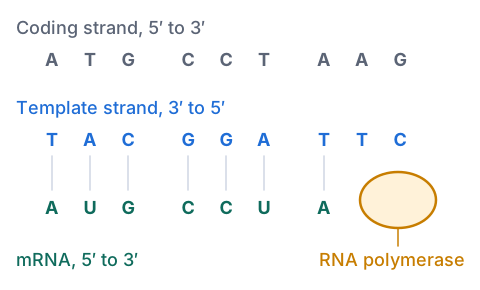
- The enzyme RNA polymerase binds at the start of the gene and unwinds a short stretch of the DNA.
- Only one strand, the template strand, is read; free RNA nucleotides pair with it (A with U, T with A, G with C, C with G) and are joined into mRNA running 5′ to 3′.
- The other strand is the coding strand: the mRNA has the same sequence, except U replaces T.
- At the end of the gene the mRNA is released, the DNA zips back up, and the mRNA leaves the nucleus through a nuclear pore to a ribosome.
Translation: mRNA to polypeptide at the ribosome
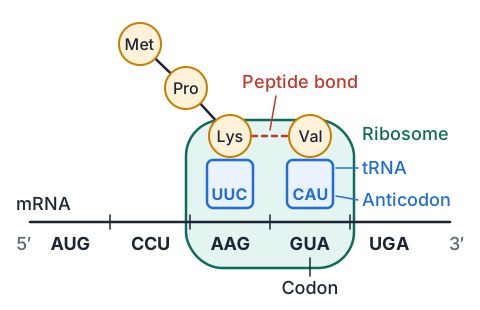
- A ribosome attaches to the mRNA and moves along it to the start codon, AUG.
- A tRNA whose anticodon is complementary to the codon (UAC for AUG) pairs with it, carrying the matching amino acid (Met).
- The next tRNA pairs with the next codon, and an enzyme in the ribosome joins the two amino acids with a peptide bond; the first tRNA leaves to collect another amino acid.
- The ribosome moves one codon at a time until it reaches a stop codon, which no tRNA matches, and the finished polypeptide is released to fold into its 3D shape.
Example: from template strand to amino acids
- A section of DNA template strand, written 3′ to 5′, reads TAC GGA TTC CAT ACT.
- Find the mRNA, the tRNA anticodons and the amino acid sequence, using the codon table.
- mRNA: AUG CCU AAG GUA UGApair each base: T→A, A→U, C→G, G→C
- anticodons: UAC GGA UUC CAUcomplementary to each codon; the template letters with U for T
- AUG = Met, CCU = Pro, AAG = Lys, GUA = Val, UGA = stopread the table from the mRNA, never from the DNA
- Met-Pro-Lys-Val
- UGA is a stop codon, so it has no tRNA and adds no amino acid
Example: when you are given the coding strand
- A question gives the coding strand, 5′ to 3′: ATG GCT TGG AAA TAG.
- Find the mRNA and the amino acids.
- mRNA: AUG GCU UGG AAA UAGthe mRNA matches the coding strand, with U for T
- complementing it would give UAC CGA ACC UUU AUCthat is the anticodon set, not the mRNA
- AUG = Met, GCU = Ala, UGG = Trp, AAA = Lys, UAG = stopcodon table
- Met-Ala-Trp-Lys
One gene, one polypeptide, and why proteins matter
- A gene is a section of DNA whose base sequence codes for one polypeptide, so the order of bases sets the order of amino acids.
- The amino acid order decides how the chain folds, and the folded shape decides what the protein can do.
- Structural proteins build the body: keratin in hair and nails, collagen in skin and tendons.
- Catalytic proteins are enzymes, and each has an active site whose shape fits only its own substrate; transcription, replication and translation are themselves run by enzymes.
- Change the base sequence and you may change the amino acids, the shape and the function: the link to mutations in the next lesson.
Why not translate the DNA directly?
- Ribosomes are in the cytoplasm and DNA stays in the nucleus, so a mobile copy of the gene has to carry the code out through the nuclear pores.
- A ribosome reads a single strand; DNA is double-stranded and wound up with proteins, so it cannot be read where it sits.
- One gene can be transcribed many times, so many mRNA copies can be translated at once by many ribosomes, making lots of protein quickly when the cell needs it.
- The DNA master copy stays protected in the nucleus, away from enzymes in the cytoplasm, while the short-lived mRNA can be broken down to switch the protein off.
Example: what each grade looks like
- Question: discuss why transcription is needed before translation, using codons and anticodons.
- Achieved defines and describes; Merit explains how or why; Excellence links the steps together and to the reasons.
| Grade | A model answer |
|---|---|
| Achieved | Transcription makes an mRNA copy of a gene in the nucleus. Translation uses the mRNA at a ribosome to make a polypeptide. A codon is three bases on mRNA. |
| Merit | RNA polymerase pairs free RNA nucleotides with the template strand (A with U, C with G), making mRNA that leaves the nucleus. At the ribosome each codon pairs with a tRNA anticodon, so the right amino acid is added each time. |
| Excellence | DNA cannot leave the nucleus and ribosomes cannot read a double strand, so transcription makes a single-stranded mRNA that carries the base sequence out. Because each codon pairs only with its complementary anticodon, and each tRNA carries one specific amino acid, the order of bases in the gene fixes the order of amino acids, so the protein folds into the right shape. Many mRNA copies also let many ribosomes make the protein at once. |
Common mistakes
- The template triplet TAC gives the mRNA codon ATG.RNA has uracil, not thymine, so the codon is AUG.
- The codon AUG has the anticodon AUG.The anticodon is complementary to the codon, so AUG pairs with UAC.
- Given the coding strand ATG, I complemented it to get the mRNA UAC.The mRNA copies the coding strand (with U for T), so it is AUG; only the template strand is complemented.
- Translation happens in the nucleus, where the DNA is.Transcription is in the nucleus; translation is at ribosomes in the cytoplasm.
Make a protein from a paper gene
You need: a strip of paper about 30 cm long, a second strip the same size, a pen, scissors, the codon table from this lesson
- On the first strip, write this template strand in large letters, leaving a gap after every third base: TAC CGG AAA TTT ATC.
- Transcribe it: on the second strip, write the mRNA that pairs with each base (A with U, T with A, C with G, G with C). You should get AUG GCC UUU AAA UAG.
- Cut the mRNA strip into codons and translate each one with the codon table, in order, until you reach a stop codon.
- Now make a point mutation: change the third template triplet from AAA to AAT, rewrite that mRNA codon and translate it again.
- Look for: the first gene codes Met, Ala, Phe, Lys and then stops; after the mutation the third amino acid becomes Leu, a missense change that alters one amino acid but keeps the rest of the chain.
Safety: Scissors are the only sharp item, so cut on a table with the blades moving away from the hand holding the paper.
Your turn
Write the complementary strand of 5′ ATGCCA 3′, with its ends labelled.
A DNA template triplet is TTC. What is the mRNA codon?
What anticodon pairs with the mRNA codon GGU?
Which amino acid does AUG code for, and what else does AUG do?
Of the 64 codons, how many code for amino acids?
A DNA sample is 30% adenine. What percentage is guanine?
Show answer
1. 3′ TACGGT 5′ (complementary and antiparallel). 2. AAG (T→A, T→A, C→G). 3. CCA (G→C, G→C, U→A). 4. Methionine (Met); it is also the start codon. 5. 61; the other 3 are stop codons. 6. A = T = 30%, so G + C = 100 − 60 = 40%, and G = 20%.
Exam-style question: a section of a keratin gene
- Keratin is the structural protein in hair and nails. A short, made-up section of the template strand of a keratin gene, written 3′ to 5′, reads TAC AAA CGT GGC ATT.
Give the mRNA codons and the amino acid sequence this section codes for.
Give the anticodons of the tRNAs that bring the first four amino acids.
Explain why changing the codon GCA to GCC would not change the keratin.
Discuss how the base sequence of the gene decides the shape and function of keratin, and why the ribosome reads mRNA rather than the DNA itself.
Show answer
1. mRNA AUG UUU GCA CCG UAA; Met-Phe-Ala-Pro, then stop (Achieved for the correct row). 2. UAC AAA CGU GGC; UAA is a stop codon, so no tRNA matches it (Achieved). 3. The code is degenerate: GCA and GCC both code for alanine, so the same amino acid is added and the polypeptide is unchanged (Merit, because it gives the reason). 4. Achieved: the gene is transcribed into mRNA and translated into a chain of amino acids. Merit: each mRNA codon pairs with a complementary tRNA anticodon carrying one specific amino acid, so the base order sets the amino acid order. Excellence: the amino acid order decides how the chain folds, so keratin gets the strong, fibrous shape it needs for hair and nails; the DNA is copied into single-stranded mRNA because DNA stays protected in the nucleus while ribosomes work in the cytoplasm, and many mRNA copies let many ribosomes make keratin at once.
Gene Expression Essentials
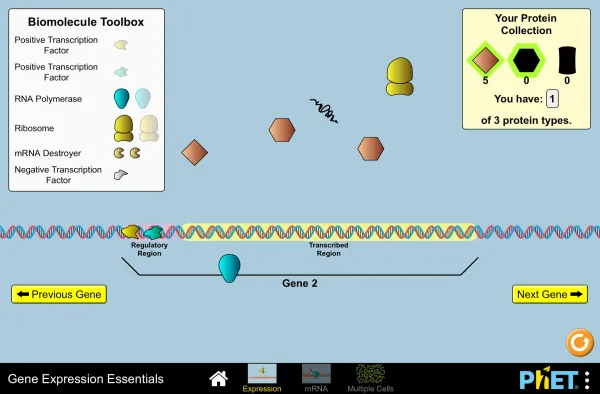
Full screen · PhET Interactive Simulations, University of Colorado Boulder, CC BY 4.0
Recap
- DNA: nucleotides of phosphate, deoxyribose and a base; A with T, G with C; antiparallel strands.
- Transcription in the nucleus: RNA polymerase pairs RNA nucleotides with the template strand to make mRNA (U instead of T).
- Translation at the ribosome: codons pair with tRNA anticodons, amino acids join by peptide bonds, start at AUG and stop at UAA, UAG or UGA.
- Base order sets amino acid order, which sets shape and function; the degenerate code means some base changes make no difference.
| You are given | To get the mRNA |
|---|---|
| Template strand | Complement it, with U opposite A |
| Coding strand | Copy it, swapping T for U |
| tRNA anticodons | Complement them |
| mRNA | Read the codon table directly |
How is NCEA Level 2 maths going?
See the NCEA Level 2 maths guide