Magnetic forces and induced voltage
What this lesson covers
- A current makes a magnetic field that circles the wire, and the right-hand grip rule gives its direction.
- A wire carrying current at right angles to a field feels a force F = BIL; a wire parallel to the field feels none.
- A charge moving across a field feels a force F = Bqv, at right angles to both its velocity and the field.
- The right-hand slap rule gives the force direction for conventional current or a positive charge; reverse it for electrons.
- A conductor moving across a field has a voltage V = BvL induced between its ends, because the field pushes its electrons to one end.
Magnetic fields and the right-hand grip rule
- A magnetic field is a region where a magnet, a current or a moving charge feels a force; its strength B is measured in tesla (T).
- Outside a magnet the field lines run from the north pole to the south pole, and between two flat pole faces they are straight and evenly spaced: a uniform field.
- Magnetic poles are north and south, never positive and negative; poles and electric charges are different things.
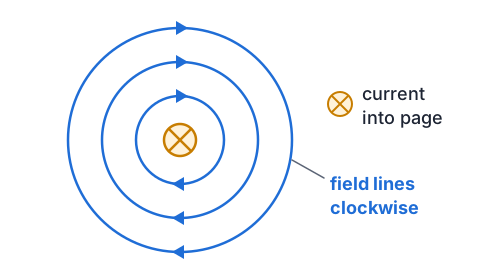
- A current in a straight wire makes circular field lines around it: point your right thumb along the conventional current and your fingers curl the way the field goes.
- On diagrams a dot (⊙) means a current or field coming out of the page and a cross (⊗) means one going into it.
Force on a current-carrying wire
- A wire carrying current across a magnetic field feels a force F = BIL, where L is the length of wire inside the field, in metres.
- F = BIL is the force when the current is at right angles to the field, which is the biggest it can be; when the current runs parallel to the field the force is zero.
- The force is at right angles to both the current and the field.
- Right-hand slap rule: fingers along the field (N to S), thumb along the conventional current, and the force comes out of your palm, the way you would slap.
- Reverse either the current or the field and the force reverses; reverse both and it stays the same.
Example: a wire between magnet poles
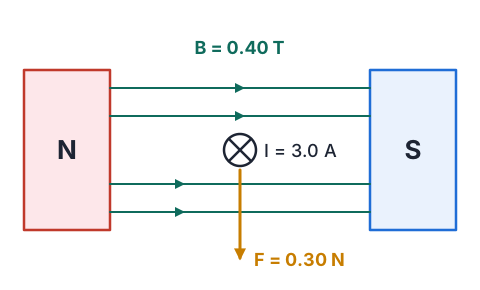
- A wire carries 3.0 A into the page between a north pole on the left and a south pole on the right. The field is 0.40 T and 25 cm of the wire is in it.
- How big is the force on the wire, and which way does it act?
- L = 25 cm = 0.25 mmetres first
- F = BIL = 0.40 × 3.0 × 0.25 = 0.30 Nthe current crosses the field at right angles
- fingers to the right (N to S), thumb into the page: the palm faces down the pageright-hand slap rule
- F = 0.30 N, towards the bottom of the page
- the wire's own clockwise field adds to the magnet's field above the wire and cancels it below, so the wire is pushed down, towards the weaker field
Coils and motors
- A motor has a coil of wire in a magnetic field; the two sides that cross the field carry current in opposite directions, so they are pushed opposite ways and the coil turns.
- With N turns, each side of the coil carries the current N times over, so the force on one side is F = NBIL.
- The ends of the coil that lie along the field feel no force, because their current runs parallel to the field lines.
- Exam questions use motors as contexts, but they test F = BIL and the direction of the force, not the names of the motor's parts.
Force on a moving charge
- A current is moving charge, so a single charge moving across a field feels a force too: F = Bqv, with v at right angles to B.
- For a positive charge, use the slap rule with your thumb along its velocity; an electron is pushed the opposite way, because its motion is the opposite of conventional current.
- The force is always at right angles to the velocity, so it changes the charge's direction but not its speed, and the path curves.
- A charge moving parallel to the field, or a charge at rest, feels no magnetic force.
- Compare the electric field: there F = Eq acts even on a charge at rest, and points along the field lines.
Example: an electron crossing a field
- An electron moves to the right at 2.0 × 10⁶ m s⁻¹ through a 0.050 T field that points into the page.
- How big is the force on it, and which way does it act?
- F = Bqv = 0.050 × 1.6 × 10⁻¹⁹ × 2.0 × 10⁶velocity at right angles to the field
- F = 1.6 × 10⁻¹⁴ N
- for a positive charge: fingers into the page, thumb to the right, palm faces up the pageright-hand slap rule
- an electron is negative, so the force is reversed
- F = 1.6 × 10⁻¹⁴ N, towards the bottom of the page
- the force is at right angles to the velocity, so the electron curves downwards at a constant speed
Voltage induced in a moving rod
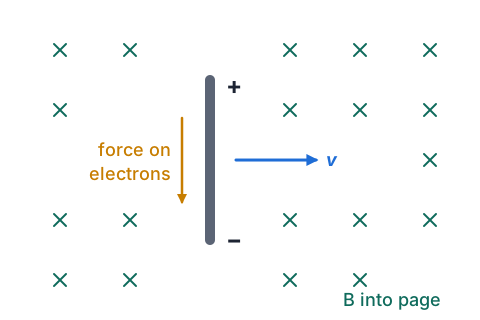
- Move a metal rod across a magnetic field and its free electrons move with it, so each one is a charge moving through the field and feels a force F = Bqv along the rod.
- The electrons pile up at one end, which becomes negative, and the other end is left short of electrons and positive: a voltage is induced between the ends.
- Its size is V = BvL, where v is the rod's speed at right angles to the field and L is the length of rod in the field.
- The rod must cut across field lines; moving along the field lines, or standing still, induces no voltage.
- To find the negative end, use the slap rule with your thumb along the rod's velocity: that gives the push on positive charge, so the electrons go the other way.
Example: a roof rack on the motorway
- In Auckland the Earth's field points north and steeply up out of the ground, with a vertical part of 47.6 μT (4.76 × 10⁻⁵ T).
- A car drives north at 100 km/h with a 1.5 m steel roof-rack bar lying east to west. Find the voltage between the ends of the bar, and which end is negative.
| Place | Total field | Vertical part (upwards) | Angle above horizontal |
|---|---|---|---|
| Auckland | 53.5 μT | 47.6 μT | 62.8° |
| Christchurch | 57.2 μT | 53.2 μT | 68.6° |
- v = 100 ÷ 3.6 = 27.8 m s⁻¹km/h to m s⁻¹
- the bar moves horizontally, so it cuts only the vertical part of the fieldmoving along the horizontal part cuts no field lines
- V = BvL = 4.76 × 10⁻⁵ × 27.8 × 1.5 = 1.98 × 10⁻³ V
- thumb north, fingers up: the palm faces east, so positive charge is pushed east and electrons westright-hand slap rule
- V = 2.0 × 10⁻³ V (2.0 mV), with the west end negative
- units: T × m s⁻¹ × m = V, and a field of a few tens of microtesla gives only millivolts
Generators: when is the voltage biggest?
- Turn a coil in a magnetic field and its long sides cut through the field lines, so a voltage is induced in each side.
- Going round the coil, the voltages in the two long sides add, so a coil of N turns gives at most 2 × N × BvL.
- The voltage is biggest when the sides move at right angles to the field (the coil lies flat along the field) and zero when they move along the field lines (the coil faces the field).
- So the voltage rises and falls as the coil turns, and reverses every half turn: an alternating voltage.
- Spinning faster, or using a stronger field or more turns, gives a bigger voltage.
What Achieved, Merit and Excellence look like
- Achieved names the idea; Merit gives the cause with a formula; Excellence links the force on each electron to the separation of charge and to the size of the voltage.
- When a question asks for a direction, give it, and say which rule you used.
| Grade | A model answer |
|---|---|
| Achieved | The rod cuts through the magnetic field, so a voltage is induced. |
| Merit | The rod's electrons move with it through the field, so each feels a force (F = Bqv) along the rod, and they gather at one end, making it negative. |
| Excellence | The electrons move with the rod at right angles to the field, so each feels a force F = Bqv along the rod. They collect at one end, leaving the other end short of electrons, so one end is negative and the other positive. This separation of charge is the induced voltage, V = BvL, which grows with the speed, the field and the rod's length. |
Common mistakes
- In V = BvL the two V's are the same thing, so a 12 V generator means v = 12.Capital V is the voltage in volts and small v is the speed in m s⁻¹; rearrange to v = V ÷ (BL).
- For an electron moving right, point your thumb right and read the force off your palm.The slap rule is for positive charge or conventional current; for an electron, reverse the force you find.
- The side of the coil that lies along the field feels the same force as the other sides.Current parallel to the field feels no force; only current that crosses the field lines is pushed, most strongly at right angles.
- The positive pole of the magnet is on the left.Magnets have north and south poles; positive and negative describe electric charge, and field lines run from north to south.
Make a current move a compass
You need: 1 AA battery, a strip of aluminium foil about 30 cm long, folded to 1 cm wide, sticky tape, a compass, or a phone compass app
- Lay the compass flat, let the needle settle pointing north, and lay the foil strip straight across the top of it, along the needle, from north to south.
- Tape the north end of the foil to the − end of the battery.
- Touch the south end of the foil to the + end of the battery for one second only, watching the needle; the current now flows north along the foil.
- Swap the foil ends on the battery so the current flows south, and touch for one second again.
- Look for: the needle swings one way, then the other way when the current reverses; with the current flowing north above the needle, the grip rule puts the field under the wire pointing west, so the north end swings west.
Safety: The foil joins the battery's ends directly, a short circuit, so touch for one second at a time: held longer, the foil and battery get hot enough to burn. Use only an AA battery, never a button cell or a car battery.
Your turn
What force acts on 0.50 m of wire carrying 4.0 A at right angles to a 0.20 T field?
The same wire is turned to lie along the field lines. What is the force now?
A proton moves at 3.0 × 10⁵ m s⁻¹ at right angles to a 0.80 T field. What force acts on it?
A 2.0 m rod moves at 5.0 m s⁻¹ across a 0.10 T field. What voltage is induced between its ends?
At what speed would the same rod need to move to induce 0.25 V?
Show answer
1. F = BIL = 0.20 × 4.0 × 0.50 = 0.40 N. 2. 0 N, because current parallel to the field feels no force. 3. F = Bqv = 0.80 × 1.6 × 10⁻¹⁹ × 3.0 × 10⁵ = 3.8 × 10⁻¹⁴ N. 4. V = BvL = 0.10 × 5.0 × 2.0 = 1.0 V. 5. v = V ÷ (BL) = 0.25 ÷ (0.10 × 2.0) = 1.25 m s⁻¹.
Exam-style question: a model motor
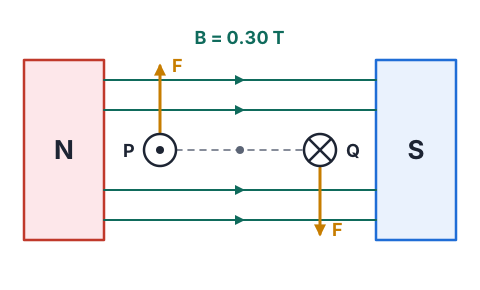
- A model motor has a rectangular coil of 25 turns between a north pole on the left and a south pole on the right, where the field is 0.30 T. Each long side has 4.0 cm of wire in the field and the coil carries 1.2 A. Seen end-on, side P carries current out of the page and side Q carries it into the page.
State the direction of the force on side P, and the rule you used.
Calculate the size of the force on side P.
In the position shown, the short ends of the coil run along the field. Explain why they feel no force.
The battery is removed and the coil is spun so each long side moves at 0.50 m s⁻¹. Calculate the biggest voltage the whole coil can produce.
Explain where the coil must be in its turn to give that biggest voltage, and where it gives none.
Show answer
1. Upwards, towards the top of the page: fingers along the field to the right, thumb out of the page, and the palm faces up (Achieved). 2. F = NBIL = 25 × 0.30 × 1.2 × 0.040 = 0.36 N (Merit: L in metres and all 25 turns counted). 3. Their current runs parallel to the field lines, and a force needs current that crosses the field, so F = BIL is zero (Merit for the reason). 4. One side of one turn: V = BvL = 0.30 × 0.50 × 0.040 = 6.0 × 10⁻³ V; both long sides of all 25 turns add: 6.0 × 10⁻³ × 2 × 25 = 0.30 V (Excellence for counting both sides and every turn). 5. Achieved: biggest when the coil lies flat, as shown. Merit: then P and Q move up and down, at right angles to the field, so they cut field lines fastest. Excellence: when the coil stands upright, across the field, P and Q move sideways along the field lines, cut none, and V = BvL gives zero because only the part of the velocity across the field counts; between these positions the voltage rises and falls.
Faraday's Law
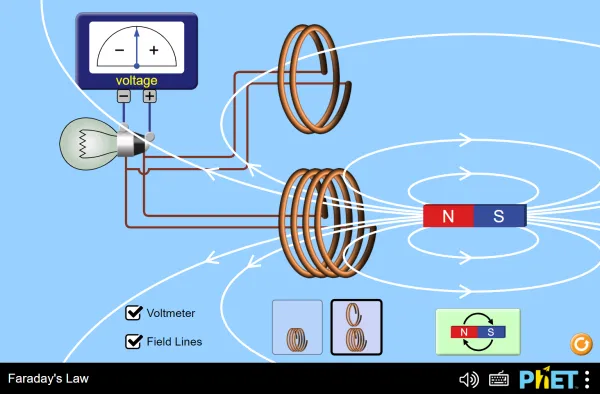
Full screen · PhET Interactive Simulations, University of Colorado Boulder, CC BY 4.0
Recap
- A current makes a circular field: right thumb along the current, fingers give the field.
- F = BIL on a wire and F = Bqv on a moving charge, both at right angles to the field; zero when the motion is along the field.
- Slap rule: fingers along B, thumb along the current or a positive charge's velocity, palm gives the force; reverse it for electrons.
- A rod cutting a field has V = BvL between its ends, with the electrons pushed to the negative end.
- Convert cm to m, km/h to m s⁻¹ and μT to T, and never mix up V (voltage) with v (velocity).
| Formula | Use it to find |
|---|---|
| F = BIL | the force on a wire across a field |
| F = Bqv | the force on a charge moving across a field |
| V = BvL | the voltage induced in a moving conductor |
| F = NBIL | the force on one side of a coil of N turns |
How is NCEA Level 2 maths going?
See the NCEA Level 2 maths guide