DC circuits: series, parallel and combined
What this lesson covers
- Current is the rate charge flows (I = q/t) and voltage is the energy each coulomb carries (V = E/q).
- In series the current is the same everywhere, the voltages add up to the supply and Rₜ = R₁ + R₂.
- In parallel each branch has the same voltage, the branch currents add, and 1/Rₜ = 1/R₁ + 1/R₂ makes the total smaller than any branch.
- Power P = IV (also I²R and V²/R) sets how bright a lamp is, and E = Pt gives the energy it transfers.
- When a part changes, the total resistance changes first, then the total current, then the voltages across each part.
Charge, current, voltage and resistance
- Current is the rate at which charge passes a point: I = q/t, so 1 A is 1 coulomb every second, and q = It.
- Voltage is the energy each coulomb gains from the supply or gives to a component: V = E/q, so 1 V is 1 joule per coulomb.
- Resistance links them through V = IR, measured in ohms (Ω).
- An ammeter goes in series with the part it measures; a voltmeter goes in parallel across it.
| Quantity | Symbol | Unit | Formula |
|---|---|---|---|
| Charge | q | coulomb (C) | q = It |
| Current | I | amp (A) | I = q/t |
| Voltage | V | volt (V) | V = E/q |
| Resistance | R | ohm (Ω) | R = V/I |
| Power | P | watt (W) | P = IV = E/t |
Series and parallel rules
- In series there is one path, so the same current flows through every part, the voltages add up to the supply voltage and the resistances add: Rₜ = R₁ + R₂ + ...
- In parallel each branch is connected across the same two points, so every branch has the same voltage.
- The branch currents add up to the current entering the junction, and the branch with less resistance carries more current, because I = V/R with the same V.
- Resistances in parallel combine as 1/Rₜ = 1/R₁ + 1/R₂ + ..., so adding a branch always lowers the total, and the total is less than the smallest branch.
- Two equal resistors in parallel give half of one: two 8.0 Ω lamps make 4.0 Ω.
| Series | Parallel | |
|---|---|---|
| Current | the same everywhere | branch currents add up to the total |
| Voltage | shared; adds up to the supply | the same across each branch |
| Total resistance | Rₜ = R₁ + R₂ | 1/Rₜ = 1/R₁ + 1/R₂ |
Example: two resistors in parallel
- A 6.0 Ω resistor and a 12 Ω resistor are connected in parallel.
- Find their total resistance.
- 1/Rₜ = 1/6.0 + 1/12parallel rule
- 1/Rₜ = 2/12 + 1/12 = 3/12 = 0.25 Ω⁻¹common denominator
- Rₜ = 1 ÷ 0.25 = 4.0 Ωturn the fraction over
- (6.0 × 12) ÷ (6.0 + 12) = 72 ÷ 18 = 4.0 Ωproduct over sum, for two branches
- 4.0 Ω is less than 6.0 Ω, the smaller branch
A resistor in series with a parallel pair
- Treat the parallel pair as one resistor: find its combined resistance first, then add the series resistor to get the total.
- The total current is Iₜ = V ÷ Rₜ, and all of it passes through the battery and the series resistor.
- The series resistor takes V = IₜR; the rest of the supply voltage is across the parallel pair.
- Each branch current is that parallel voltage divided by the branch resistance, and the branch currents must add back up to Iₜ, which is your check.
Example: a combined circuit
- A 12 V battery is connected to a 2.0 Ω resistor in series with the 6.0 Ω and 12 Ω resistors in parallel.
- Find the total current, the current in each branch and the power of the 6.0 Ω resistor.
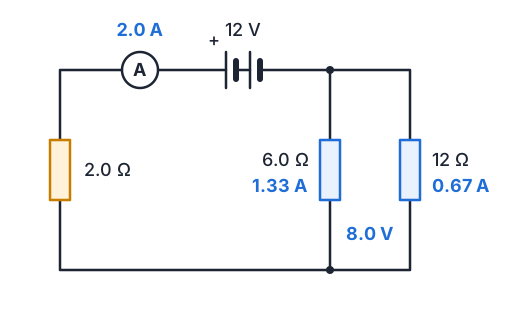
- parallel pair = 4.0 Ωfrom the last example
- Rₜ = 2.0 + 4.0 = 6.0 Ω
- Iₜ = V ÷ Rₜ = 12 ÷ 6.0 = 2.0 Athrough the battery and the 2.0 Ω resistor
- V(2.0 Ω) = IR = 2.0 × 2.0 = 4.0 V, so V(pair) = 12 − 4.0 = 8.0 Vthe voltages round the loop add to the supply
- I(6.0 Ω) = 8.0 ÷ 6.0 = 1.33 A, I(12 Ω) = 8.0 ÷ 12 = 0.67 Athe same voltage across each branch
- 1.33 + 0.67 = 2.0 A
- P(6.0 Ω) = VI = 8.0 × 1.33 = 10.7 W
- Iₜ = 2.0 A; 1.33 A and 0.67 A in the branches; P = 10.7 W
Power, energy and charge
- Power is the rate of energy transfer: P = E/t, and for any component P = IV.
- Put V = IR into P = IV to get two more forms: P = I²R when you know the current, and P = V²/R when you know the voltage.
- A lamp's brightness depends on its power, not on its current or its voltage alone.
- Energy is E = Pt in joules and charge is q = It in coulombs when t is in seconds, so change minutes and hours to seconds first.
- One coulomb is 1 ÷ (1.6 × 10⁻¹⁹) = 6.25 × 10¹⁸ electrons, so the number of electrons is n = q ÷ e.
Example: charge and energy in 5 minutes
- The combined circuit above runs for 5.0 minutes.
- Find the charge that flows through the battery, the energy it supplies and the number of electrons that pass.
- t = 5.0 × 60 = 300 sseconds first
- q = It = 2.0 × 300 = 600 C
- P = IV = 2.0 × 12 = 24 W, so E = Pt = 24 × 300 = 7200 J
- E = qV = 600 × 12 = 7200 Jeach coulomb carries 12 J
- powers: 8.0 W + 10.7 W + 5.3 W = 24 Wthe three resistors add up to the battery's output
- n = q ÷ e = 600 ÷ 1.6 × 10⁻¹⁹ = 3.75 × 10²¹ electrons
- q = 600 C, E = 7200 J, n = 3.8 × 10²¹
When something in the circuit changes
- Start every explanation with the total resistance, then the total current (the supply voltage stays the same), then the voltages.
- If a parallel branch breaks, there is one fewer path, so the total resistance rises and the total current falls.
- With less current, the series resistor takes a smaller voltage (V = IR), which leaves more voltage across the parallel part, so a lamp still working there gets brighter.
- Adding a branch does the opposite; turning up a rheostat in series cuts the total current and the voltage across the parallel part, so everything there dims.
- A component wired straight across the supply always has the full supply voltage, so changes in other branches do not change its current or power.
Example: one branch breaks
- In the combined circuit, the 12 Ω resistor burns out.
- Find the new power of the 6.0 Ω resistor and say whether a lamp in its place would be brighter or dimmer.
- Rₜ = 2.0 + 6.0 = 8.0 Ωnow a simple series circuit
- Iₜ = 12 ÷ 8.0 = 1.5 Amore resistance, so less current
- V(2.0 Ω) = 1.5 × 2.0 = 3.0 V, so V(6.0 Ω) = 12 − 3.0 = 9.0 V
- P = VI = 9.0 × 1.5 = 13.5 W
- P = V²/R = 9.0² ÷ 6.0 = 13.5 W
- 13.5 W, up from 10.7 W, so a lamp there would be brighter
What Achieved, Merit and Excellence look like
- Achieved names a correct effect; Merit gives the reason with a formula; Excellence follows the whole chain from the total resistance to the part asked about, saying what stays fixed at each step.
- A full chain often needs numbers, so calculate when the question gives values.
| Grade | A model answer |
|---|---|
| Achieved | The total resistance goes up, so less current flows from the battery. |
| Merit | With one fewer path the total resistance rises, so with the supply fixed at 12 V the total current falls (I = V/R), and the 2.0 Ω resistor takes less voltage (V = IR). |
| Excellence | The total resistance rises from 6.0 Ω to 8.0 Ω, so the current falls from 2.0 A to 1.5 A. The 2.0 Ω resistor's voltage drops from 4.0 V to 3.0 V, so the 6.0 Ω resistor's rises from 8.0 V to 9.0 V. Its current rises from 1.33 A to 1.5 A, so its power P = VI goes up from 10.7 W to 13.5 W. |
Common mistakes
- Current gets used up as it goes through each lamp, so less comes back to the battery.The current returning to the battery equals the current leaving it; the lamps transfer energy, not charge.
- 1/Rₜ = 1/6.0 + 1/12 = 0.25, so Rₜ = 0.25 Ω.0.25 is 1/Rₜ; turn it over to get Rₜ = 4.0 Ω, which must be smaller than the smallest branch.
- When one branch breaks, the other lamp keeps the same voltage, so nothing else changes.The total current changes, so the voltage across the series resistor changes, and so does the voltage across the parallel part.
- The current splits in parallel, so each branch gets half.Both branches have the same voltage, so the current splits by I = V/R: a branch with twice the resistance takes half the current.
A pencil-lead dimmer
You need: 2 AA batteries, a refill lead for a mechanical pencil, a small torch bulb, or an LED from an old toy, aluminium foil, sticky tape
- Tape the two AA batteries end to end, + to −, and tape a strip of folded foil to each end to make two wires.
- Tape one foil wire to one contact of the bulb (for an LED, the longer leg goes to the + end of the batteries).
- Tape the pencil lead flat on the table and press the bulb's other contact onto one end of the lead.
- Touch the second foil wire onto the lead far from the bulb, then slide it slowly towards the bulb.
- Look for: the light gets brighter as the gap shrinks, because a shorter piece of lead has less resistance, so more current flows round the series circuit.
Safety: Never touch the two foil wires together or onto the lead with no bulb in the loop: that short-circuits the batteries and the foil gets hot enough to burn, so keep the bulb in the circuit and stop if anything feels warm.
Your turn
Find the total resistance of a 4.0 Ω and a 12 Ω resistor in parallel.
A 9.0 V battery drives 0.30 A round a circuit. How much charge flows in 2.0 minutes?
A lamp has 6.0 V across it and a resistance of 4.0 Ω. What is its power?
A 5.0 Ω resistor in series with two 10 Ω resistors in parallel is connected to 20 V. What is the total current?
In question 4, what is the current in each 10 Ω resistor?
Show answer
1. 1/Rₜ = 1/4.0 + 1/12 = 4/12, so Rₜ = 12 ÷ 4 = 3.0 Ω. 2. q = It = 0.30 × 120 = 36 C (2.0 minutes = 120 s). 3. P = V² ÷ R = 6.0² ÷ 4.0 = 9.0 W. 4. The pair is 10 ÷ 2 = 5.0 Ω; Rₜ = 5.0 + 5.0 = 10 Ω; I = V ÷ R = 20 ÷ 10 = 2.0 A. 5. The 5.0 Ω resistor takes 2.0 × 5.0 = 10 V, leaving 20 − 10 = 10 V across the pair; I = 10 ÷ 10 = 1.0 A in each, half of 2.0 A.
Exam-style question: a campervan's lights
- A campervan's 12 V battery runs two lamps in parallel: a reading lamp of 12 Ω and a ceiling lamp of 4.0 Ω. A dimmer, a rheostat set to 1.0 Ω, is in series with the battery.
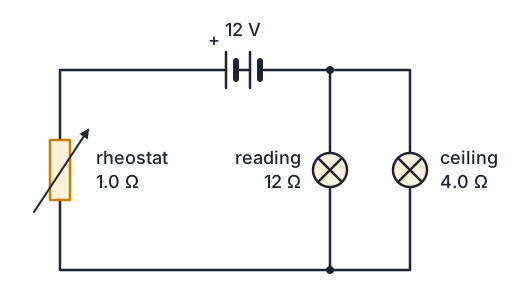
Show that the two lamps together have a resistance of 3.0 Ω.
Calculate the current in the ceiling lamp.
Explain why the reading lamp carries a third of the ceiling lamp's current.
Calculate the energy the reading lamp transfers in 2.0 hours.
The ceiling lamp burns out. Discuss what happens to the brightness of the reading lamp.
Show answer
1. 1/Rₜ = 1/12 + 1/4.0 = 1/12 + 3/12 = 4/12, so Rₜ = 12 ÷ 4 = 3.0 Ω (Achieved). 2. Rₜ = 1.0 + 3.0 = 4.0 Ω; Iₜ = 12 ÷ 4.0 = 3.0 A; the rheostat takes 3.0 × 1.0 = 3.0 V, leaving 12 − 3.0 = 9.0 V across the lamps; I = 9.0 ÷ 4.0 = 2.25 A, about 2.3 A (Merit: a chain of steps). 3. The lamps are in parallel, so both have the same 9.0 V; the reading lamp has three times the resistance, so by I = V/R it has a third of the current: 0.75 A against 2.25 A (Merit for the reason with the formula). 4. P = VI = 9.0 × 0.75 = 6.75 W; t = 2.0 × 3600 = 7200 s; E = Pt = 6.75 × 7200 = 48 600 J, about 4.9 × 10⁴ J (Merit). 5. Achieved: there is one fewer path, so the total resistance goes up and the current falls. Merit: with the supply fixed at 12 V, Rₜ rises to 1.0 + 12 = 13 Ω and Iₜ falls to 0.92 A, so the rheostat's voltage falls (V = IR) to 0.92 V. Excellence: that leaves 11.1 V across the reading lamp, up from 9.0 V, and its current rises from 0.75 A to 0.92 A, so its power P = VI rises from 6.75 W to about 10.2 W and it glows brighter.
Circuit Construction Kit: DC
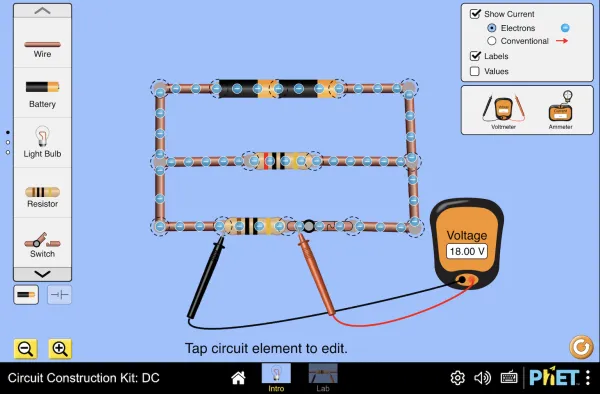
Full screen · PhET Interactive Simulations, University of Colorado Boulder, CC BY 4.0
Recap
- Series: same current, voltages add, Rₜ = R₁ + R₂.
- Parallel: same voltage, currents add, 1/Rₜ = 1/R₁ + 1/R₂, and the total is less than the smallest branch.
- Combined: parallel pair first, then add the series part, then Iₜ, then the voltages, then the branch currents.
- P = IV = I²R = V²/R sets brightness; E = Pt and q = It need time in seconds.
- When something changes: total resistance, then total current, then voltages, then power.
| Formula | Use it to find |
|---|---|
| V = IR | voltage, current or resistance |
| I = q/t | current, or charge with q = It |
| V = E/q | energy carried by each coulomb |
| P = IV = E/t | power, then energy with E = Pt |
| 1/Rₜ = 1/R₁ + 1/R₂ | the resistance of a parallel pair |
The maths behind it
How is NCEA Level 2 maths going?
See the NCEA Level 2 maths guide