Related rates of change: spheres, cones and the chain rule

What this lesson covers
- When two quantities change with time, the chain rule links their rates.
- Write every rate you know and the one you want before differentiating anything.
Rates that are linked
- Radius and volume both change with time.
- Know one rate, find the other.
- The chain rule makes the link.
Write it down before you differentiate
- The rate you are given.
- The rate you want.
- A formula linking the two quantities.
The chain rule links the rates
- dV/dt = dV/dr × dr/dt.
- The dr parts cancel like fractions.
- Want dr/dt? Divide by dV/dr.
A ripple: dr/dt = 3 cm/s
- Given dr/dt, want dA/dt.
- Chain: dA/dr × dr/dt.
- given: dr/dt = 3 cm/s
- want: dA/dt when r = 10
- A = πr², dA/dr = 2πrthe link
- dA/dt = dA/dr × dr/dtchain rule
- = 2π(10) × 3r = 10, dr/dt = 3
- = 60π ≈ 188 cm²/s
A balloon: dV/dt = 100 cm³/s
- Given dV/dt, want dr/dt.
- Divide by dV/dr.
- given: dV/dt = 100 cm³/s
- want: dr/dt when r = 5
- V = (4/3)πr³the link
- dV/dr = 4πr²(4/3) × 3 = 4
- r = 5: dV/dr = 4π(25) = 100π
- dV/dt = dV/dr × dr/dtchain rule
- 100 = 100π × dr/dtsubstitute
- dr/dt = 100/100π = 1/πdivide by 100π
- ≈ 0.318 cm/s
Then the surface area
- dr/dt = 1/π from before.
- Chain: dS/dr × dr/dt.
- S = 4πr², dS/dr = 8πrthe link
- r = 5: dS/dr = 8π(5) = 40π
- dS/dt = dS/dr × dr/dtchain rule
- = 40π × 1/πdr/dt from before
- = 40 cm²/s
Substituting too early
- r is 5 at one instant only.
- Differentiate first.
- V = (4/3)π(5)³ = 500π/3r = 5 too early
- dV/dt = 0a constant
- dV/dr = 4πr²differentiate first
- r = 5: dV/dr = 100πthen substitute
A cone: two variables, one link
- Radius 4 cm, height 12 cm, point down.
- Water depth h, surface radius r.
- Similar triangles: r = h/3.
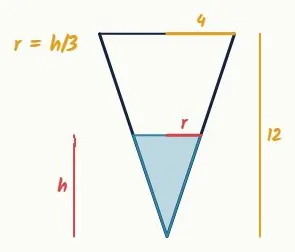
Filling the cone: dV/dt = 8 cm³/s
- Substitute r = h/3 into V.
- One variable, then d/dh.
- given: dV/dt = 8 cm³/s
- want: dh/dt when h = 6
- V = (1/3)πr²hcone volume
- r = h/3similar triangles
- V = (1/3)π(h/3)²hsubstitute r = h/3
- = (1/3)π(h²/9)h(h/3)² = h²/9
- = πh³/27one variable
Filling the cone: dh/dt at h = 6
- Chain: dV/dh × dh/dt.
- Then substitute h = 6.
- V = πh³/27
- dV/dh = 3πh²/27 = πh²/9differentiate
- h = 6: dV/dh = 36π/9 = 4π
- dV/dt = dV/dh × dh/dtchain rule
- 8 = 4π × dh/dtsubstitute
- dh/dt = 8/4π = 2/πdivide by 4π
- ≈ 0.637 cm/s
Negative means falling
- Leaking: dV/dt is negative.
- Say it in words.
- dV/dt = −100 cm³/sleaking
- r = 5: dV/dr = 100πas before
- −100 = 100π × dr/dtchain rule
- dr/dt = −1/π ≈ −0.318 cm/s
- the radius falls at 0.318 cm/s
Show it and say it
- Every derivative, and the chain rule step.
- Full accuracy, then 3 significant figures.
- Units, and a sentence in context.
Where the marks are
- Achieved: both pieces, differentiated.
- Merit: through to the rate, e.g. a sphere.
- Excellence: build the link yourself.
What to take away
- List the rates, link them in one variable, differentiate, then substitute.
| List | given and wanted |
| Link | a formula, one variable |
| Differentiate | before substituting |
| Chain | multiply or divide |
| Sign | negative is falling |
| Answer | units, in context |
Your turn: four questions
- Pause here and answer each one.
- Question 4: the cone has r = h/2.
- Show every derivative, give units.
| Given | Find | |
|---|---|---|
| 1 | circle, dr/dt = 2 | dA/dt at r = 5 |
| 2 | sphere, dV/dt = 36π | dr/dt at r = 3 |
| 3 | cube, ds/dt = 0.5 | dV/dt at s = 4 |
| 4 | cone r = h/2, leak 2π | dh/dt at h = 4 |
Show answer
1. dA/dt = 2πr × dr/dt = 20π ≈ 62.8 cm²/s. 2. dV/dr = 4πr² = 36π, so dr/dt = 36π ÷ 36π = 1 cm/s. 3. dV/ds = 3s² = 48, so dV/dt = 48 × 0.5 = 24 cm³/s. 4. V = πh³/12, dV/dh = πh²/4 = 4π, dV/dt = −2π, so dh/dt = −0.5 cm/s: the depth falls at 0.5 cm/s.
The answers: questions 1 and 2
- 1. A = πr², dA/dr = 2πr = 10πr = 5
- dA/dt = dA/dr × dr/dtchain rule
- = 10π × 2 = 20π ≈ 62.8 cm²/s
- 2. V = (4/3)πr³, dV/dr = 4πr²
- r = 3: dV/dr = 36π
- dV/dt = dV/dr × dr/dtchain rule
- 36π = 36π × dr/dtsubstitute
- dr/dt = 1 cm/sdivide by 36π
The answers: questions 3 and 4
- 3. V = s³, dV/ds = 3s² = 48s = 4
- dV/dt = dV/ds × ds/dtchain rule
- = 48 × 0.5 = 24 cm³/s
- 4. V = (1/3)π(h/2)²hsubstitute r = h/2
- = πh³/12(1/3)(1/4) = 1/12
- dV/dh = πh²/4 = 4πh = 4
- dV/dt = dV/dh × dh/dtchain rule
- −2π = 4π × dh/dtleaking, so negative
- dh/dt = −0.5 cm/sthe depth falls
Is your child on track?
Take the free placement test