Parametric differentiation, and the second derivative
What this lesson covers
- For a curve given by x(t) and y(t), dy/dx is dy/dt divided by dx/dt.
- The second derivative is the derivative of dy/dx with respect to t, divided by dx/dt again.
A curve drawn by a parameter
- x and y are both given in terms of t.
- As t changes, the point (x, y) moves.
- To differentiate, work through t.
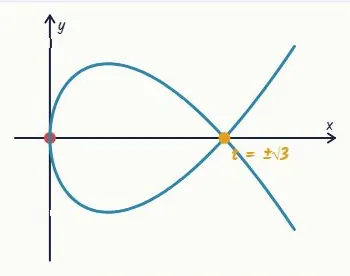
x = t², y = t³ − 3t
- t = 0 is the origin.
- From t = −2 to 2 it swings out and back.
- It crosses itself at (3, 0).
Where it crosses itself
- Two values of t, one point.
- t and −t give the same x.
- x(−t) = (−t)² = x(t)same x
- need y(t) = y(−t)
- t³ − 3t = −t³ + 3t
- 2t³ − 6t = 0collect terms
- 2t(t² − 3) = 0factorise
- t = 0t and −t are equal
- t = ±√3
- x = 3, y = 3√3 − 3√3 = 0
- crosses itself at (3, 0)
The first derivative
- Differentiate x and y in t.
- dy/dx = dy/dt ÷ dx/dt.
- In the formula booklet.
- x = t², y = t³ − 3t
- dx/dt = 2t
- dy/dt = 3t² − 3
- dy/dx = (dy/dt) ÷ (dx/dt)chain rule
- = (3t² − 3)/(2t)
Stationary points and vertical tangents
- Stationary: dy/dt = 0.
- Vertical: dx/dt = 0.
- 3t² − 3 = 0dy/dt = 0
- t² = 1, so t = ±1
- t = 1: x = 1, y = 1 − 3 = −2
- t = −1: x = 1, y = −1 + 3 = 2
- (1, −2) and (1, 2)stationary points
- 2t = 0, so t = 0dx/dt = 0
- vertical tangent at (0, 0)
The tangent at t = 2
- Point and gradient: same t.
- Finish in y = mx + c.
- t = 2: x = 2² = 4
- y = 2³ − 3(2) = 2
- point (4, 2)
- m = (3(2)² − 3)/(2(2))into dy/dx
- = 9/4
- y − 2 = (9/4)(x − 4)point-gradient form
- y = (9/4)x − 9 + 2expand
- y = (9/4)x − 7
The normal at t = 2
- Normal: perpendicular.
- Gradients multiply to −1.
- End in y = mx + c.
- point (4, 2), tangent m = 9/4
- m = −1 ÷ (9/4) = −4/9negative reciprocal
- y − 2 = −(4/9)(x − 4)same point
- y = −(4/9)x + 16/9 + 2expand
- y = −(4/9)x + 34/9
- (9/4) × (−4/9) = −1
The second derivative: the 2025 error
- d²y/dx² means differentiate dy/dx with respect to x.
- But dy/dx is written in t.
- So differentiate with respect to t, then ÷ dx/dt.
Where candidates stopped
- d/dt alone is not finished.
- Then ÷ dx/dt = 2t.
- dy/dx = (3t² − 3)/(2t)
- = (3/2)t − 3/(2t)split the fraction
- d/dt: 3/2 + 3/(2t²)not d²y/dx² yet
- d²y/dx² = (3/2 + 3/(2t²)) ÷ 2t
- = ((3t² + 3)/(2t²)) ÷ 2tcommon denominator
- = (3t² + 3)/(4t³)
Using it to classify
- Positive: a minimum.
- Negative: a maximum.
- t = 1: (3 + 3)/4 = 3/2
- 3/2 > 0: (1, −2) is a minimum
- t = −1: (3 + 3)/(−4) = −3/2
- −3/2 < 0: (1, 2) is a maximum
- stopped early: 3/2 + 3/2 = 3
- 3 > 0 at both: two minima?impossible
Trig: x = 2cos t, y = 3sin t
- Work through t again.
- Then ÷ dx/dt = −2sin t.
- dx/dt = −2sin t
- dy/dt = 3cos t
- dy/dx = 3cos t/(−2sin t)
- = −(3/2)cot t
- d/dt: (3/2)cosec² td/dt cot t = −cosec² t
- ÷ (−2sin t): −3/(4sin³ t)÷ dx/dt
- t = π/2: −3/(4(1)³) = −3/4
- negative: concave down
Points of inflection
- d²y/dx² = 0 and changes sign.
- Set its numerator to zero and solve for t.
- Then find x and y.
Show every derivative
- No credit for a calculator answer alone.
- Unknown constants stop the calculator.
- Write dx/dt, dy/dt and the division.
Where the marks are
- Achieved: dy/dx of a parametric curve.
- Merit: tangents, normals, second derivatives.
- Excellence: both derivatives together.
What to take away
- Work through t, and divide by dx/dt again for the second derivative.
| dy/dx | dy/dt ÷ dx/dt |
| Stationary | dy/dt = 0 |
| Vertical tangent | dx/dt = 0 |
| Tangent | y = mx + c |
| d²y/dx² | d/dt(dy/dx) ÷ dx/dt |
| Show it | every derivative |
Your turn: four questions
- Pause here and answer each one.
- Question 2 uses the curve from question 1.
- Question 3: the tangent as a full equation.
| Curve | Find | |
|---|---|---|
| 1 | x = t² + 1, y = t³ − 12t | stationary points |
| 2 | the same curve | classify t = 2 |
| 3 | x = eᵗ, y = e²ᵗ − 4t | tangent at t = 0 |
| 4 | x = 3sin t, y = 2cos t | dy/dx at t = π/4 |
Show answer
1. dy/dx = (3t² − 12)/(2t); t = ±2: (5, −16) and (5, 16). 2. d²y/dx² = (3t² + 12)/(4t³); 3/4 at t = 2, so (5, −16) is a minimum. 3. Point (1, 1), gradient −2: y = −2x + 3. 4. dy/dx = −(2/3)tan t = −2/3.
The answers: question 1
- 1. dx/dt = 2t, dy/dt = 3t² − 12
- dy/dx = (3t² − 12)/(2t)
- 3t² − 12 = 0, so t = ±2top = 0
- t = 2: x = 5, y = 8 − 24 = −16
- t = −2: x = 5, y = −8 + 24 = 16
- (5, −16) and (5, 16)
The answers: question 2
- 2. dy/dx = (3/2)t − 6/tsplit the fraction
- d/dt: 3/2 + 6/t²
- ÷ 2t: (3t² + 12)/(4t³)÷ dx/dt
- t = 2: (12 + 12)/32 = 3/4
- 3/4 > 0: (5, −16) is a minimum
The answers: questions 3 and 4
- 3. x = e⁰ = 1, y = e⁰ − 0 = 1t = 0
- dx/dt = eᵗ, dy/dt = 2e²ᵗ − 4
- m = (2 − 4)/1 = −2at t = 0
- y − 1 = −2(x − 1), so y = −2x + 3
- 4. dx/dt = 3cos t
- dy/dt = −2sin t
- dy/dx = −2sin t/(3cos t)
- = −(2/3)tan t
- t = π/4: −(2/3)(1) = −2/3
Is your child on track?
Take the free placement test