Trapezium and Simpson's rules: numerical areas

What this lesson covers
- When a function cannot be integrated, or only data is given, the area is estimated from ordinates.
- The strip width h is the interval width divided by the number of strips, not the number of ordinates.
When you cannot integrate
- No antiderivative, or only data.
- Estimate from the heights: ordinates.
- Equally spaced values of x.
Both rules are in the booklet
- Trapezium rule and Simpson's rule.
- Know what goes into them.
- h = (b − a) ÷ number of strips.
y = 1/x, from 1 to 3, four strips
- Each strip is a trapezium.
- h = (3 − 1)/4 = 0.5.
- The tops sit just above the curve.
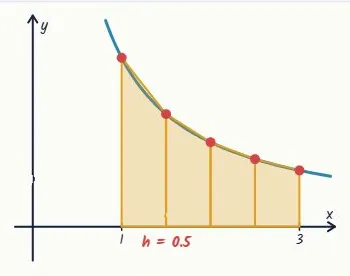
Four strips, five ordinates
- One ordinate at each strip edge.
- Ends count once.
- Middle ordinates count twice.
| x | y = 1/x | Weight |
|---|---|---|
| 1 | 1 | 1 |
| 1.5 | 2/3 | 2 |
| 2 | 1/2 | 2 |
| 2.5 | 2/5 | 2 |
| 3 | 1/3 | 1 |
The trapezium rule
- Ends once, middle twice.
- Exact fractions, then 4 d.p.
- A ≈ (h/2)[ends + 2 × middle]
- h/2 = 0.5/2 = 1/4
- ends: 1 + 1/3 = 4/3
- middle: 2/3 + 1/2 + 2/5
- = 20/30 + 15/30 + 12/30 = 47/30
- 2 × 47/30 = 47/15
- bracket = 20/15 + 47/15 = 67/15
- A ≈ (1/4)(67/15) = 67/60
- ≈ 1.1167
The wrong h: a 2025 error
- Strips, not ordinates.
- Strips = ordinates − 1.
- bracket = 67/15
- h = (3 − 1)/5 = 0.45 ordinates
- 0.2 × 67/15 = 67/75 ≈ 0.8933
- h = (3 − 1)/4 = 0.54 strips
- 0.25 × 67/15 = 67/60 ≈ 1.1167
Simpson's rule
- An even number of strips.
- Weights 1, 4, 2, 4, …, 4, 1.
- Multiply by h/3, not h/2.
Simpson's rule on y = 1/x
- Weights: odd 4, even 2.
- Then multiply by h/3.
- A ≈ (h/3)[ends + 4 odd + 2 even]
- h/3 = 0.5/3 = 1/6
- ends: 1 + 1/3 = 4/3
- 4(2/3 + 2/5) = 4(16/15) = 64/15
- 2(1/2) = 1the even ordinate
- bracket = 4/3 + 64/15 + 1
- = 20/15 + 64/15 + 15/15 = 99/15
- A ≈ (1/6)(99/15) = 99/90
- = 11/10 = 1.1
How close are they?
- Exact: ln 3 ≈ 1.0986.
- Trapezium is over: the curve bends up.
- Simpson's is much closer.
| Value | |
|---|---|
| exact | ln 3 ≈ 1.0986 |
| trapezium | ≈ 1.1167, over |
| Simpson's | 1.1000 |
From a table: a car speeding up
- Distance = area under the speed graph.
- 7 readings, so 6 strips.
- 6 is even, so both rules work.
| t (s) | v (m/s) | Simpson |
|---|---|---|
| 0 | 0 | 1 |
| 2 | 5 | 4 |
| 4 | 9 | 2 |
| 6 | 12 | 4 |
| 8 | 14 | 2 |
| 10 | 15 | 4 |
| 12 | 15 | 1 |
Distance: the trapezium rule
- h = 2, so h/2 = 1.
- Ends once, middle twice.
- h = (12 − 0)/6 = 2, h/2 = 1
- ends: 0 + 15 = 15
- middle: 5 + 9 + 12 + 14 + 15 = 55
- d ≈ 1 × [15 + 2(55)]trapezium rule
- = 15 + 110 = 125 m
Distance: Simpson's rule
- Simpson's: h/3 = 2/3.
- Units, and what it means.
- h/3 = 2/3
- ends: 0 + 15 = 15
- 4(5 + 12 + 15) = 4(32) = 128t = 2, 6, 10
- 2(9 + 14) = 2(23) = 46t = 4, 8
- bracket = 15 + 128 + 46 = 189
- d ≈ (2/3)(189) = 126 m
- about 126 m in the first 12 s
Show every ordinate
- Write the rule with each ordinate.
- Full accuracy, then 3 s.f.
- Odd strips: no Simpson's.
Where the marks are
- Achieved: the trapezium rule, right h.
- Merit, Excellence: part of a bigger problem.
- Compare with exact, or use in context.
What to take away
- h is the interval width over the number of strips.
| h | (b − a) ÷ strips |
| Ordinates | strips + 1 |
| Trapezium | ends + 2 × middle |
| Simpson's | ends + 4 odd + 2 even |
| Simpson's n | must be even |
| Show it | every ordinate |
Your turn: four questions
- Pause here and answer each one.
- Question 3 uses the integral in 2.
- Write out h and every ordinate.
| Given | Find | |
|---|---|---|
| 1 | x = 1 to 5, 8 strips | h, and ordinates |
| 2 | ∫₀⁴ √x dx, 4 strips | trapezium rule |
| 3 | the same integral | Simpson's rule |
| 4 | y: 3, 5, 6, 4, 2 | Simpson's, x = 0 to 4 |
Show answer
1. h = (5 − 1)/8 = 0.5, with 9 ordinates. 2. h = 1, ordinates 0, 1, √2, √3, 2: 0.5[0 + 2 + 2(1 + √2 + √3)] ≈ 5.15. 3. (1/3)[0 + 2 + 4(1 + √3) + 2√2] ≈ 5.25, closer to the exact 16/3 ≈ 5.33. 4. (1/3)[3 + 2 + 4(5 + 4) + 2(6)] = 53/3 ≈ 17.7.
The answers: questions 1 and 2
- 1. h = (5 − 1)/8 = 0.5
- 8 strips, so 9 ordinates
- 2. h = (4 − 0)/4 = 1
- ordinates: 0, 1, √2, √3, 2
- (1/2)[0 + 2 + 2(1 + √2 + √3)]trapezium rule
- = (1/2)(4 + 2√2 + 2√3)
- = (1/2)(10.2925) = 5.14634 d.p.
- ≈ 5.15
The answers: questions 3 and 4
- 3. (1/3)[0 + 2 + 4(1 + √3) + 2√2]
- = (1/3)(6 + 4√3 + 2√2)
- = (1/3)(15.7566) = 5.25224 d.p.
- ≈ 5.25
- exact: (2/3)(8) = 16/3 ≈ 5.3333Simpson is closer
- 4. (1/3)[3 + 2 + 4(5 + 4) + 2(6)]
- = (1/3)(5 + 36 + 12) = 53/3
- ≈ 17.7
Is your child on track?
Take the free placement test