Differential equations: growth, decay and Newton's cooling
What this lesson covers
- A differential equation gives a rate; solving it gives the quantity itself.
- Separating variables and integrating both sides leaves one constant, found from the starting condition.
A rate, and the quantity behind it
- A differential equation gives a rate.
- Solving it gives the quantity.
- Every integration brings a constant.
dy/dx = 6x² − 4, y = 5 at x = 1
- Integrate, with + c.
- Put in the point to find c.
- dy/dx = 6x² − 4
- y = ∫ (6x² − 4) dxintegrate
- = 2x³ − 4x + ckeep the + c
- 5 = 2(1)³ − 4(1) + cx = 1, y = 5
- 5 = −2 + c, so c = 7
- y = 2x³ − 4x + 7
A second derivative: a = 4e²ᵗ
- Integrate twice.
- Two constants, in turn.
- a = 4e²ᵗat rest at the origin
- v = ∫ 4e²ᵗ dt = 2e²ᵗ + c₁integrate
- 0 = 2e⁰ + c₁ = 2 + c₁v = 0 at t = 0
- c₁ = −2
- v = 2e²ᵗ − 2
- s = ∫ (2e²ᵗ − 2) dtintegrate again
- = e²ᵗ − 2t + c₂a new constant
s = 0 at t = 0 does not mean c = 0
- e⁰ = 1, not 0.
- Always substitute.
- s = e²ᵗ − 2t + c₂
- c₂ = 0assumed, not found
- 0 = e⁰ − 2(0) + c₂s = 0 at t = 0
- 0 = 1 + c₂, so c₂ = −1e⁰ = 1
- s = e²ᵗ − 2t − 1
- s(0) = 1 − 0 − 1 = 0
- c₂ = 0 gives s(0) = 1not 0
Separating variables: dy/dx = ky
- Separate y and x.
- The c goes into the power.
- dy/dx = ky
- ∫ (1/y) dy = ∫ k dxseparate
- ln y = kx + cy > 0, no modulus
- y = e^(kx + c)undo the log
- y = Ae^(kx)A = e^c
One constant, all the way: a 2025 error
- The c goes into the power.
- Call it A and keep it.
- y = e^(kx) + cc moved
- y = e^(kx + c)
- = e^(kx) × e^cindex law
- = Ae^(kx)one constant, A
Growth: N = Ae^(kt)
- t = 0 gives A.
- A second reading gives k.
- N = Ae^(kt)
- 200 = Ae⁰ = At = 0
- 800 = 200e^(2k)t = 2
- e^(2k) = 4divide by 200
- 2k = ln 4ln both sides
- k = (ln 4)/2 = ln 2 ≈ 0.6931
When is N = 6400?
- Isolate the exponential.
- Answer in context.
- 6400 = 200e^(kt)
- e^(kt) = 32divide by 200
- kt = ln 32ln both sides
- t = ln 32 / ln 2k = ln 2
- = 5 ln 2 / ln 2 = 532 = 2⁵
- after 5 hours
Newton's law of cooling
- Separate and integrate.
- T(0) = 100 gives A.
- dT/dt = −k(T − 20)
- ∫ dT/(T − 20) = ∫ −k dtseparate
- ln(T − 20) = −kt + cT > 20
- T − 20 = Ae^(−kt)A = e^c
- 100 − 20 = Ae⁰, so A = 80t = 0
- T = 20 + 80e^(−kt)
Cooling towards the room
- It falls towards 20 °C, never below.
- T(10) = 60 gives k.
- Then find when T = 40.
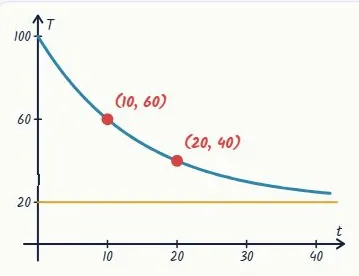
Finding k from T(10) = 60
- Isolate the exponential.
- Then ln both sides.
- T = 20 + 80e^(−kt)
- 60 = 20 + 80e^(−10k)t = 10, T = 60
- 40 = 80e^(−10k)subtract 20
- e^(−10k) = 1/2divide by 80
- −10k = ln(1/2) = −ln 2ln both sides
- k = ln 2 / 10 ≈ 0.0693divide by −10
When is the water at 40 °C?
- Isolate, then ln.
- Keep k exact.
- T = 20 + 80e^(−kt)
- k = ln 2 / 10
- 40 = 20 + 80e^(−kt)T = 40
- 20 = 80e^(−kt)subtract 20
- e^(−kt) = 1/4divide by 80
- −kt = ln(1/4) = −ln 4ln both sides
- t = ln 4 / k = 10 ln 4 / ln 2
- = 10(2 ln 2)/ln 2 = 20ln 4 = 2 ln 2
- after 20 minutes
Keep k exact
- Isolate, then ln both sides.
- Round only at the end.
- k = ln 2 / 10exact
- t = ln 4 / k = 20
- k ≈ 0.07rounded too early
- t = ln 4 / 0.07 ≈ 19.80drifts
Where the marks are
- Achieved: integrate, find the constant.
- Merit: separate, use starting values.
- Excellence: models in context, logs.
What to take away
- Integrate, keep one constant, and find it by substituting.
| y′ = f(x) | integrate, find c |
| y″ = f(x) | twice, two constants |
| y′ = ky | y = Ae^(kx) |
| Cooling | T − room = Ae^(−kt) |
| Find k | isolate, then ln |
| c | never assume zero |
Your turn: four questions
- Pause here and answer each one.
- Question 2 has two constants.
- Question 4: a room at 15 °C.
| Given | Find | |
|---|---|---|
| 1 | dy/dx = e²ˣ, y(0) = 3 | y |
| 2 | y″ = 12x, y′(0) = 1 | y, if y(1) = 5 |
| 3 | dN/dt = kN, N(0) = 50 | N(8), if N(4) = 150 |
| 4 | room 15 °C, T(0) = 75 | T(30), if T(10) = 45 |
Show answer
1. y = (1/2)e²ˣ + c; 3 = 1/2 + c, so y = (1/2)e²ˣ + 5/2. 2. y′ = 6x² + 1, y = 2x³ + x + c₂; y(1) = 5 gives c₂ = 2, so y = 2x³ + x + 2. 3. N = 50e^(kt); e^(4k) = 3, so N(8) = 50 × 3² = 450. 4. T − 15 = 60e^(−kt); e^(−10k) = 1/2, so T(30) = 15 + 60 × 1/8 = 22.5 °C.
The answers: questions 1 and 2
- 1. y = ∫ e²ˣ dx = (1/2)e²ˣ + creverse chain rule
- 3 = (1/2)e⁰ + c, so c = 5/2x = 0, y = 3
- y = (1/2)e²ˣ + 5/2
- 2. y′ = ∫ 12x dx = 6x² + c₁integrate
- 1 = 6(0)² + c₁, so c₁ = 1y′(0) = 1
- y = ∫ (6x² + 1) dx = 2x³ + x + c₂
- 5 = 2 + 1 + c₂, so c₂ = 2y(1) = 5
- y = 2x³ + x + 2
The answers: questions 3 and 4
- 3. N = 50e^(kt)N(0) = 50
- 150 = 50e^(4k), so e^(4k) = 3N(4) = 150
- N(8) = 50e^(8k) = 50(e^(4k))²index law
- = 50 × 3² = 450
- 4. T − 15 = 60e^(−kt)T(0) = 75, so A = 60
- 30 = 60e^(−10k), so e^(−10k) = 1/2
- T(30) = 15 + 60e^(−30k)
- = 15 + 60(1/2)³ = 15 + 7.5e^(−30k) = (1/2)³
- = 22.5 °C
Is your child on track?
Take the free placement test