Margin of error: the three rules of thumb
What this lesson covers
- The margin of error measures sampling variation only, not bias or other errors.
- The 1/√n rules of thumb are not in the booklet, so they must be learned.
One sample, one answer
- A different sample gives a slightly different result.
- The margin of error measures how much.
- It turns a sample result into a range.
What a margin of error covers
- Sampling variation, and nothing else.
- Not bias, non-response or wording.
- Keep the two ideas apart.
Rule 1: one proportion
- Learn it: not in the booklet
- Then form the interval.
- MOE ≈ 1/√none proportion
- n = 1000: MOE ≈ 1/√1000
- = 0.0316 ≈ 3.2%4 decimal places
- 42% ± 3.2%
- 42 − 3.2 = 38.8
- 42 + 3.2 = 45.2
- 38.8% to 45.2%
Form the interval, then say what it means
- A margin of error on its own is not an answer.
- Name the population and the variable.
- Between 38.8% and 45.2% of all voters.
Statistics explorer
Four times the sample, half the margin
- N = 100: 10%.
- N = 400: 5%.
- N = 1600: 2.5%.
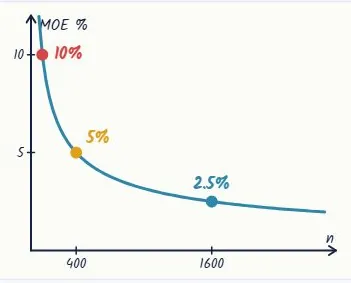
Try it: four times the sample
Rule 2: a difference within one group
- Two results, one sample.
- One up, the other down.
- So the margin doubles.
- A: 42%, B: 35%same 1000 voters
- MOE ≈ 2 × 1/√nsame sample
- = 2 × 1/√1000 = 2 × 0.0316
- = 0.0632 ≈ 6.3%
- 42 − 35 = 7 pointsthe difference
- 7 − 6.3 = 0.7
- 7 + 6.3 = 13.3
- 0.7 to 13.3 points
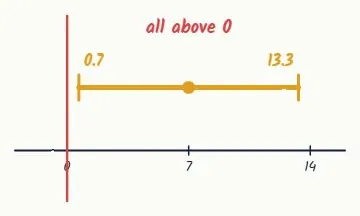
Is zero in the interval?
- Difference: 7 points ± 6.3.
- 0.7 to 13.3 points.
- All above zero: A leads B.
Rule 3: a difference between two groups
- Two independent samples.
- Each has its own 1/√n.
- A: n = 400, 58% yes
- B: n = 625, 47% yes
- A: 1/√400 = 1/20 = 5%
- B: 1/√625 = 1/25 = 4%
1.5 × the average margin of error
- Average, then times 1.5.
- Difference ± that margin.
- A: 5%, B: 4%
- average = (5 + 4)/2 = 4.5%
- MOE ≈ 1.5 × 4.5 = 6.75%two samples
- 58 − 47 = 11 pointsthe difference
- 11 − 6.75 = 4.25
- 11 + 6.75 = 17.75
- 4.25 to 17.75 points
Pick the rule first
- The wrong rule: a named 2025 error.
- One proportion, same sample, or two samples?
- The answer picks the rule.
| Situation | MOE |
|---|---|
| One proportion | 1/√n |
| Two, same sample | 2 × 1/√n |
| Two samples | 1.5 × average MOE |
When the rules do not apply
- Proportions roughly 30% to 70%.
- A random sample.
- Never a cover for bias.
| Condition | Needs |
|---|---|
| Proportion | about 30% to 70% |
| Sample | random |
| Covers | sampling error only |
Where the marks are
- Achieved: a margin of error and an interval.
- Merit: interpret it in context.
- Excellence: right rule, its limits, a claim.
What to take away
- Pick the rule, form the interval, then interpret it in context.
| One proportion | 1/√n |
| Same sample | 2 × 1/√n |
| Two samples | 1.5 × average MOE |
| Then | form the interval |
| Only if | 30% to 70%, random |
| Not covered | bias, non-response |
Common mistakes
- A 42% and B 35% from the same 1000 voters: MOE ≈ 1/√1000 = 3.2%.A difference within one sample uses 2 × 1/√n ≈ 6.3%, because when one result goes up the other goes down.
- Two towns, n = 400 and n = 625: MOE ≈ 5% + 4% = 9%.Two independent samples use 1.5 × the average margin: 1.5 × (5 + 4)/2 = 6.75%.
- The margin of error is 3.2%, so that is the answer.Form the interval, 38.8% to 45.2%, and say what it means for the proportion of all voters.
- Only 4% said yes, so use MOE ≈ 1/√n as usual.The rules of thumb suit proportions roughly 30% to 70%; at 4% the rule overstates the margin of error.
Your turn: four questions
- Decide which rule fits first.
- Write each interval in full.
| Given | Find | |
|---|---|---|
| 1 | n = 900, 45% say yes | interval |
| 2 | same poll: 45% v 38% | A − B |
| 3 | 60% of 100, 45% of 400 | difference |
| 4 | 4% of 1000 | rule OK? |
Show answer
1. MOE 1/√900 = 3.3%; 41.7% to 48.3%. 2. Same sample: 2/√900 = 6.7%; difference 7: 0.3 to 13.7 points. 3. Two samples: 1.5 × (10% + 5%)/2 = 11.25%; difference 15: 3.75 to 26.25 points. 4. No: 4% is outside 30% to 70%, so the rule overstates the margin.
The answers: questions 1 and 2
- 1. MOE ≈ 1/√900 = 1/30one proportion
- = 0.0333 ≈ 3.3%
- 45 − 3.3 = 41.7, 45 + 3.3 = 48.3
- 41.7% to 48.3%
- 2. MOE ≈ 2/√900 = 2/30same sample
- = 0.0667 ≈ 6.7%
- 45 − 38 = 7 pointsthe difference
- 7 − 6.7 = 0.3, 7 + 6.7 = 13.7
- 0.3 to 13.7 points
The answers: questions 3 and 4
- 3. 1/√100 = 10%, 1/√400 = 5%two samples
- average = (10 + 5)/2 = 7.5%
- MOE ≈ 1.5 × 7.5 = 11.25%
- 60 − 45 = 15 pointsthe difference
- 15 − 11.25 = 3.75
- 15 + 11.25 = 26.25
- 3.75 to 26.25 points
- 4. p = 4%: outside 30% to 70%
- rule does not applyit overstates the margin
Sample question: Achieved
A random poll of 1600 New Zealand voters finds 38% support a four-year parliamentary term. Use the rule of thumb to find the margin of error, and give the confidence interval.
Hint
For one proportion the margin of error is about 1√n.
Answer
Margin of error 2.5%; interval 35.5% to 40.5%
Step by step
- This is one proportion from one sample, so use the first rule: MOE ≈ 1√n.
- √1600 = 40, so MOE ≈ 140 = 0.025, which is 2.5%.
- The interval is the estimate ± the margin: 38% ± 2.5%.
- Lower: 38 − 2.5 = 35.5%. Upper: 38 + 2.5 = 40.5%.
- Check the rule applies: 38% is between 30% and 70%, and the sample is random.
- Classic mistake: stopping at the margin of error. The answer is the interval.
Full working
- MOE ≈ 1√1600 = 140one proportion
- = 0.025 = 2.5%
- 38 − 2.5 = 35.5, 38 + 2.5 = 40.5
- 35.5% to 40.5%
Sample questions: Merit
A random sample of 900 Aucklanders is asked to choose one of two stadium sites. 52% choose Site A and 41% choose Site B. Find a confidence interval for the difference (A − B) and state what it shows.
Hint
Both results come from the same 900 people, so use the same-sample rule, 2 × 1√n.
Answer
Margin about 6.7%; interval 4.3 to 17.7 percentage points. The whole interval is above zero, so Site A is preferred by Aucklanders.
Step by step
- First choose the rule. Both percentages come from one sample of 900, and each person picked one site.
- In one sample, when one share goes up the other tends to go down, so the margin for the difference is doubled: 2 × 1√n.
- √900 = 30, so the margin is 230 = 0.0667, about 6.7%.
- The difference is 52 − 41 = 11 percentage points.
- Interval: 11 − 6.7 = 4.3 and 11 + 6.7 = 17.7 percentage points.
- Classic mistake: using 1.5 × the average margin. That rule is for two separate samples, not one.
- Zero is not inside 4.3 to 17.7. All values are positive.
- So I am fairly sure the proportion of Aucklanders choosing Site A is between 4.3 and 17.7 points higher than for Site B: Site A is preferred.
- Check: both percentages are between 30% and 70%, so the rule of thumb is reasonable.
Full working
- same sampleMOE ≈ 2 × 1√n
- 2√900 = 230 ≈ 6.7%
- difference = 52 − 41 = 11 points
- 11 − 6.7 = 4.3, 11 + 6.7 = 17.7
- 4.3 to 17.7 points; all above zero, Site A preferred
A random sample of 400 Year 12 students finds 63% use TikTok daily. A separate random sample of 900 adults finds 48% do. Find a confidence interval for the difference (students − adults) and state what it shows.
Hint
Two separate samples: find each margin with 1√n, average them, then multiply by 1.5.
Answer
Margin 6.25%; interval 8.75 to 21.25 percentage points. All above zero, so a higher proportion of Year 12 students than adults use TikTok daily.
Step by step
- Choose the rule. These are two independent samples, so use 1.5 × the average margin of error.
- Students: 1√400 = 120 = 5%.
- Adults: 1√900 = 130 = 3.33%.
- Average: 5 + 3.332 = 4.17%.
- Margin for the difference: 1.5 × 4.17 = 6.25%.
- Difference: 63 − 48 = 15 percentage points.
- Interval: 15 − 6.25 = 8.75 and 15 + 6.25 = 21.25 points.
- Zero is not inside, so I am fairly sure the proportion of Year 12 students who use TikTok daily is between 8.75 and 21.25 points higher than for adults.
- Classic mistake: adding the two margins, 5 + 3.33 = 8.33. That overstates the margin; the rule is 1.5 × the average.
Full working
- two samplesMOE ≈ 1.5 × average MOE
- 1√400 = 5%, 1√900 = 3.33%
- average = 5 + 3.332 = 4.171.5 × 4.17 = 6.25%
- difference = 63 − 48 = 15 points
- 15 − 6.25 = 8.75, 15 + 6.25 = 21.25
- 8.75 to 21.25 points; students higher
Sample questions: Excellence
In a mayoral poll, Candidate A has 47% and Candidate B has 42%, both from the same random sample. A newspaper with a sample of 1000 says "A is ahead". Is this justified? What is the smallest sample size for which the same percentages would let you claim A is ahead? Give one reason the claim could still be wrong with that sample size.
Hint
Same sample, so the margin for the difference is 2√n; A is ahead only if the whole interval for the 5-point difference is above zero.
Answer
With n = 1000 the margin is about 6.3%, giving −1.3 to 11.3 points, so the claim is not justified. You need 2√n < 5%, so n > 1600: at least 1601 people. Even then the margin covers sampling variation only; bias such as non-response, or voters changing their minds, could still make the claim wrong.
Step by step
- Both candidates' shares come from one sample, so the margin for the difference is 2 × 1√n.
- With n = 1000: 2√1000 = 2 × 0.0316 = 0.0632, about 6.3%.
- The difference is 47 − 42 = 5 points. Interval: 5 − 6.3 = −1.3 to 5 + 6.3 = 11.3.
- Zero is inside, so B could be level or even ahead. The newspaper's claim is not justified.
- Now the smallest n. A is ahead only if the margin is less than the 5-point difference.
- So 2√n < 0.05, which means √n > 2 ÷ 0.05 = 40, so n > 1600.
- At n = 1600 the margin is exactly 5%, and the interval is 0 to 10. It still touches zero, so that is not enough.
- So at least 1601 people are needed.
- Even then, a margin of error describes sampling variation and nothing else.
- In context: supporters of one candidate may be less likely to answer polls (non-response bias), or voters may change their minds before election day.
- So the poll would support A being ahead at the time of polling, not prove it.
Full working
- same sampleMOE ≈ 2√n
- n = 1000: 2√1000 ≈ 6.3%5 ± 6.3 = −1.3 to 11.3, zero inside
- need 2√n < 0.05margin less than the 5-point gap
- √n > 40, so n > 1600
- n = 1600 gives 0 to 10, touching zeroneed n ≥ 1601
- MOE covers sampling error onlynon-response, changing minds
- not justified at 1000; need at least 1601
A random sample of 2500 NZ adults finds 4% rode an e-scooter yesterday. (a) Use the rule of thumb 1√n to give an interval. (b) A more exact margin of error is 1.96 × √(p(1 − p) ÷ n). Use it with p = 0.04 to give a second interval. (c) Show that the exact formula gives about 1√n when p = 0.5, and use this to explain why the rule of thumb is only used for proportions between about 30% and 70%.
Hint
In (c), put p = 0.5 into p(1 − p) and notice 1.96 × 0.5 is almost 1; then compare p(1 − p) for 4%.
Answer
(a) 2% to 6%. (b) Margin 0.77%, so 3.23% to 4.77%. (c) With p = 0.5, 1.96 × √(0.25 ÷ n) = 0.98√n ≈ 1√n. p(1 − p) is largest at p = 0.5, so the rule of thumb gives the biggest possible margin. Between 30% and 70% the exact margin is still close to it (at 30% it is about 0.9√n), but at 4% the rule gives a margin about 2.6 times too big.
Step by step
- (a) Rule of thumb: 1√2500 = 150 = 0.02 = 2%. Interval 4 ± 2: 2% to 6%.
- (b) Put p = 0.04 and n = 2500 into 1.96 × √(p(1 − p) ÷ n).
- p(1 − p) = 0.04 × 0.96 = 0.0384. Divide by 2500: 0.00001536. Square root: 0.003919.
- Multiply by 1.96: 0.00768, about 0.77%. Interval 4 ± 0.77: 3.23% to 4.77%.
- The two intervals are very different: the rule of thumb is much wider.
- (c) Put p = 0.5: p(1 − p) = 0.5 × 0.5 = 0.25, and √0.25 = 0.5.
- So the exact margin is 1.96 × 0.5 ÷ √n = 0.98√n, which is almost exactly 1√n. That is where the rule of thumb comes from.
- p(1 − p) is biggest when p = 0.5, so the rule of thumb is the largest margin a proportion can have.
- Near 0.5 this hardly matters. At p = 0.3, 1.96 × √0.21 = 0.90, so the margin is about 0.9√n, still close to 1√n.
- At p = 0.04, 1.96 × √0.0384 = 0.38, so the true margin is about 0.38√n. The rule overstates it: 2 ÷ 0.77 ≈ 2.6 times too big.
- So outside about 30% to 70% the rule of thumb gives intervals that are far too wide.
Full working
- (a) 1√2500 = 2%4 ± 2 = 2% to 6%
- (b) 1.96 × √(0.04 × 0.96 ÷ 2500) = 0.0077
- 4 ± 0.77 = 3.23% to 4.77%
- (c) p = 0.5: 1.96 × √(0.25 ÷ n) = 0.98√n ≈ 1√n
- p(1 − p) is largest at p = 0.5rule is the maximum margin
- p = 0.3: 0.90√n; p = 0.04: 0.38√nclose inside 30% to 70%, far off outside
- 2% to 6%; 3.23% to 4.77%; the rule overstates the margin outside 30% to 70%
Projectile Sampling Distributions
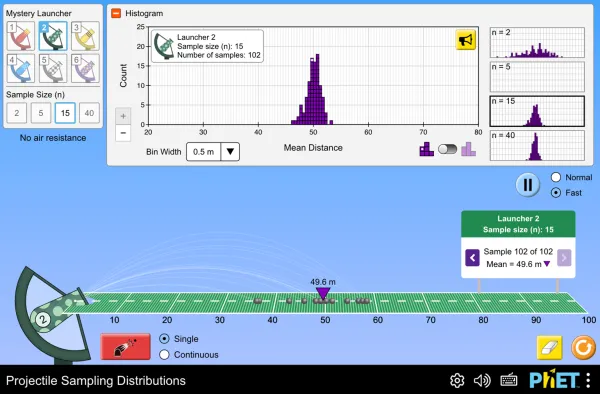
Full screen · PhET Interactive Simulations, University of Colorado Boulder, CC BY 4.0
Practise this
Report a mistake
More in AS 91584
Margin of error: the three rules of thumb8 min Confidence intervals, claims, and why overlap fails9 min
 Experiments vs observational studies: what you can conclude7 min
 Surveys and bias: sampling frames, non-response and wording6 min
 Evaluating a statistical report: the full answer7 min
 Margin of error: 7 exam questions solved step by step10 min
 Confidence intervals: 7 exam questions solved step by step10 min
 Study design: 7 exam questions solved step by step10 min
 Surveys and bias: 7 exam questions solved step by step10 min
 Evaluating reports: 7 exam questions solved step by step10 min
Is your child on track?
Take the free placement test