Independent or mutually exclusive? The two tests
What this lesson covers
- Mutually exclusive events cannot happen together; independent events do not affect each other.
- Each has its own test, and each test must be written as a probability statement.
Two ideas, two tests
- Mixing up the tests: a named 2025 error.
- Each idea has its own test.
- Write each test as a probability.
What the words mean
- Mutually exclusive: cannot happen together.
- Independent: one does not change the other.
- Overlap versus influence.
| Word | Means |
|---|---|
| Mutually exclusive | cannot happen together |
| Independent | no effect on each other |
The two tests side by side
- Mutually exclusive: P(A and B) = 0.
- Independent: P(A and B) = P(A) × P(B).
- Or: P(A | B) = P(A).
| Claim | Test |
|---|---|
| Mutually exclusive | P(A and B) = 0 |
| Independent | P(A and B) = P(A) × P(B) |
| or | P(A | B) = P(A) |
Mutually exclusive: no overlap
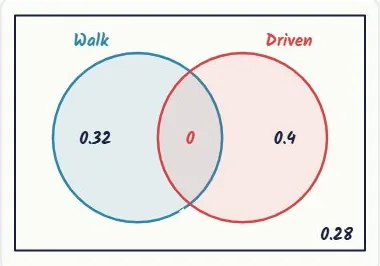
- Main way to school, 250 students.
- P(walk) = 0.32, P(driven) = 0.4.
- Nobody has two main ways: overlap 0.
A probability, not a count
- State it as a probability.
- Write P(W and D) = 0.
- P(neither) = 1 − (0.32 + 0.4)
- = 1 − 0.72 = 0.28
- no student did botha count, not the test
- P(W and D) = 0 ÷ 250 = 0a probability
- W and D are mutually exclusive
Independence: 400 café customers
- 160 have a loyalty card.
- 100 order oat milk; 40 do both.
- Does a card make a difference?
| Oat milk | Other | Total | |
|---|---|---|---|
| Loyalty card | 40 | 120 | 160 |
| No card | 60 | 180 | 240 |
| Total | 100 | 300 | 400 |
The rest of the table
- Each gap: total − known.
- Check one cell twice.
- card, other: 160 − 40 = 120
- no card: 400 − 160 = 240
- no card, oat: 100 − 40 = 60
- other: 400 − 100 = 300
- no card, other: 240 − 60 = 180
- check: 300 − 120 = 180
The product test
- Find P(L and O).
- Multiply P(L) × P(O).
- Equal: independent.
- P(L and O) = 40 ÷ 400 = 0.1
- P(L) = 160 ÷ 400 = 0.4
- P(O) = 100 ÷ 400 = 0.25
- P(L) × P(O) = 0.4 × 0.25 = 0.1
- P(L and O) = P(L) × P(O)
- L and O are independent
The conditional test
- Given a card: 0.25.
- Overall: also 0.25.
- No difference.
- P(O | L) = 40 ÷ 160 = 0.25card holders only
- P(O) = 100 ÷ 400 = 0.25everyone
- P(O | L) = P(O)
- P(O | no card) = 60 ÷ 240 = 0.25
- a card makes no difference
A pair that fails the test
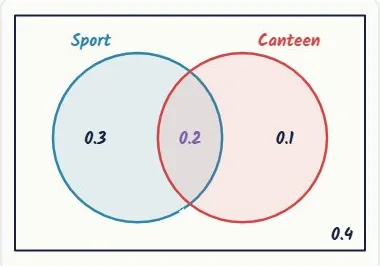
- P(S) = 0.5, P(C) = 0.3.
- P(S and C) = 0.2.
- Middle first, then the rest.
The product test fails
- Regions first.
- Then the product test.
- only S = 0.5 − 0.2 = 0.3
- only C = 0.3 − 0.2 = 0.1
- neither = 1 − 0.6 = 0.41 − (0.3 + 0.2 + 0.1)
- P(S) × P(C) = 0.5 × 0.3
- = 0.15
- P(S and C) = 0.2the overlap
- 0.15 ≠ 0.2product test fails
- S and C are not independent
Explaining it in context
- Compare with P(C).
- Then say it in context.
- P(C | S) = P(S and C) ÷ P(S)
- = 0.2 ÷ 0.5 = 0.4
- P(C) = 0.3overall
- P(C | S) > P(C)sport: canteen more often
Exclusive, so not independent
- Exclusive: P(W and D) = 0.
- Product: 0.128, not 0.
- P(W and D) = 0mutually exclusive
- P(W) × P(D) = 0.32 × 0.4
- = 0.128
- 0.128 ≠ 0product test fails
- W and D are not independent
- P(D | W) = 0, but P(D) = 0.4
Why they are never the same
- Both probabilities above zero.
- Mutually exclusive means not independent.
- Never use one word for the other.
Where the marks are
- Achieved: the probabilities each test needs.
- Merit: both tests, as probability statements.
- Excellence: the relationship, in context.
What to take away
- Two ideas, two tests, each written as a probability statement.
| Exclusive | P(A and B) = 0 |
| Independent | P(A and B) = P(A)P(B) |
| or | P(A | B) = P(A) |
| Write | as a probability |
| Explain | compare P(A | B), P(A) |
| Not the same | exclusive is dependent |
Your turn: four questions
- Pause here and answer each one.
- Classify: independent, exclusive, both, neither.
- Question 3: explain in context.
| Given | Find | |
|---|---|---|
| 1 | A 0.4, B 0.5, both 0.2 | classify |
| 2 | A 0.2, B 0.45, both 0 | classify |
| 3 | P(L | R) 0.4, P(L) 0.2 | independent? |
| 4 | A 50, B 80, both 20 | classify |
Show answer
1. P(A) × P(B) = 0.2 = P(A and B): independent; P(A and B) ≠ 0, so not mutually exclusive. 2. P(A and B) = 0: mutually exclusive; P(A) × P(B) = 0.09 ≠ 0, so not independent. 3. P(L | R) = 0.4 ≠ P(L) = 0.2: not independent; a student is twice as likely to be late on a rainy day. 4. P(A) = 0.25, P(B) = 0.4, P(A) × P(B) = 0.1 = 20 ÷ 200: independent; not mutually exclusive.
The answers: questions 1 and 2
- 1. P(A) × P(B) = 0.4 × 0.5 = 0.2
- = P(A and B): independent
- P(A and B) = 0.2 ≠ 0not mutually exclusive
- 2. P(A and B) = 0mutually exclusive
- P(A) × P(B) = 0.2 × 0.45 = 0.09
- 0.09 ≠ 0not independent
The answers: questions 3 and 4
- 3. P(L | R) = 0.4, P(L) = 0.2
- 0.4 ≠ 0.2: not independent
- 0.4 ÷ 0.2 = 2twice the overall chance
- 4. P(A) = 50 ÷ 200 = 0.25
- P(B) = 80 ÷ 200 = 0.4
- P(A) × P(B) = 0.25 × 0.4 = 0.1
- P(A and B) = 20 ÷ 200 = 0.1
- equal: independent
- P(A and B) ≠ 0: not exclusive
Is your child on track?
Take the free placement test