Relative risk: times as likely, and when you need a ratio
What this lesson covers
- Relative risk compares the risk in one group with the risk in another.
- 'Twice as likely' and 'twice more likely' do not mean the same thing.
Risk is a conditional probability
- Risk of late work, given a job.
- Relative risk: one risk ÷ another.
- Say it right; know when you need it.
Part-time jobs and late work
- 400 invented Year 13 students.
- Job: 60 of 200 late.
- No job: 40 of 200 late.
| Late | On time | Total | |
|---|---|---|---|
| Job | 60 | 140 | 200 |
| No job | 40 | 160 | 200 |
| Total | 100 | 300 | 400 |
The rest of the table
- Each gap: total − known.
- Check the grand total.
- job, on time: 200 − 60 = 140
- no job, on time: 200 − 40 = 160
- late: 60 + 40 = 100
- on time: 140 + 160 = 300
- 100 + 300 = 400
Two risks, then divide
- Each risk: its own group.
- Then divide, job ÷ no job.
- P(late | job) = 60 ÷ 200job group only
- = 0.3
- P(late | no job) = 40 ÷ 200no-job group only
- = 0.2
- relative risk = 0.3 ÷ 0.2job v no job
- = 1.5
Times as likely, not times more likely
- Say "times as likely".
- % more = (RR − 1) × 100
- Avoid "times more likely".
- RR = 1.5: 1.5 times as likely
- (RR − 1) × 100percent more
- (1.5 − 1) × 100 = 50
- 50% more likely
- RR = 2: (2 − 1) × 100 = 100%
- RR = 3: (3 − 1) × 100 = 200%
- "1.5 times more likely"ambiguous
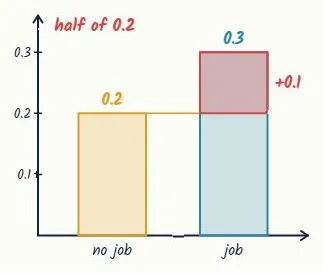
Fifty percent more, drawn
- No job: 0.2. Job: 0.3.
- The extra 0.1 is half of 0.2.
- The whole risk, plus half again.
Percentage points or percent?
- Subtract: % points.
- Divide: percent more.
- 30% − 20% = 10 percentage points
- 0.3 ÷ 0.2 = 1.5relative risk
- (1.5 − 1) × 100 = 50% morepercent
- "10% more likely"mixes the two
The other way round
- No job ÷ job.
- Below 1: less likely.
- P(late | no job) ÷ P(late | job)
- = 0.2 ÷ 0.3
- = 0.66674 decimal places
- about two thirds as likely
- (0.6667 − 1) × 100 = −33.33percent change
- about 33% less likely
Does the claim need a ratio?
- A ratio by habit: a named 2025 error.
- Read the claim first.
- Only a multiplier needs relative risk.
| The claim says | You need |
|---|---|
| "more likely" | compare two risks |
| "most", "over half" | one probability |
| "twice as likely" | relative risk |
| "50% more likely" | relative risk |
Claim 1: "more likely to be late"
- Compare the two risks.
- No ratio needed.
- P(late | job) = 0.3
- P(late | no job) = 0.2
- 0.3 > 0.2supported, this sample
Claim 2: "mostly from job holders"
- Given late: a new group.
- Over half means > 0.5.
- late: 60 + 40 = 100
- P(job | late) = 60 ÷ 100late students only
- = 0.6
- 0.6 > 0.5over half: supported
Claim 3: "twice as likely"
- Multiplier: use the ratio.
- No cause from a survey.
- relative risk = 0.3 ÷ 0.2 = 1.5
- 1.5 < 2claim: twice as likely
- claim not supported
- 1.5 times as likely
Where the marks are
- Achieved: risks from a table.
- Merit: a claim justified with numbers.
- Excellence: relative risk explained, claim judged.
What to take away
- Read the claim, then choose the comparison it needs.
| Risk | P(outcome | group) |
| Relative risk | risk ÷ risk, named |
| Say | times as likely |
| Percent more | (RR − 1) × 100 |
| "More likely" | compare two risks |
| Multiplier | needs the ratio |
Your turn: four questions
- Pause here and answer each one.
- Wet days: 54 of 180 trips late.
- Dry days: 36 of 360 trips late.
| Given | Find | |
|---|---|---|
| 1 | wet 54/180, dry 36/360 | both risks |
| 2 | the same trips | wet v dry RR |
| 3 | "200% more likely" | true? |
| 4 | "most late trips wet" | check it |
Show answer
1. P(late | wet) = 54 ÷ 180 = 0.3; P(late | dry) = 36 ÷ 360 = 0.1. 2. RR = 0.3 ÷ 0.1 = 3: wet-day trips were 3 times as likely to run late. 3. True: (3 − 1) × 100 = 200% more likely. 4. P(wet | late) = 54 ÷ 90 = 0.6 > 0.5, so supported; no ratio needed.
The answers: questions 1 and 2
- 1. P(late | wet) = 54 ÷ 180wet days only
- = 0.3
- P(late | dry) = 36 ÷ 360dry days only
- = 0.1
- 2. relative risk = 0.3 ÷ 0.1wet v dry
- = 3
- wet: 3 times as likely to run late
The answers: questions 3 and 4
- 3. (3 − 1) × 100 = 200percent more
- 200% more likely: true
- 4. late: 54 + 36 = 90
- P(wet | late) = 54 ÷ 90late trips only
- = 0.6
- 0.6 > 0.5: supportedno ratio needed
Is your child on track?
Take the free placement test