True probability, model estimates and experimental estimates
What this lesson covers
- The true probability is usually unknown; models and experiments both estimate it.
- Which estimate to trust depends on the assumptions behind the model and the size of the experiment.
Three kinds of probability
- The true probability.
- A model estimate.
- An experimental estimate.
Where each one comes from
- True: the long-run chance, almost never known.
- Model: from assumptions.
- Experimental: from trials or data.
| Probability | Comes from |
|---|---|
| True | the long run, unknown |
| Model | assumptions |
| Experimental | trials or data |
A café prize spinner
- Model estimate: 1/8.
- It assumes a fair spinner.
- 8 equal sectors, 1 wins
- assume equally likelythe model
- P(win) = 1/8 = 0.125model estimate
Two experimental estimates
- Wins ÷ spins.
- Neither is the true P.
- 30 spins, 6 wins
- 6/30 = 0.2
- 1000 spins, 131 wins
- 131/1000 = 0.131
- both experimentalfrom real trials
Small experiments wobble
- Does 0.2 mean unfair?
- More trials, less variation.
- X ~ Bin(30, 0.125)if the spinner is fair
- P(X ≥ 6) = 1 − P(X ≤ 5)
- = 1 − 0.8356binomial cdf, x = 5
- = 0.1644about 16%
- not unusual if fair
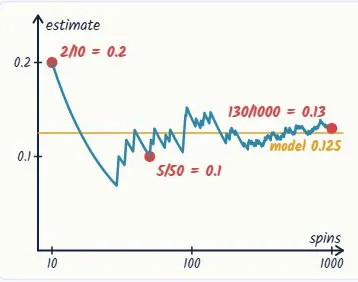
A simulation of the model
- 10 spins: 2/10 = 0.2.
- 50 spins: 5/50 = 0.1.
- 1000 spins: 130/1000 = 0.13.
A simulation inherits the model
- It runs on the model's assumptions.
- Longer runs approach the model, not the truth.
- Only real trials show a sticking spinner.
Which to trust for prediction
- Model: if its assumptions make sense.
- Experiment: if it has many trials.
- Same conditions as the prediction.
| Estimate | Trust it when |
|---|---|
| True | never known |
| Model | assumptions hold |
| Experimental | many trials |
| Small experiment | least reliable |
The café: they agree
- 0.131 is close to 0.125.
- Supports equally likely sectors.
- Thirty spins are too few.
| Estimate | |
|---|---|
| Model | 0.125 |
| 1000 spins | 0.131 |
| They agree | model supported |
| 30 spins | too variable |
When they disagree
- Suppose 200 wins in 1000.
- Then trust the experiment.
- 200/1000 = 0.2suppose
- if fair: X ~ Bin(1000, 0.125)
- P(200 ≤ X ≤ 1000)binomial cdf
- ≈ 1.48 × 10⁻¹¹almost impossible
- predict with 0.2the model is wrong
Calculator check: standard form
- Read E−4 as × 10⁻⁴.
- A probability is at most 1.
- P(all 5 late) = 0.2⁵independent
- screen: 3.2E−4
- = 3.2 × 10⁻⁴
- = 0.00032point moves 4 left
- 3.2over 1: impossible
Decimals, percentages, 0 to 1
- 0.25 is 25%, not 0.25%.
- Every probability is between 0 and 1.
- A probability table adds to 1.
| Check | |
|---|---|
| 0.25 | 25%, not 0.25% |
| Any probability | between 0 and 1 |
| Got 1.3? | impossible: recheck |
| A table | adds to exactly 1 |
Where the marks are
- Achieved: the estimates, named.
- Merit: a statement justified with numbers.
- Excellence: which predicts better, and why.
What to take away
- Name each estimate, and trust the one with sound reasons.
| True | unknown, long run |
| Model | from assumptions |
| Simulation | inherits the model |
| Experimental | from real trials |
| More trials | less variation |
| Every P | between 0 and 1 |
Your turn: four questions
- Pause here and answer each one.
- A six counts as a win.
- Name each kind of estimate.
| Given | Find | |
|---|---|---|
| 1 | a dice, rolling a six | model |
| 2 | 60 rolls, 14 sixes | experimental |
| 3 | 600 rolls, 101 sixes | which, why? |
| 4 | screen: 4.5E−3 | decimal, % |
Show answer
1. 1/6 = 0.1667, a model estimate that assumes the dice is fair. 2. 14 ÷ 60 = 0.2333, an experimental estimate. 3. 101 ÷ 600 = 0.1683, close to 0.1667, so the model is supported; 60 rolls vary too much to trust. 4. 0.0045, which is 0.45%.
The answers
- 1. P(six) = 1/6 = 0.1667model: a fair dice
- 2. 14/60 = 0.2333experimental
- 3. 101/600 = 0.1683experimental
- 0.1683 is close to 0.1667model supported
- 60 rolls vary too muchso not question 2
- 4. 4.5E−3 = 4.5 × 10⁻³
- = 0.0045
- 0.0045 × 100 = 0.45%
Is your child on track?
Take the free placement test