Choosing a distribution, and naming it every time
What this lesson covers
- Each distribution has conditions, and the conditions decide the model, not the number it produces.
- Name the distribution and its parameters every time, or the answer cannot earn a grade.
Which distribution?
- Every question starts with a choice.
- Say it clearly, then calculate.
- Unsaid, even a right number earns nothing.
First, say what is random
- X is what you count or measure.
- Write it in words, with units.
- A named 2025 gap: no random variable.
| Situation | Random variable X |
|---|---|
| 20 shots at goal | goals scored |
| 10 minutes at a café | cars that arrive |
| A pie from the oven | its mass in grams |
| Waiting for a bus | minutes waited |
Binomial: four conditions
- Fixed n, two outcomes.
- The same p every trial.
- Trials independent, in context.
| Condition | In context |
|---|---|
| Fixed n | 20 shots |
| Two outcomes | goal or miss |
| Constant p | 0.7 on every shot |
| Independent | no effect on next shot |
| Model | X ~ Bin(20, 0.7) |
Poisson: two conditions
- Events occur independently.
- At a constant average rate.
- Per unit of time or space.
| Condition | In context |
|---|---|
| Independent | cars arrive separately |
| Constant rate | 3 per 10 minutes |
| No fixed n | no upper limit |
| Model | X ~ Po(3) |
Hints are not conditions
- Rare and discrete: hints only.
- Not conditions about probability.
- Name the cars and the ten minutes.
| Written | Verdict |
|---|---|
| Events are rare | indicator only |
| Counts are discrete | indicator only |
| Probability is small | not a condition |
| Cars independent | condition |
| Constant average rate | condition |
Three models for measurements
- Normal: a symmetric bell.
- Uniform: flat between min and max.
- Triangular: a peak at the mode.
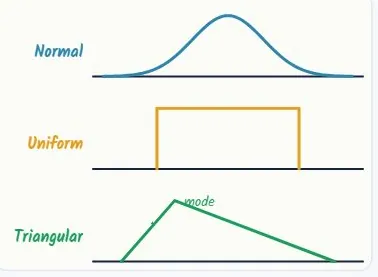
Their parameters
- Normal: the mean and standard deviation.
- Uniform: a minimum and a maximum.
- Triangular: minimum, mode, maximum.
| Model | Shape | Parameters |
|---|---|---|
| Normal | symmetric bell | μ and σ |
| Uniform | flat | min, max |
| Triangular | peak at the mode | min, mode, max |
Sort the situations
- Counts in n trials: binomial.
- Counts in an interval: Poisson.
- Measurements: normal, uniform, triangular.
| Situation | Model |
|---|---|
| Goals in 20 shots | X ~ Bin(20, 0.7) |
| Cars in 10 minutes | X ~ Po(3) |
| Pie mass, grams | X ~ N(180, 6) |
| Wait, bus every 10 min | uniform, 0 to 10 |
| Bus lateness, minutes | min 0, mode 2, max 10 |
Two models, almost the same number
- 100 customers, p = 0.03 each.
- P(X = 2): 0.2252 against 0.2240.
- The number cannot show the model.
| Model | P(X = 2) |
|---|---|
| X ~ Bin(100, 0.03) | 0.2252 |
| X ~ Po(3) | 0.2240 |
| Difference | 0.0011 |
Write it the same way every time
- No named model: no grade.
- X in words, the model, the conditions.
- Only then calculate.
| Step | Write |
|---|---|
| 1. Define X | X = goals in 20 shots |
| 2. Name it | X ~ Bin(20, 0.7) |
| 3. Conditions | in the context |
| 4. Then | the probability |
Is the condition believable?
- Say which condition might fail.
- Say why, in the context.
- That is Merit and Excellence thinking.
| Condition | Could fail if |
|---|---|
| Independent cars | a tour bus arrives |
| Constant rate | a lunchtime rush |
| Constant p, netball | she tires late on |
Where the marks are
- Achieved: right model, independence in context.
- Merit: why it suits, and its parameters.
- Excellence: judge the model and assumptions.
What to take away
- Define X, name the model with its parameters, and state conditions in context.
| Define X | in words, with units |
| Binomial | fixed n, constant p |
| Poisson | constant average rate |
| Both | independent, in context |
| Rare, discrete | indicators only |
| Every answer | X ~ Bin(n, p) and so on |
Your turn: four questions
- Pause here and answer each one.
- Define X and write the model.
- Question 2: both conditions in context.
| Given | Find | |
|---|---|---|
| 1 | 15 kicks, p = 0.8 each | X and model |
| 2 | 6 emails an hour | conditions |
| 3 | mean 250 mL, sd 4 mL | model |
| 4 | ferry every 20 minutes | your wait |
Show answer
1. X = number of kicks scored out of 15; X ~ Bin(15, 0.8). 2. X = emails in one hour; X ~ Po(6): emails arrive independently, at a constant average rate of 6 per hour. 3. X = volume in mL; X ~ N(250, 4). 4. Uniform, from 0 to 20 minutes, if you arrive at a random time.
The answers
- X ~ Bin(15, 0.8).
- X ~ Po(6): independent, constant rate.
- X ~ N(250, 4).
- Uniform, 0 to 20 minutes.
Is your child on track?
Take the free placement test