Binomial and Poisson: at least, at most, and the rate
What this lesson covers
- Binomial counts successes in a fixed number of trials; Poisson counts events in an interval.
- A Poisson rate scales with the interval, so a rate per hour becomes a rate per day by multiplying.
Two counting models
- Binomial: successes in n trials.
- Poisson: events in an interval.
- Keep four decimal places throughout.
Exactly three: P(X = 3)
- X = oat milk orders in 10.
- Formula, then calculator.
- X ~ Bin(10, 0.3)
- P(X = 3) = 10C3 × 0.3³ × 0.7⁷
- = 120 × 0.027 × 0.0823543
- = 0.2668
- Bin pdf: x = 3, n = 10, p = 0.3
Translate the words first
- At most 2: 2 or fewer.
- Fewer than 2: 1 or fewer.
- At least 4: one minus 3 or fewer.
| Words | Means | Calculate |
|---|---|---|
| at most 2 | X ≤ 2 | P(X ≤ 2) |
| fewer than 2 | X ≤ 1 | P(X ≤ 1) |
| at least 4 | X ≥ 4 | 1 − P(X ≤ 3) |
| more than 4 | X ≥ 5 | 1 − P(X ≤ 4) |
At most two: P(X ≤ 2)
- Add P(0), P(1) and P(2).
- Or cumulative binomial.
- P(X ≤ 2) = P(0) + P(1) + P(2)
- P(0) = 0.7¹⁰ = 0.0282
- P(1) = 10 × 0.3 × 0.7⁹ = 0.1211
- P(2) = 45 × 0.3² × 0.7⁸ = 0.2335
- = 0.0282 + 0.1211 + 0.2335
- = 0.3828
- Bin cdf: x = 2, n = 10, p = 0.3
At least four: P(X ≥ 4)
- Four and every value above it.
- Seven bars: too many to add.
- Take the rest away from 1.
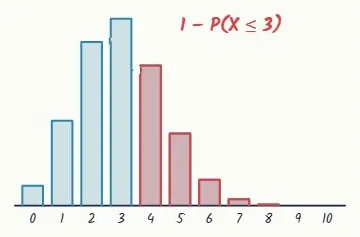
At least four: the working
- Complement: 1 − the rest.
- Cumulative up to 3.
- P(X ≥ 4) = 1 − P(X ≤ 3)complement
- Bin cdf: x = 3, n = 10, p = 0.3
- P(X ≤ 3) = 0.6496
- P(X ≥ 4) = 1 − 0.6496
- = 0.3504
Which values are you keeping?
- 1 − P(X ≤ 4) loses the 4.
- Say which values you keep.
- 1 − P(X ≤ 4) = 1 − 0.8497drops X = 4
- = 0.1503
- 1 − P(X ≤ 3) = 1 − 0.6496keeps 4 to 10
- = 0.3504
Poisson: exactly five cars
- X = cars in 10 minutes.
- Formula, then calculator.
- X ~ Po(3)
- P(X = 5) = e⁻³ × 3⁵ ÷ 5!
- = 0.049787 × 243 ÷ 120
- = 0.1008
- Poisson pdf: x = 5, λ = 3
Scale the rate to the interval
- Three times as long: λ = 9.
- Write the new model.
- 10 minutes: λ = 3
- 30 minutes: λ = 3 × 3 = 9
- X ~ Po(9)
- P(X ≤ 5)
- Poisson cdf: x = 5, λ = 9
- P(X ≤ 5) = 0.1157
Forgetting to scale
- Scale the rate.
- Never the probability.
- Poisson cdf: x = 5, λ = 3λ not scaled
- P(X ≤ 5) = 0.9161
- Poisson cdf: x = 5, λ = 9λ for 30 minutes
- P(X ≤ 5) = 0.1157
Reading E−4 on the calculator
- E−4 means × 10⁻⁴.
- Never above 1.
- P(X = 0) = e⁻⁹ × 9⁰ ÷ 0!
- = e⁻⁹
- screen: 1.2341E−4
- = 1.2341 × 10⁻⁴
- = 0.00012341
- 1.2341above 1: impossible
Working backwards to λ
- None = 1 − at least one.
- Take logs.
- X ~ Po(λ), per 15 minutes
- P(X ≥ 1) = 0.9
- P(X = 0) = 1 − 0.9 = 0.1
- e^(−λ) = 0.1
- −λ = ln 0.1
- λ = −ln 0.1 = 2.3026
- per hour: 4 × 2.3026 ≈ 9.21
When algebra cannot isolate λ
- Algebra cannot isolate λ.
- Try values, or a solver.
- X ~ Po(λ), per week
- P(X ≤ 1) = P(X = 0) + P(X = 1)
- e^(−λ) + λe^(−λ) = 0.5
- e^(−λ)(1 + λ) = 0.5
- λ = 1.6: 0.5249too big
- λ = 1.7: 0.4932too small
- λ = 1.68: 0.4995just under
- solver: λ = 1.6783
Where the marks are
- Achieved: a probability, model named.
- Merit: a rate from a probability, in context.
- Excellence: multi-step, and judge the model.
What to take away
- Translate the words, scale the rate, and keep four decimal places.
| At most 2 | P(X ≤ 2) |
| At least 4 | 1 − P(X ≤ 3) |
| Poisson rate | scale λ to the interval |
| Inverse | e^(−λ) = P(X = 0) |
| E−4 on screen | times 10 to the −4 |
| Working | four decimal places |
Your turn: four questions
- Pause here and answer each one.
- Write the model before each calculation.
- Question 3: scale to 90 minutes first.
| Given | Find | |
|---|---|---|
| 1 | n = 12, p = 0.4 | at most 3 |
| 2 | the same X | at least 6 |
| 3 | 2 an hour, over 90 min | at most 2 |
| 4 | P(0 in a day) = 0.25 | λ per week |
Show answer
1. X ~ Bin(12, 0.4): P(X ≤ 3) = 0.2253. 2. P(X ≥ 6) = 1 − P(X ≤ 5) = 1 − 0.6652 = 0.3348. 3. X ~ Po(3) for 90 minutes: P(X ≤ 2) = 0.4232. 4. e^(−λ) = 0.25, λ = 1.3863 a day, so 9.7041 a 7-day week.
The answers: questions 1 and 2
- 1. X ~ Bin(12, 0.4)
- Bin cdf: x = 3, n = 12, p = 0.4
- P(X ≤ 3) = 0.2253
- 2. P(X ≥ 6) = 1 − P(X ≤ 5)
- Bin cdf: x = 5, n = 12, p = 0.4
- P(X ≤ 5) = 0.6652
- P(X ≥ 6) = 1 − 0.6652 = 0.3348
The answers: questions 3 and 4
- 3. 90 minutes: λ = 2 × 1.5 = 3
- X ~ Po(3)
- Poisson cdf: x = 2, λ = 3
- P(X ≤ 2) = 0.4232
- 4. P(X = 0) = e^(−λ) = 0.25
- λ = −ln 0.25 = 1.3863per day
- week: 7 × 1.3863 = 9.7041
Is your child on track?
Take the free placement test