The normal distribution: forwards, backwards and conditional
What this lesson covers
- A normal probability is an area under the curve, found from the mean and standard deviation.
- Working backwards from a probability finds an unknown value, mean or standard deviation.
Level 3 normal: what is new
- Name the model every time.
- Unknown mean or standard deviation.
- Conditions, and proposing a σ.
Name the variable and the model
- X = time for a random trip, in minutes.
- X ~ N(42, 6): mean 42, sd 6.
- Name the model and its parameters.
| This question | |
|---|---|
| Random variable | X = trip time (min) |
| Distribution | normal |
| Parameters | μ = 42, σ = 6 |
| Written | X ~ N(42, 6) |
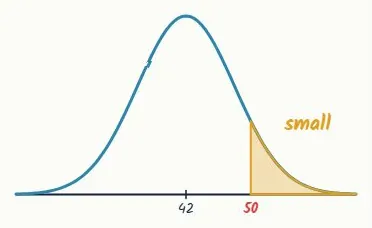
P(X > 50): sketch it first
- Mean 42 in the middle.
- Shade the right tail beyond 50.
- Expect a small area.
Try it: shade the curve
P(X > 50): the working
- Standardise: z = (x − μ)/σ.
- Keep 4 decimal places.
- X ~ N(42, 6)
- P(X > 50)
- z = (50 − 42)/6 = 8/6
- = 1.33334 d.p.
- normal cdf: 50 to ∞, μ 42, σ 6
- P(X > 50) = 0.0912
Backwards: the fastest 10%
- Area to the left: 0.1.
- Then x = μ + zσ.
- X ~ N(42, 6)
- P(X < k) = 0.1
- inverse normal: area 0.1
- z = −1.2816
- k = μ + zσ
- = 42 + (−1.2816)(6)
- = 42 − 7.6896 = 34.3104
- k = 34.31 min
Try it: backwards from an area
An unknown standard deviation
- Find z first.
- Then solve for σ.
- X ~ N(240, σ)
- P(X < 230) = 0.05
- inverse normal: area 0.05
- z = −1.6449
- (230 − 240)/σ = −1.6449
- −10/σ = −1.6449
- σ = 10/1.6449 = 6.0794
- σ = 6.08 ml
An unknown mean
- Find z first.
- Then solve for μ.
- X ~ N(μ, 5)
- P(X < 230) = 0.01
- inverse normal: area 0.01
- z = −2.3263
- (230 − μ)/5 = −2.3263
- 230 − μ = −2.3263 × 5 = −11.6315
- μ = 230 + 11.6315 = 241.6315
- μ = 241.63 ml
Where marks are lost
- No named model.
- z rounded early: σ comes out wrong.
- Show the working, every time.
| Loses marks | Keeps them | |
|---|---|---|
| Model | not stated | X ~ N(240, σ) |
| z | rounded to −1.6 | −1.6449 |
| σ | 6.25 ml | 6.08 ml |
| Working | answer only | z, equation, solve |
Probability calculator
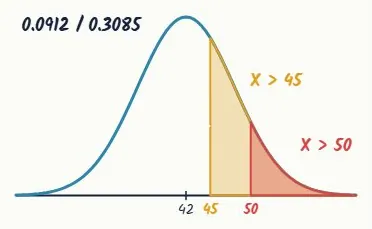
Given it has passed 45 minutes
- The condition: X > 45.
- Inside it, the event: X > 50.
- Smaller area ÷ larger area.
P(X > 50 | X > 45)
- Both ÷ the condition.
- Over 50 is already over 45.
- P(X > 50 | X > 45)
- = P(X > 50 and X > 45)/P(X > 45)
- = P(X > 50)/P(X > 45)over 50 is over 45
- P(X > 50) = 0.0912from before
- z = (45 − 42)/6 = 0.5
- P(X > 45) = 0.3085
- = 0.0912/0.3085
- = 0.2956
Propose σ: the first condition
- Mean 242 ml.
- At most 1% under 230.
- X ~ N(242, σ)
- P(X < 230) ≤ 0.01
- inverse normal: area 0.01
- z = −2.3263
- (230 − 242)/σ = −2.3263
- σ = 12/2.3263 = 5.1584
- σ ≤ 5.158round a limit down
Propose σ: the second condition
- At most 5% over 250.
- The smaller limit wins.
- σ ≤ 5.158
- P(X > 250) ≤ 0.05
- inverse normal: area 0.95
- z = 1.6449
- (250 − 242)/σ = 1.6449
- σ = 8/1.6449 = 4.8635
- σ ≤ 4.863round a limit down
- both: σ ≤ 4.863the smaller wins
Justify it: check both
- Propose σ = 4.5 ml.
- Check both conditions.
- propose σ = 4.5
- z = (230 − 242)/4.5 = −2.6667
- P(X < 230) = 0.0038 < 0.01
- z = (250 − 242)/4.5 = 1.7778
- P(X > 250) = 0.0377 < 0.05
- σ = 5: z = 8/5 = 1.6
- P(X > 250) = 0.0548 > 0.05too many spill
Where the marks are
- Achieved: name the model, sketch, probability.
- Merit: unknown μ or σ, or a condition.
- Excellence: propose and justify a σ.
What to take away
- Name it, sketch it, then work forwards or backwards.
| Name it | X ~ N(μ, σ) in context |
| Sketch | shade the area first |
| Unknown μ or σ | find z, then solve |
| Conditional | P(A and B) ÷ P(B) |
| Propose σ | check every condition |
| Rounding | 4 dp until the end |
Common mistakes
- z ≈ −1.6, so σ = 10 ÷ 1.6 = 6.25 mlKeep z = −1.6449 to four decimal places: σ = 10 ÷ 1.6449 = 6.08 ml; a rounded z gives the wrong σ.
- Fastest 10%: inverse normal with area 0.9, so k = 49.69 min.Sketch it first: the fastest trips are in the left tail, so use area 0.1, z = −1.2816 and k = 42 − 7.6896 = 34.31 min.
- P(X > 50 | X > 45) = P(X > 50) × P(X > 45)Divide by the condition: P(X > 50) ÷ P(X > 45) = 0.0912 ÷ 0.3085, because every trip over 50 minutes is already over 45.
- σ ≤ 5.158 from the first condition, so propose σ = 5.Check every condition: the 250 ml limit needs σ ≤ 4.863, and σ = 5 gives P(X > 250) = 0.0548, which is over 5%.
Your turn: four questions
- Name the model and sketch it first.
- Question 3 is conditional.
| Given | Find | |
|---|---|---|
| 1 | X ~ N(42, 6), 35 to 45 | probability |
| 2 | σ = 6, 15% over 50 | μ |
| 3 | N(42, 6), and X > 36 | P(X > 48) |
| 4 | μ = 242, ≤ 2% < 235 | largest σ |
Show answer
1. z from −1.1667 to 0.5: 0.6915 − 0.1217 = 0.5698. 2. z = 1.0364: μ = 50 − 1.0364 × 6 = 43.78 min. 3. P(X > 48 | X > 36) = 0.1587 ÷ 0.8413 = 0.1886. 4. z = −2.0537: σ ≤ 7 ÷ 2.0537 = 3.408, so propose 3.4 ml or less (P(X < 235) = 0.0198).
The answers: questions 1 and 2
- 1. X ~ N(42, 6)
- z = (35 − 42)/6 = −1.1667
- z = (45 − 42)/6 = 0.5
- P(−1.1667 < Z < 0.5)
- = 0.6915 − 0.1217 = 0.5698
- 2. P(X > 50) = 0.15, σ = 6
- z = 1.0364inverse normal, 0.85
- (50 − μ)/6 = 1.0364
- μ = 50 − 6.2184 = 43.78 min
The answers: questions 3 and 4
- 3. P(X > 48)/P(X > 36)over 48 is over 36
- z = (48 − 42)/6 = 1 → 0.1587
- z = (36 − 42)/6 = −1 → 0.8413
- = 0.1587/0.8413 = 0.1886
- 4. P(X < 235) ≤ 0.02, μ = 242
- z = −2.0537inverse normal, 0.02
- (235 − 242)/σ = −2.0537
- σ = 7/2.0537 = 3.4085
- σ ≤ 3.408: propose 3.4 ml
Sample question: Achieved
Ferry crossing times from Auckland to Devonport are normally distributed with mean 12 minutes and standard deviation 1.5 minutes. Find the probability that a crossing takes between 10 and 14 minutes.
Hint
Name the model, sketch it with the mean in the middle, then use the normal cdf between the two values.
Answer
P(10 < X < 14) = 0.8176
Step by step
- Define X = crossing time in minutes, and name the model: X ~ N(12, 1.5).
- Sketch a bell curve with 12 in the middle. Shade from 10 to 14, which is a middle area.
- Standardise each end with z = x − μσ.
- z = 10 − 121.5 = −1.3333 and z = 14 − 121.5 = 1.3333.
- The two ends are the same distance from the mean, so the shaded area is symmetric.
- Normal cdf from 10 to 14 with μ = 12, σ = 1.5 gives 0.8176.
- Check: 10 and 14 are about 1.33 standard deviations either side, a bit wider than ±1 (68%). 82% fits.
Full working
- X ~ N(12, 1.5)X = crossing time, minutes
- z = 10 − 121.5 = −1.3333
- z = 14 − 121.5 = 1.3333
- normal cdf: 10 to 14, μ 12, σ 1.5
- P(10 < X < 14) = 0.8176
Sample questions: Merit
Kiwifruit masses are normally distributed with mean 110 g. 8% of kiwifruit weigh less than 95 g. Find the standard deviation, and hence the proportion of kiwifruit that weigh more than 120 g.
Hint
Use inverse normal on the standard normal to get z for an area of 0.08, then solve 95 − 110σ = z.
Answer
σ = 10.6756 g; P(X > 120) = 0.1745
Step by step
- Define X = mass of a kiwifruit in grams. X ~ N(110, σ), with σ unknown.
- We know an area, so work backwards. P(X < 95) = 0.08 is a left tail.
- Inverse normal on the standard normal, area 0.08 to the left: z = −1.4051. Keep four decimals.
- 95 is below the mean, so z must be negative. That checks out.
- Link z to the values: 95 − 110σ = −1.4051, so −15σ = −1.4051.
- σ = 151.4051 = 10.6756 g.
- Now go forwards: P(X > 120) with X ~ N(110, 10.6756). z = 120 − 11010.6756 = 0.9367.
- Normal cdf from 120 upwards gives 0.1745.
- Classic mistake: rounding z to −1.4. That gives σ = 10.71, and a slightly wrong final answer.
- Check: 120 is about one standard deviation above the mean, where the tail is about 16%. 17.45% fits.
Full working
- X ~ N(110, σ)X = kiwifruit mass, g
- P(X < 95) = 0.08, inverse normal: z = −1.4051
- 95 − 110σ = −1.4051
- σ = 151.4051 = 10.6756
- z = 120 − 11010.6756 = 0.9367
- σ = 10.6756 g, P(X > 120) = 0.1745
The distance an e-scooter travels on one charge is normally distributed with mean 38 km and standard deviation 5 km. A scooter has already gone 40 km and is still running. Find the probability that it goes more than 46 km on this charge.
Hint
This is conditional: the condition is X > 40, the event is X > 46. Divide the smaller area by the larger one.
Answer
P(X > 46 | X > 40) = 0.1590
Step by step
- Define X = distance on one charge in km. X ~ N(38, 5).
- We already know X > 40. That is the condition. Inside it, we want X > 46.
- Recall conditional probability: P(A | B) = P(A and B) ÷ P(B).
- Going over 46 km means it has already gone over 40 km, so 'over 46 and over 40' is just 'over 46'.
- So P(X > 46 | X > 40) = P(X > 46)P(X > 40).
- P(X > 46): z = 46 − 385 = 1.6, area 0.0548.
- P(X > 40): z = 40 − 385 = 0.4, area 0.3446.
- Divide: 0.05480.3446 = 0.1590.
- Classic mistake: answering 0.0548. That ignores what we already know, that the scooter is past 40 km.
- Check: the answer must be bigger than 0.0548, because the scooters that died early are already ruled out. It is.
Full working
- X ~ N(38, 5)X = distance on one charge, km
- P(X > 46 given X > 40) = P(X > 46)P(X > 40)P(A and B) ÷ P(B)
- z = 46 − 385 = 1.6, P(X > 46) = 0.0548
- z = 40 − 385 = 0.4, P(X > 40) = 0.3446
- = 0.05480.3446
- 0.1590
Sample questions: Excellence
In a half marathon, finishing times are modelled as normal. 10% of runners finish in under 95 minutes and 25% take more than 130 minutes. Find the mean and standard deviation of the finishing times. Hence find the proportion of runners who finish in under 2 hours.
Hint
Each fact gives a z value and one equation of the form x = μ + zσ. Solve the two equations together.
Answer
μ = 117.93 minutes, σ = 17.89 minutes; P(X < 120) = 0.5460
Step by step
- Define X = finishing time in minutes. X ~ N(μ, σ), with both unknown.
- Two facts, two unknowns: each fact gives one equation.
- Fact 1: P(X < 95) = 0.1. Inverse normal, area 0.1: z = −1.2816. So 95 = μ − 1.2816σ.
- Fact 2: P(X > 130) = 0.25, which is an area of 0.75 to the left. Inverse normal: z = 0.6745. So 130 = μ + 0.6745σ.
- Subtract the first equation from the second: 35 = 1.9561σ.
- σ = 351.9561 = 17.8933 minutes.
- Then μ = 95 + 1.2816 × 17.8933 = 95 + 22.9318 = 117.9312 minutes.
- Now go forwards: 2 hours is 120 minutes. z = 120 − 117.931217.8933 = 0.1156.
- Normal cdf below 120 gives 0.5460.
- Classic mistake: using 0.25 as the area for Fact 2. Inverse normal wants the area to the left, which is 0.75.
- Check: the mean is just under 120, so a little over half should finish under 2 hours. 0.5460 fits.
Full working
- X ~ N(μ, σ)X = finishing time, minutes
- P(X < 95) = 0.1: z = −1.2816, μ − 1.2816σ = 95
- P(X > 130) = 0.25: z = 0.6745, μ + 0.6745σ = 130area 0.75 to the left
- 1.9561σ = 35, σ = 17.8933subtract
- μ = 95 + 1.2816 × 17.8933 = 117.9312
- z = 120 − 117.931217.8933 = 0.1156
- μ = 117.93, σ = 17.89, P(X < 120) = 0.5460
A machine fills bags of flour. The mean fill is 503 g. The rules are: at most 2% of bags under 495 g, and at most 1% of bags over 515 g. Find the largest standard deviation that meets both rules. Propose a value of σ and justify it by checking both rules. Then, with your σ, find the lowest mean fill that still meets the 2% rule.
Hint
Find the largest σ for each rule separately; the smaller one wins. For the last part, keep σ fixed and solve for μ.
Answer
σ ≤ 3.8953 g, so propose σ = 3.8 g (2% rule: 0.0176, 1% rule: 0.0008). Lowest mean with σ = 3.8 is 502.80 g
Step by step
- Define X = mass of flour in a bag, in grams. X ~ N(503, σ).
- Rule 1: P(X < 495) ≤ 0.02. Inverse normal, area 0.02: z = −2.0537.
- 495 − 503σ = −2.0537, so σ = 82.0537 = 3.8953. A bigger σ spreads more bags below 495, so σ ≤ 3.8953.
- Rule 2: P(X > 515) ≤ 0.01, an area of 0.99 to the left. Inverse normal: z = 2.3263.
- 515 − 503σ = 2.3263, so σ = 122.3263 = 5.1583. So σ ≤ 5.1583.
- Both must hold, so the smaller limit wins: σ ≤ 3.8953 g.
- Propose σ = 3.8 g, a little below the limit to give a margin.
- Check rule 1: z = −83.8 = −2.1053, P(X < 495) = 0.0176, which is under 0.02.
- Check rule 2: z = 123.8 = 3.1579, P(X > 515) = 0.0008, which is under 0.01.
- Last part: keep σ = 3.8 and lower μ until exactly 2% are under 495: 495 − μ3.8 = −2.0537.
- μ = 495 + 2.0537 × 3.8 = 502.80 g. Any lower and more than 2% of bags are light.
- Classic mistake: choosing σ = 5.1583, the larger limit. It passes rule 2 but fails rule 1.
Full working
- X ~ N(503, σ)X = flour per bag, g
- P(X < 495) ≤ 0.02: z = −2.0537, σ ≤ 82.0537 = 3.8953
- P(X > 515) ≤ 0.01: z = 2.3263, σ ≤ 122.3263 = 5.1583
- both: σ ≤ 3.8953the smaller limit wins
- propose σ = 3.8: P(X < 495) = 0.0176 < 0.02
- σ = 3.8: P(X > 515) = 0.0008 < 0.01
- μ = 495 + 2.0537 × 3.8 = 502.80keep σ, solve for μ
- σ = 3.8 g (limit 3.8953); lowest mean 502.80 g
Practise this
Report a mistake
More in AS 91586
 Choosing a distribution, and naming it every time7 min
 Discrete random variables: mean and standard deviation9 min
 Binomial and Poisson: at least, at most, and the rate10 minThe normal distribution: forwards, backwards and conditional11 min
 Uniform and triangular distributions, and judging a model10 min
 Choosing a distribution: 7 exam questions solved step by step10 min
 Discrete random variables: 7 exam questions solved step by step11 min
 Binomial and Poisson: 7 exam questions solved step by step10 min
 Normal distribution: 7 exam questions solved step by step10 min
 Uniform and triangular: 7 exam questions solved step by step10 min
Is your child on track?
Take the free placement test