Discrete random variables: mean and standard deviation
What this lesson covers
- The mean of a discrete random variable is each value times its probability, added up.
- The probabilities in a table must sum to 1, which finds any missing value.
More from the same table
- Level 2: the mean as a long-run average.
- Level 3: the spread as well.
- And what scaling does to both.
Bikes per booking
- X = number of bikes in one booking.
- Three probabilities are known.
- The one for 3 bikes is k.
| Bikes, x | P(X = x) |
|---|---|
| 1 | 0.35 |
| 2 | 0.3 |
| 3 | k |
| 4 | 0.15 |
The probabilities add to 1
- Probabilities add to 1.
- Each is between 0 and 1.
- If not, find the error.
- 0.35 + 0.3 + k + 0.15 = 1sum to 1
- 0.8 + k = 1
- k = 1 − 0.8 = 0.2
- 0 ≤ 0.2 ≤ 1
The distribution, drawn
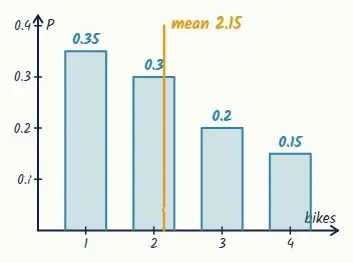
- One bike is the most likely.
- The bars step down to 0.15.
- The mean is the balance point.
The mean: Σ x × P(X = x)
- Value × probability.
- Write every product.
- E(X) = Σ x × P(X = x)
- = 1 × 0.35 + 2 × 0.3
- + 3 × 0.2 + 4 × 0.15
- = 0.35 + 0.6 + 0.6 + 0.6
- = 2.15 bikes
One more sum: E(X²)
- Square each value first.
- Then times its probability.
- E(X²) = Σ x² × P(X = x)
- = 1² × 0.35 + 2² × 0.3
- + 3² × 0.2 + 4² × 0.15
- = 0.35 + 1.2 + 1.8 + 2.4
- = 5.75
Variance and standard deviation
- Var(X) = E(X²) − μ².
- Square root for σ.
- Var(X) = E(X²) − [E(X)]²
- = 5.75 − 2.15²
- = 5.75 − 4.6225
- = 1.1275
- σ = √1.1275 = 1.0618 bikes
Rounding early: the 2025 warning
- Round μ to 2.2: Var = 0.91.
- Nearly 20% too small.
- Keep 4 decimal places.
- μ ≈ 2.2: 2.2² = 4.84
- Var = 5.75 − 4.84 = 0.91rounded too early
- Var = 5.75 − 4.6225 = 1.1275
- 0.91/1.1275 = 0.8071about 19% too small
The expectation rules in the booklet
- E(aX + b) = aE(X) + b.
- Var(aX + b) = a²Var(X).
- Adding b does not change the spread.
| Rule | Gives |
|---|---|
| E(aX + b) | aE(X) + b |
| Var(aX + b) | a²Var(X) |
| SD(aX + b) | |a| × SD(X) |
The charge: T = 30X + 10
- E(T) = 30E(X) + 10.
- No + 10 in the spread.
- T = 30X + 10
- E(T) = 30 × E(X) + 10
- = 30 × 2.15 + 10
- = 64.50 + 10 = $74.50
- Var(T) = 30² × Var(X)
- = 900 × 1.1275 = 1014.75
- SD(T) = √1014.75 = 31.8551
- ≈ $31.86
- 30 × 1.1275 + 10a not squared, + 10
What the mean means
- Over many bookings: 2.15 bikes on average.
- No single booking hires 2.15 bikes.
- 200 × $74.50 = $14,900.
Where the marks are
- Achieved: missing probability and the mean.
- Merit: SD, the rules, meaning in context.
- Excellence: accurate through a long problem.
What to take away
- Sum to 1, then the mean, then E(X²) − μ², with four decimal places throughout.
| Missing p | sum to 1, then check |
| E(X) | Σ x × P(X = x) |
| Var(X) | E(X²) − μ² |
| SD | √Var(X) |
| aX + b | mean: aμ + b |
| variance: a²Var(X) | |
| Working | four decimal places |
Your turn: four questions
- Pause here and answer each one.
- X = hockey goals: x = 0, 1, 2, 3.
- Question 3: $50 a goal plus $20.
| Given | Find | |
|---|---|---|
| 1 | P: 0.1, 0.4, k, 0.2 | k |
| 2 | the same X | E(X), SD |
| 3 | Y = 50X + 20 dollars | E(Y), SD(Y) |
| 4 | E(X) = 1.6 goals | meaning |
Show answer
1. 0.1 + 0.4 + k + 0.2 = 1, so k = 0.3. 2. E(X) = 1.6; E(X²) = 3.4; Var(X) = 3.4 − 2.56 = 0.84; SD = 0.9165. 3. E(Y) = 50 × 1.6 + 20 = $100; Var(Y) = 2500 × 0.84 = 2100; SD(Y) = $45.83. 4. Over many games, the team averages 1.6 goals a game; no single game has 1.6.
The answers: questions 1 and 2
- 1. 0.1 + 0.4 + k + 0.2 = 1
- 0.7 + k = 1, so k = 0.3
- 2. E(X) = 0 × 0.1 + 1 × 0.4
- + 2 × 0.3 + 3 × 0.2
- = 0 + 0.4 + 0.6 + 0.6 = 1.6
- E(X²) = 0 × 0.1 + 1 × 0.4
- + 4 × 0.3 + 9 × 0.2
- = 0 + 0.4 + 1.2 + 1.8 = 3.4
The answers: questions 2 to 4
- E(X) = 1.6, E(X²) = 3.4
- Var(X) = 3.4 − 1.6² = 3.4 − 2.56
- = 0.84
- SD = √0.84 = 0.9165
- 3. E(Y) = 50 × 1.6 + 20 = $100
- Var(Y) = 50² × 0.84 = 2500 × 0.84
- = 2100
- SD(Y) = √2100 = $45.83
- 4. 1.6 goals a game, on average
Is your child on track?
Take the free placement test