The equals sign, and growing patterns
What this lesson covers
- Numbers can be compared using “greater than” (>), “less than” (<), and equals (=).
- Applying the same operation to both sides of a number sentence preserves the balance.
- Growing patterns can increase or decrease by the addition or subtraction of a constant (arithmetically) or multiplication or division by a constant (geometrically).
What the equals sign really means
- You have seen = thousands of times, like this: 4 + 3 = __
- So it looks like it means "work it out and write it here".
- It does not. It means "is the same as".
| what people think = means | what it actually means |
|---|---|
| "here comes the answer" | "is the same as" |
| an instruction | a claim about both sides |
Why that matters
- Try this one: 8 + 4 = __ + 5
- Most people write 12. But 12 + 5 is 17, not 12.
- Both sides have to match. The answer is 7.
| if you write | the sentence says | true? |
|---|---|---|
| 12 | 8 + 4 = 12 + 5 | no, 12 is not 17 |
| 7 | 8 + 4 = 7 + 5 | yes, both sides are 12 |
A number sentence is a claim
- Someone writes 11 × 7 = 78. That is not a question.
- It is a claim, and you are allowed to disagree with it.
- 11 × 7 is 77. So the claim is false.
| sentence | true or false? | why |
|---|---|---|
| 11 × 7 = 78 | false | 11 × 7 is 77 |
| 8205 − 4721 = 3484 | true | check it and it holds |
| 6 × 5 = 30 + 0 | true | both sides are 30 |
| 9 + 3 = 12 + 1 | false | 12 is not 13 |
Three things you can claim
- = says the two sides are the same.
- > says the left one is bigger.
- < says the left one is smaller.
| sign | means | for example |
|---|---|---|
| = | is the same as | 4 + 3 = 7 |
| > | is bigger than | 9 > 4 |
| < | is smaller than | 4 < 9 |
Sentences with a hole in them
- 7 + __ = 12. There is a gap.
- Your job is to fill it so the claim becomes true.
- 7 and 5 is 12, so the gap is 5.
| open sentence | fill the gap with | and now |
|---|---|---|
| 7 + __ = 12 | 5 | both sides are 12 |
| 4200 − __ = 4001 | 199 | both sides are 4001 |
| __ ÷ 10 = 12 | 120 | both sides are 12 |
Do the same to both sides
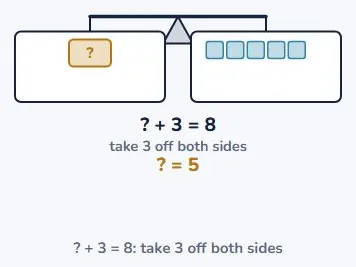
- Picture a balance. Both pans weigh the same.
- Take 3 off one pan only, and it tips. The claim breaks.
- Take 3 off both, and it still balances.
A pattern is a rule
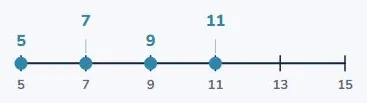
- 5, 7, 9, 11. What is the rule?
- Add 2 each time.
- And a rule is a claim; you can check it on every step.
Some patterns multiply instead
- 3, 6, 12, 24. The gaps are not equal.
- Each one is double the one before.
- Multiplying patterns take off much faster.
| pattern | the rule | what comes next |
|---|---|---|
| 5, 7, 9, 11, … | add 2 each time | 13, 15 |
| 30, 25, 20, 15, … | subtract 5 each time | 10, 5 |
| 3, 6, 12, 24, … | multiply by 2 each time | 48, 96 |
Say the rule, then test it
- Find the rule by looking at the gap between two terms.
- Then check it works for every other pair.
- If it holds all the way along, you have the rule.
| step | to step | gap |
|---|---|---|
| 30 | 25 | − 5 |
| 25 | 20 | − 5 |
| 20 | 15 | − 5 |
Your turn
- True or false: 6 × 9 = 54 + 0
- Fill the gap: 15 − __ = 8
- What comes next: 4, 8, 16, 32, …?
| try these | |
|---|---|
| 6 × 9 = 54 + 0 | true or false? |
| 15 − __ = 8 | fill the gap |
| 4, 8, 16, 32, … | what is the rule? |
Show answer
True: 6 × 9 is 54, and 54 + 0 is 54, so both sides match. 7, because 15 − 7 is 8. 64 and 128: this one doubles rather than adding, and the giveaway is that the gaps grow: 4, then 8, then 16. Anyone who answers "add 4" has checked only the first pair.
Equals, and rules
- = means "is the same as", not "answer goes here".
- A number sentence is a claim, so it can be false.
- A pattern rule is a claim too: test it on every step.
| idea | what to remember |
|---|---|
| = | is the same as |
| > and < | the open end faces the bigger number |
| a number sentence | a claim: it can be true or false |
| an open sentence | fill the gap to make it true |
| both sides | do the same to each, and it stays true |
| a pattern | a rule that holds at every step |
Is your child on track?
Take the free placement test