Money: totals, change and coins
What this lesson covers
- New Zealand currency is a decimal system of dollars made up of 100 cents.
A dollar is 100 cents
- You already know this one.
- 100 cents make a dollar. Not 10. A hundred.
- So money needs two columns after the point.
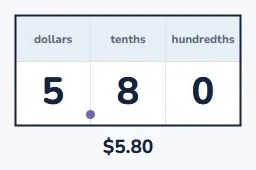
The same columns, one step further
- A 10c coin is one tenth of a dollar.
- One cent would be one hundredth.
- Same rule as always: ten times, every step left.
| column | worth | the coin |
|---|---|---|
| dollars | $1 | the $1 coin |
| tenths | 10c | the 10c coin |
| hundredths | 1c | no coin: NZ has none |
New Zealand has no 1c coin
- Our smallest coin is 10c.
- There is no 1c, no 2c, no 5c any more.
- So cash amounts always end on a 10.
| what we have | values |
|---|---|
| coins | 10c · 20c · 50c · $1 · $2 |
| notes | $5 · $10 · $20 · $50 · $100 |
| no longer made | 1c · 2c · 5c |
Making $5.80
- A $5 note, a 50c, a 20c and a 10c.
- Or two $2 coins, a $1, and the same silver.
- Same amount. Different handfuls.
| way | what you hand over |
|---|---|
| the fewest pieces | $5 note + 50c + 20c + 10c |
| with $2 coins | $2 + $2 + $1 + 50c + 20c + 10c |
| all in 20s and 50s | $5 note + 20c × 4 |
Adding up a shop
- A $4 book, a $3 pen, and two $2 stickers.
- The stickers are 2 × $2 = $4.
- $4 + $3 + $4 = $11 altogether.
| item | how many | costs |
|---|---|---|
| book | 1 | $4 |
| pen | 1 | $3 |
| stickers | 2 | $4 |
| total | $11 |
Change is not really subtraction
- You pay $20 for something costing $13.40.
- Written as a subtraction it is full of borrowing.
- So do not subtract. Count forwards instead.
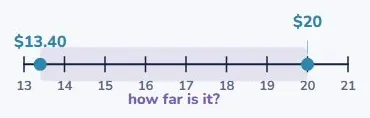
Count on to a tidy number first
- From $13.40, 60c takes you to $14.
- From $14, six dollars takes you to $20.
- 60c and $6 is $6.60. That is the change.
| from | add | and you reach |
|---|---|---|
| $13.40 | 60c | $14.00 |
| $14.00 | $6.00 | $20.00 |
| so the change is | $6.60 |
Why shopkeepers do it that way
- They hand you coins to a round number, then notes.
- Every step is an easy one.
- And you can check it as it is counted into your hand.
| they say | they hand you |
|---|---|
| "thirteen forty..." | |
| "...and sixty makes fourteen" | 50c + 10c |
| "...and six makes twenty" | $5 note + $1 |
Your turn
- Three $6 tickets. What do they cost altogether?
- You pay with a $20 note. What is the change?
- Make $3.70 using the fewest coins you can.
Show answer
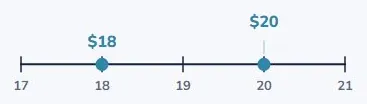
$18: three sixes. $2 change: count on from 18 to 20. $3.70 in fewest pieces is $2 + $1 + 50c + 20c, which is four pieces; accept $2 + $1 + 50c + 10c + 10c as correct but not fewest. Watch for anyone reaching for a 5c or 1c; those have not existed here for years.
Money, totals and change
- 100 cents in a dollar, so two columns of cents.
- Our smallest coin is 10c.
- Count change forwards. Never borrow.
| idea | what to remember |
|---|---|
| $1 | 100 cents: two columns after the point |
| 10c | one tenth of a dollar |
| NZ coins | 10c · 20c · 50c · $1 · $2 |
| totals | multiply the repeats, then add |
| change | count on to a tidy number, then up |
Is your child on track?
Take the free placement test