Regular shapes and lines of symmetry
What this lesson covers
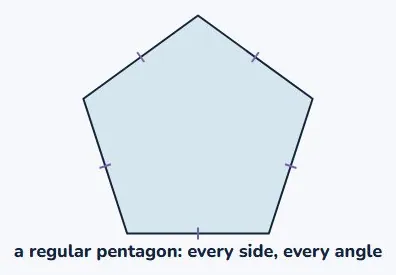
- A regular polygon is a two-dimensional shape with all sides of equal length and all interior angles of equal measure.
- Circles have an infinite number of lines of symmetry.
- Shapes may appear different when viewed from a different perspective.
What "regular" means
- All the sides the same length.
- AND all the angles the same size.
- Both. Miss either one and it is irregular.
Irregular does not mean messy
- A rectangle is perfectly tidy. It is still irregular.
- Its angles all match, but its sides do not.
- You need both to be regular.
| shape | what it has | so it is |
|---|---|---|
| square | 4 equal sides, 4 equal angles | regular |
| rectangle | 4 equal angles, but 2 long and 2 short | irregular |
| equilateral triangle | 3 equal sides, 3 equal angles | regular |
| isosceles triangle | only 2 sides equal | irregular |
Counting edges, corners and angles
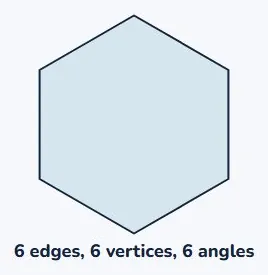
- Edges are the straight sides.
- Vertices are the corners where two edges meet.
- A polygon always has the same number of each.
A line of symmetry is a fold
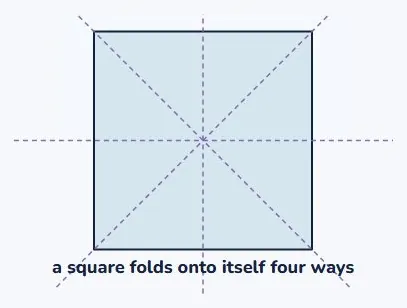
- Imagine folding the shape along a line.
- If the two halves land exactly on each other, it is a mirror line.
- If anything sticks out, it is not.
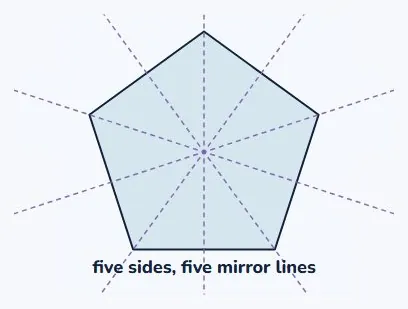
A regular shape: as many lines as sides
- Every side and every corner is interchangeable.
- So you can fold through any corner, and any side middle.
- Triangle 3, square 4, pentagon 5. Count the sides.
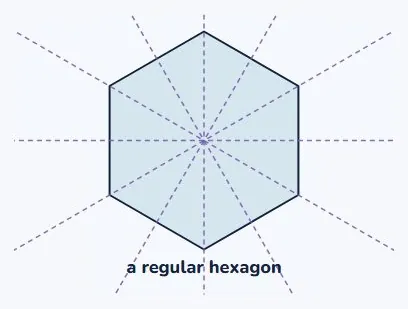
Six sides, six lines
- Three go corner to corner.
- Three go through the middles of opposite sides.
- Six sides, six lines. The rule keeps working.
The pattern, and where it ends up
- More sides, more mirror lines. Always equal.
- So what about a circle, which has no straight sides?
- It never runs out. Infinitely many.
| shape | sides | lines of symmetry |
|---|---|---|
| equilateral triangle | 3 | 3 |
| square | 4 | 4 |
| regular pentagon | 5 | 5 |
| regular hexagon | 6 | 6 |
| circle | no straight sides at all | infinitely many |
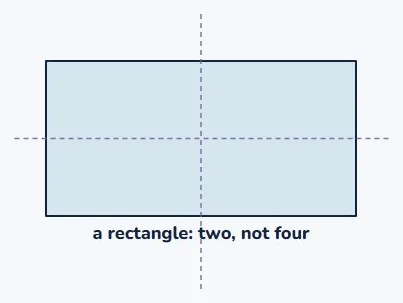
An irregular shape has fewer
- A rectangle has only 2, not 4.
- Across the middle each way, and that is all.
- Fold it along a diagonal and the corners miss.
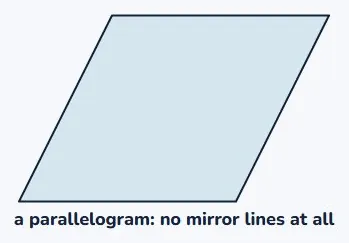
And some have none at all
- A parallelogram looks like it should be symmetrical.
- It is not. There is no fold that works.
- Looking symmetrical and being symmetrical are different.
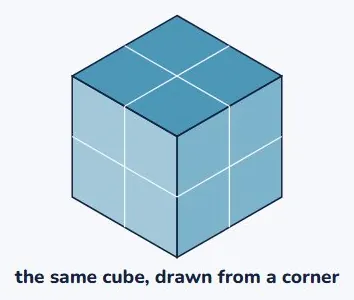
A drawing of a solid is always a bit of a lie
- Look at a cube straight on and you see a square.
- Turn it slightly and you see three faces at once.
- Same cube. Completely different drawing.
Your turn
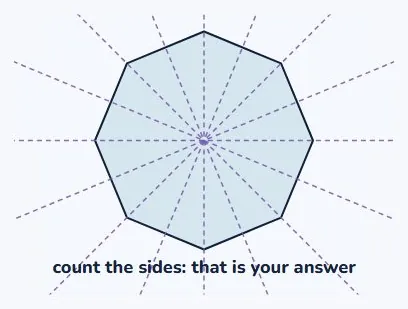
- How many lines of symmetry has a regular octagon?
- Is a rhombus regular?
- How many has an equilateral triangle?
Show answer
8: a regular shape has as many as it has sides, so nobody needs to count them one by one. No, a rhombus is irregular: all four sides match but the angles do not, and you need both. It does still have 2 lines of symmetry, along its diagonals. 3 for the equilateral triangle.
Regular shapes and mirrors
- Regular means all sides AND all angles equal.
- A regular shape has as many mirror lines as sides.
- A circle never runs out of either.
| idea | what to remember |
|---|---|
| regular | all sides equal AND all angles equal |
| irregular | tidy is not the same as regular |
| a mirror line | a fold where the halves match exactly |
| a regular n-gon | n sides, n lines of symmetry |
| a rectangle | only 2, not the diagonals |
| a circle | infinitely many |
Is your child on track?
Take the free placement test