Turns, angles and telling the time
What this lesson covers
- Angles are a measure of turn and can be measured using the unit of degrees; a full turn is 360 degrees, a half turn is 180 degrees, and a quarter turn is 90 degrees.
- Rectangles and squares have four right angles.
- A point in time is typically measured in hours and minutes past midnight.
- Clocks relate seconds to minutes and minutes to hours according to a system based on 60.
An angle is an amount of turn
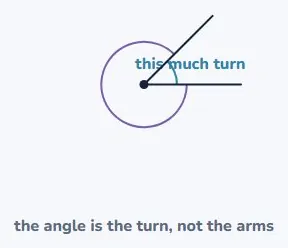
- Not a corner you point at. An amount of turning.
- Stand up and spin all the way round. That is a turn.
- Do half of it and you face the other way.
All the way round is 360°
- Turn until you face where you started. That is a full turn.
- A full turn is 360 degrees.
- People picked 360 a very long time ago, and it stuck.
Halve it, then halve it again
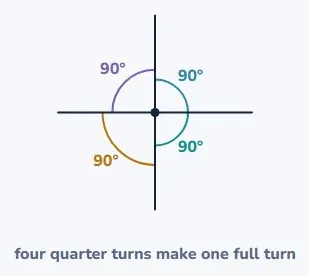
- Half a turn is 180°: you face the opposite way.
- Half of that is a quarter turn: 90°.
- One fact, halved twice. Not three facts.
| turn | degrees | what it looks like |
|---|---|---|
| a full turn | 360 degrees | all the way round, back where you started |
| a half turn | 180 degrees | facing the opposite way |
| a quarter turn | 90 degrees | a right angle, the corner of a square |
A quarter turn is a right angle
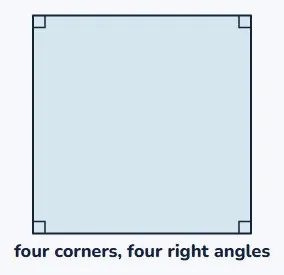
- A quarter turn has its own name: a right angle.
- You mark it with a little square, not a curve.
- Every rectangle and every square has four of them.
Your turn: estimate this one
- Bigger or smaller than a quarter turn?
- Bigger or smaller than a half turn?
- So roughly how many degrees?
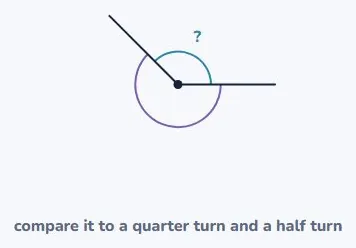
Show answer
Bigger than a quarter turn (90°) and smaller than a half turn (180°), so about 135°. Accept anything from 120° to 150°; the objective is comparing to 90 and 180, not measuring. No protractor is named anywhere in Year 4.
A clock is a turning machine
- The hands do one thing. They turn.
- So everything about turns is about to tell you the time.
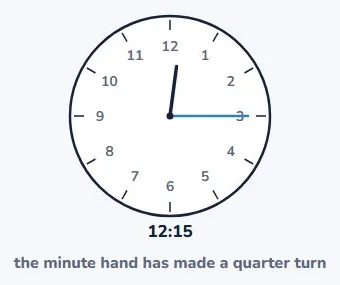
- A quarter turn of the long hand: 90° AND 15 minutes.
Clocks count in sixties
- Almost everything you measure counts in tens.
- Clocks do not. Sixty, then sixty, then twenty-four.
- Nobody is being difficult; clocks are just old.
| how many | of these | make |
|---|---|---|
| 60 | seconds | a minute |
| 60 | minutes | an hour |
| 24 | hours | a day |
Reading the hands
- Short hand: the hour. Long hand: the minutes.
- The long hand moving one small mark is one minute.
- A digital clock has already done that reading for you.
A time is a point
- A time says how far past midnight you are.
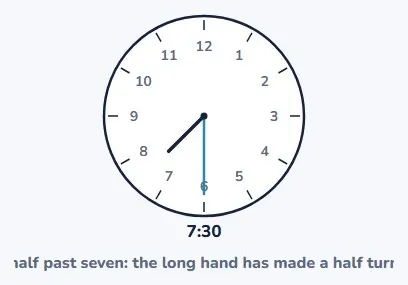
- 7:30 in the morning is 7 hours and 30 minutes since midnight.
- It is the moment you arrive at. Not how long anything took.
| the clock says | how far past midnight |
|---|---|
| 7:30 in the morning | 7 hours and 30 minutes |
| 12:00 noon | 12 hours |
| 9:45 in the morning | 9 hours and 45 minutes |
How long is a different number
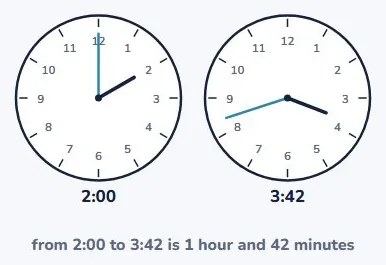
- How long something takes is called a duration.
- A film lasting 1 hour 42 minutes does not start at 1:42.
- That is a length, not a place on the clock.
Your turn: fill in the other side
- 90 seconds is how many minutes?
- 48 hours is how many days?
- 3 weeks is how many days?
| this | is the same as |
|---|---|
| 90 seconds | ? |
| 48 hours | ? |
| 3 weeks | ? |
Show answer
90 seconds = 1 and a half minutes. 48 hours = 2 days. 3 weeks = 21 days. The first is the one that catches them: 1.5 minutes is 90 seconds, not 1 minute 50 (a decimal habit meeting a clock that counts in sixties).
Turns, angles and time
- One fact about turns, halved twice.
- A clock turns too, and counts in sixties.
- A point in time is not how long something took.
| thing | what to remember |
|---|---|
| an angle | an amount of turn, not a corner |
| a full turn | 360° |
| a half turn | 180°, facing the opposite way |
| a quarter turn | 90°, a right angle |
| estimating | compare it to 90° and 180° |
| a clock | a turning machine that counts in 60s |
| a time | how far past midnight (a point) |
| a duration | how long it took (a length) |
Is your child on track?
Take the free placement test