Perimeter, area and volume
What this lesson covers
- Volume is a measure of regions in three-dimensional space.
- The areas of rectangles (including squares) can be calculated by multiplication of side lengths.
Three questions, one shape
- How far is it around the edge? That is perimeter.
- How much would cover it? That is area.
- How much would fill it? That is volume.
| the question | its name | what you count |
|---|---|---|
| how far around the edge? | perimeter | lengths (cm) |
| how much to cover it? | area | squares |
| how much to fill it? | volume | cubes |
Perimeter: walk around the edge
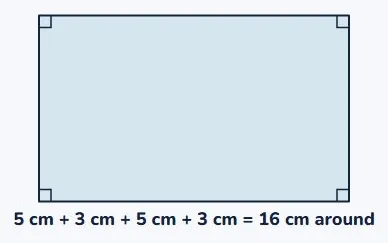
- Start at a corner and walk all the way round.
- Add up every side you walk along.
- 5 and 3 and 5 and 3 is 16 cm.
It works for any shape
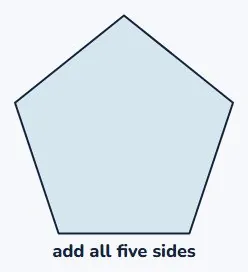
- Perimeter is not a rectangle rule.
- Any shape at all: add up all the sides.
- Five sides, six sides, it does not matter.
Area: cover it and count
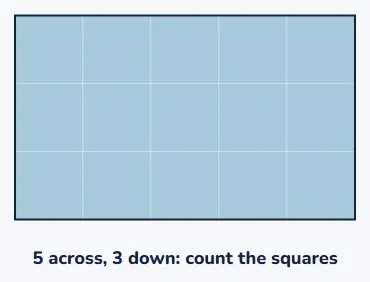
- Area asks how much it takes to cover the shape.
- So cover it in squares and count them.
- This one holds 15 squares.
Multiplying counts them faster
- There are 3 rows, and 5 squares in each row.
- 3 rows of 5 is exactly what 3 × 5 means.
- So multiplying is not a new rule. It is faster counting.
| step | what you do |
|---|---|
| cover it | 3 rows of 5 squares |
| count them | 5, 10, 15 |
| or just multiply | 3 × 5 = 15 squares |
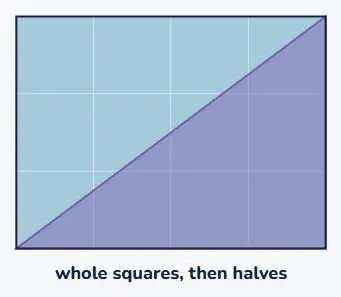
Wobbly shapes: count half squares too
- Not everything is a rectangle.
- Count the whole squares first.
- Then pair up the half squares: two halves make one.
Same perimeter, different area
- All three of these have a perimeter of 16 cm.
- But their areas are 15, 12 and 16 squares.
- So they really are different questions.
| rectangle | perimeter | area |
|---|---|---|
| 5 cm by 3 cm | 16 cm | 15 squares |
| 6 cm by 2 cm | 16 cm | 12 squares |
| 4 cm by 4 cm | 16 cm | 16 squares |
Volume: fill it with cubes
- Volume is about space inside, not surface.
- Fill the box with identical blocks and count them.
- Same idea as area, one dimension further.
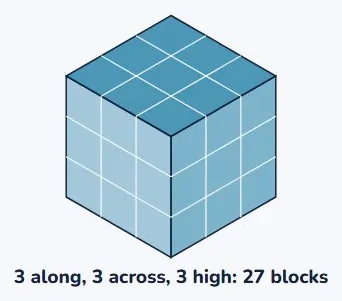
Count it in layers
- Do the bottom layer first: 3 by 3 is 9 blocks.
- Then see how many layers high it is. Three.
- 9 in a layer, 3 layers, so 27 blocks.
| step | count |
|---|---|
| one layer | 3 × 3 = 9 blocks |
| how many layers | 3 |
| altogether | 27 blocks |
Your turn
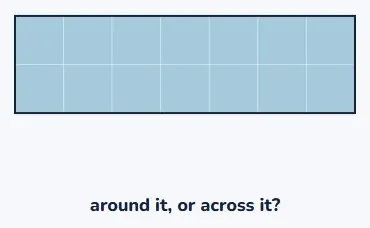
- A rectangle 7 cm by 2 cm. What is its perimeter?
- What is its area?
- A box holds 5 blocks per layer, 3 layers. How many?
Show answer
18 cm: 7 + 2 + 7 + 2, and the commonest error is adding only two sides. 14 squares: 7 × 2. Notice the two answers are different numbers for the same rectangle, which is the whole point. 15 blocks: 5 × 3. Ask which ones are lengths, which are squares and which are cubes before accepting any of them.
Around, across, inside
- Perimeter goes round the edge: add the sides.
- Area covers it: count squares, or multiply.
- Volume fills it: count cubes, layer by layer.
| question | what to do |
|---|---|
| how far around? | perimeter: add every side |
| how much to cover? | area: count the squares |
| a rectangle | area = rows × squares in a row |
| a wobbly shape | count wholes, then pair the halves |
| how much to fill? | volume: count the cubes |
| a box | one layer, then how many layers |
Is your child on track?
Take the free placement test