Adding fractions, and fractions of amounts
What this lesson covers
- Addition and subtraction of fractions with the same denominator follow the same principles as whole numbers and can result in improper fractions or whole numbers.
- Scaling changes quantities proportionally, using multiplication and division.
Adding fractions is just counting
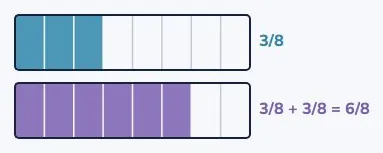
- 3 apples plus 3 apples is 6 apples.
- 3 eighths plus 3 eighths is 6 eighths.
- Same sum. The eighths are just what you are counting.
| the sum | you say | you get |
|---|---|---|
| 3 apples + 3 apples | three and three | 6 apples |
| 3/8 + 3/8 | three eighths and three eighths | 6/8 |
| 0.3 + 0.2 | three tenths and two tenths | 0.5 |
The bottom number does not get added
- Six eighths, not six sixteenths.
- The bottom number is the NAME of the piece.
- Counting apples does not change what an apple is.
Decimals add the same way
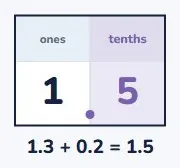
- 1.3 + 0.2. Three tenths plus two tenths is five tenths.
- So the answer is 1.5.
- The columns already lined the pieces up for you.
You can count past a whole
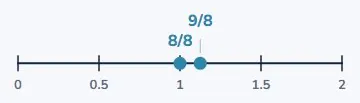
- 3/8 three times is 9 eighths.
- Eight of them made a whole, and one is left over.
- So 9/8 is 1 and 1/8: the two spellings again.
Tidying up afterwards
- Add first, then see how many wholes you made.
- 8/4 is exactly 2 wholes. Nothing left over.
- Do the counting first. Tidy up second.
| the sum | gives | which is |
|---|---|---|
| 3/8 + 3/8 + 3/8 | 9/8 | 1 1/8 |
| 5/4 + 3/4 | 8/4 | 2 |
| 7/10 + 6/10 | 13/10 | 1 3/10 |
Taking away works the same
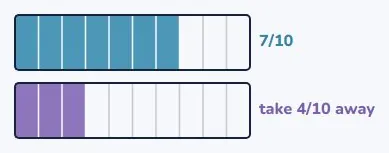
- 7/10 take away 4/10 is 3/10.
- Seven tenths, take away four of them, leaves three.
- Still counting. Still the same-sized pieces.
Scaling: everything moves together
- Double a recipe and every ingredient doubles.
- 2 cups becomes 4. 3 eggs becomes 6.
- Not "add the same". Multiply the same.
| ingredient | for 4 people | doubled, for 8 |
|---|---|---|
| flour | 2 cups | 4 cups |
| eggs | 3 | 6 |
| milk | 300 ml | 600 ml |
"Of" means share it out
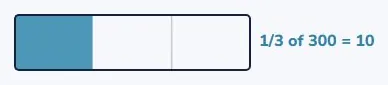
- 1/3 of 300. Cut 300 into 3 equal parts.
- That is 300 ÷ 3, which is 100.
- Finding a fraction of an amount is dividing.
And it runs backwards
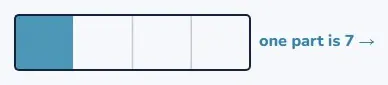
- A quarter of a set is 7. How big is the whole set?
- A quarter means 4 equal parts, and one of them is 7.
- So the whole is 7 × 4 = 28. Same fact, reversed.
One division fact, two questions
- Every row here is a fact you already know.
- Read it left to right, or right to left.
- That is why memorising the tables was worth it.
| forwards | backwards | the fact behind both |
|---|---|---|
| 1/4 of 28 is 7 | a quarter is 7, so the whole is 28 | 28 ÷ 4 = 7 |
| 1/3 of 300 is 100 | a third is 100, so the whole is 300 | 300 ÷ 3 = 100 |
| 1/5 of 45 is 9 | a fifth is 9, so the whole is 45 | 45 ÷ 5 = 9 |
Your turn
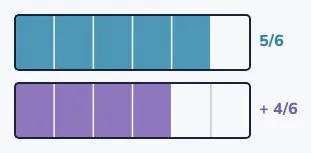
- 5/6 + 4/6. Count first, tidy after.
- 1/5 of 40?
- A third of a box is 6. How many in the whole box?
Show answer
9/6, which is 1 and 3/6: six sixths make a whole and three are left. 8: that is 40 ÷ 5. 18: a third means three equal parts and one is 6, so the whole is 6 × 3. The second and third are the same division fact read in opposite directions, which is the point of putting them together.
Counting pieces, and sharing them out
- Same-sized pieces can simply be counted.
- The bottom number is a name, so it stays put.
- "Of" means divide, and it runs backwards too.
| idea | what to remember |
|---|---|
| 3/8 + 3/8 | count the eighths: 6/8 |
| the bottom number | a name, not a quantity |
| 1.3 + 0.2 | counting tenths, same idea |
| 9/8 | count past the whole, tidy up after |
| scaling | everything multiplies together |
| 1/3 of 300 | share it into 3 → 100 |
| backwards | one part is 7, so four parts is 28 |
Is your child on track?
Take the free placement test