Tenths: the columns keep going
What this lesson covers
- The base 10 number system continues past the ones column, to the right, to create decimals such as tenths.
- Decimals are fractions that have powers of 10 as their denominators, and they can be written as numbers using a decimal point.
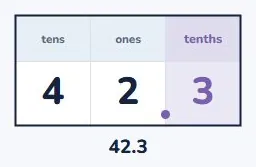
- A decimal point marks the column immediately to the right of the ones column as the tenths column.
The rule does not say to stop
- Every column is ten times the one on its right.
- So every column is a tenth of the one on its left.
- Nothing in that says to stop at the ones column.
| column | worth | as a fraction |
|---|---|---|
| hundreds | 100 | not needed |
| tens | 10 | not needed |
| ones | 1 | not needed |
| tenths | 0.1 | 1/10 |
Tenths are the next column along
- One whole, split into ten equal parts.
- Each part is one tenth.
- Not a new kind of number. The next column.

What the decimal point is for
- The point does not separate two numbers.
- It marks where the ones column ends.
- That is its whole job: telling you which column is which.
So 0.9 is bigger than 0.15 would be
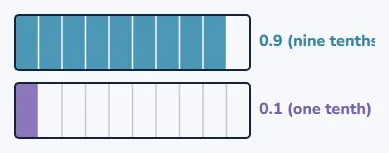
- If the point separated two numbers, 15 would beat 9.
- It does not. 0.9 is nine tenths, nearly a whole.
- Read the column, not the digits after the dot.
Fraction or decimal, same amount
- 3/10 and 0.3 are the same quantity.
- Two ways of writing it, not two numbers.
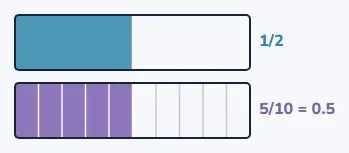
- And 5/10 is 0.5, which you already know as a half.
| fraction | decimal | you say |
|---|---|---|
| 1/10 | 0.1 | one tenth |
| 3/10 | 0.3 | three tenths |
| 5/10 | 0.5 | five tenths, or a half |
| 9/10 | 0.9 | nine tenths |
A half is five tenths
- Cut a whole into ten. Take five of them.
- That is exactly half.
- So 1/2, 5/10 and 0.5 are all the same thing.
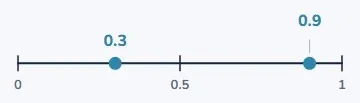
Tenths live between the whole numbers
- Between 0 and 1 there are nine tenths marks.
- 0.3 sits three of them along.
- Ordering decimals is just reading along the line.
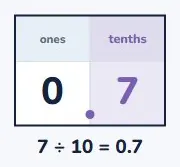
Dividing by 10 moves the digit right
- 7 ÷ 10. The 7 does not change into something else.
- It moves one column right, into the tenths.
- Now it is worth a tenth of what it was: 0.7.
Every digit shifts one place
- 40 ÷ 10 is 4. The 4 moved from tens into ones.
- 23 ÷ 10 is 2.3. Both digits moved right.
- Same move every time, whatever the number.
| divide by 10 | gives | what happened |
|---|---|---|
| 7 | 0.7 | the 7 moved into the tenths column |
| 40 | 4 | the 4 moved from tens into ones |
| 23 | 2.3 | both digits moved one column right |
Your turn
- Write 7/10 as a decimal.
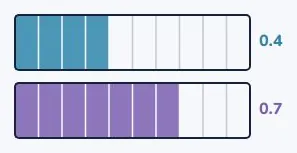
- Which is bigger: 0.4 or 0.7?
- What is 56 ÷ 10?
Show answer
0.7: seven tenths. 0.7 is bigger; both are tenths, so compare 7 and 4 in the same column, which is the only time comparing the digits after the point is safe. 5.6: both digits move one column right, so the 5 goes from tens to ones and the 6 goes from ones to tenths.
Tenths and the point
- The columns keep going past the ones.
- The point marks where the ones end.
- Dividing by 10 moves the digits, never the point.
| idea | what to remember |
|---|---|
| tenths | the next column right of the ones |
| the point | a marker, not a separator |
| 3/10 | the same as 0.3 |
| a half | 5/10, which is 0.5 |
| ÷ 10 | every digit moves one column right |
Is your child on track?
Take the free placement test