Fractions on a number line
What this lesson covers
- Tenths can be created by dividing whole numbers by 10 and can be expressed as fractions or decimals.
- Improper fractions and mixed numbers are different representations of the same quantity.
A fraction is a place
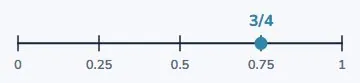
- Every fraction names a spot on the number line.
- 3/4 is three quarters of the way from 0 to 1.
- Find the spot and you have found the fraction.
The bottom number counts the cuts
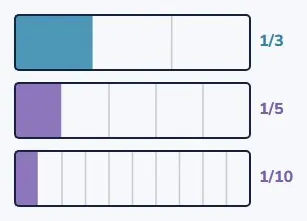
- The bottom number is an instruction: cut into this many.
- Cut a cake into 5 and the pieces are smaller than into 3.
- So 1/5 is SMALLER than 1/3. More cuts, smaller pieces.
Bigger bottom, smaller piece
- This is the one thing about fractions that feels backwards.
- It only feels backwards if you read it as a number.
- Read it as "how many pieces" and it is obvious.
| fraction | cut into | so each piece is |
|---|---|---|
| 1/3 | 3 pieces | big pieces |
| 1/5 | 5 pieces | smaller |
| 1/10 | 10 pieces | smaller again |
Same bottom? Just count
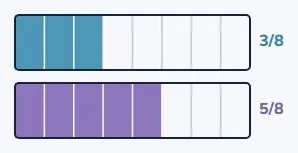
- If the bottoms match, the pieces are the same size.
- So 5/8 beats 3/8: more of the same piece.
- That is the easy case, and it is easy for a reason.
The line does not stop at 1
- 8/8 is a whole one. So what is 9/8?
- One eighth past 1. The line just keeps going.
- Nothing breaks. You walked past a whole number.
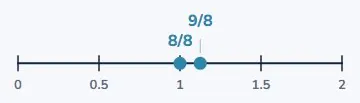
Two ways to say the same place
- 9/8 and 1 1/8 are the same spot on the line.
- One counts eighths. The other counts wholes, then eighths.
- Same place. Two spellings.
| improper | mixed number | where it lands |
|---|---|---|
| 8/8 | 1 | exactly on 1 |
| 9/8 | 1 1/8 | one eighth past 1 |
| 12/8 | 1 4/8 | halfway between 1 and 2 |
| 16/8 | 2 | exactly on 2 |
Equivalent means "lands on the same mark"
- 1/2 and 5/10 sit on exactly the same spot.
- So do 4/8 and 2/4. All of them are halfway.
- That is all equivalent means. Same place.
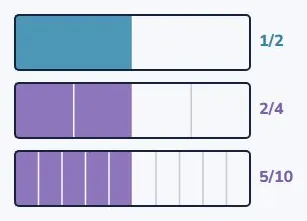
Different cuts, same amount
- Cutting a cake into more pieces does not add cake.
- Take twice the pieces from twice the cuts and you have the same.
- That is why the top and bottom move together.
| this | equals | because both land |
|---|---|---|
| 1/2 | 5/10 | halfway |
| 1/2 | 4/8 | halfway |
| 2/4 | 1/2 | halfway |
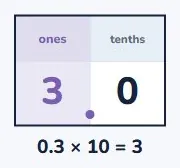
Multiplying tenths by 10
- Dividing by 10 moved digits right. This goes back.
- 0.3 × 10 moves the 3 left, into the ones. That is 3.
- One move, two directions.
Your turn
- Which is bigger: 1/4 or 1/6?
- Write 7/4 as a mixed number.
- Is 3/6 the same as 1/2?
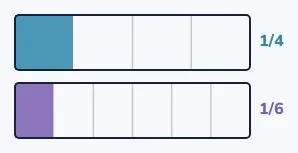
Show answer
1/4 is bigger: four cuts make bigger pieces than six, and this is the one that catches them because 6 > 4. 1 3/4: four quarters make a whole, leaving three. Yes, 3/6 is 1/2: three of six pieces is half of them, and both land on the same mark. All three are answered by the line, not a rule.
One place, several spellings
- A fraction is a place on the line.
- The bottom number counts cuts, so bigger means smaller.
- Equivalent fractions land on the same mark.
| idea | what to remember |
|---|---|
| a fraction | a place on the number line |
| the bottom number | how many pieces you cut into |
| same numerator | bigger bottom, smaller piece |
| same denominator | just count the pieces |
| 9/8 and 1 1/8 | one place, two spellings |
| equivalent | they land on the same mark |
Is your child on track?
Take the free placement test