The equals sign, inequalities and growing patterns
What this lesson covers
- The relative size of expressions involving numbers can be communicated using “greater than” (>), “less than” (<), and equals (=).
- Growing patterns can increase or decrease by the addition or subtraction of a constant (arithmetically) or multiplication or division by a constant (geometrically).
You can answer this without adding
- Is 2,456 + 203,938 bigger or smaller than 3,456 + 231,930?
- Both parts on the right are bigger than both on the left.
- So the left is smaller, and you added nothing. Read, do not calculate.
| left | right | bigger? |
|---|---|---|
| 2,456 | 3,456 | right |
| 203,938 | 231,930 | right |
What the equals sign actually means
- Equals does not mean "here comes the answer".
- It means the two sides are the same. It balances.
- Which is why it reads in both directions.
| reading "=" as | what that costs you |
|---|---|
| "here comes the answer" | you reject 7 + 5 = 6 + 6 |
| "the same as" | you accept it: both sides are 12 |
All three of these are true
- 7 + 5 = 12. Nobody argues with that one.
- 12 = 7 + 5 is equally true. The sign is not an arrow.
- 7 + 5 = 6 + 6 is true too. No single answer in sight.
| sentence | is it true? |
|---|---|
| 7 + 5 = 12 | true |
| 12 = 7 + 5 | true: it reads both ways |
| 7 + 5 = 6 + 6 | true: both sides are 12 |
When it does not balance
- Then one side is greater than the other, and you say so.
- > is greater than. < is less than.
- The pointed end always aims at the smaller number.
| symbol | means | example |
|---|---|---|
| = | the same as | 6 + 6 = 12 |
| > | greater than | 13 > 12 |
| < | less than | 11 < 12 |
Now check the opening question
- 2,456 + 203,938 is 206,394.
- 3,456 + 231,930 is 235,386.
- So the symbol is <, exactly as the comparison said.
| side | total |
|---|---|
| 2,456 + 203,938 | 206,394 |
| 3,456 + 231,930 | 235,386 |
A harder one, still no calculating
- 2,456 × 2 against 1,228 × 4.
- 2,456 is double 1,228. And 2 is half of 4.
- Double one, halve the other, and the product does not move.
| first number | second number | |
|---|---|---|
| left | 2,456 | 2 |
| right | 1,228 | 4 |
| change | halved | doubled |
Check it, once
- 2,456 × 2 = 4,912.
- 1,228 × 4 = 4,912.
- Equal. The reasoning was right, and it was quicker.
| side | value |
|---|---|
| 2,456 × 2 | 4,912 |
| 1,228 × 4 | 4,912 |
Is this sentence true?
- Work out each side separately, then compare them.
- 60 − 15 = 40 is false, because the left side is 45.
- 9 × 4 = 40 − 4 is true. Both sides come to 36.
| sentence | true or false |
|---|---|
| 45 + 30 = 75 | true |
| 60 − 15 = 40 | false: it is 45 |
| 9 × 4 = 40 − 4 | true: both are 36 |
An open sentence has something hidden
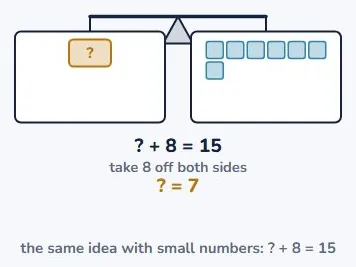
- 999,999 − ⬚ = 899,999. What is in the box?
- The balance has to stay level, so ask what was taken away.
- 999,999 down to 899,999 is a drop of 100,000.
A pattern that adds a constant
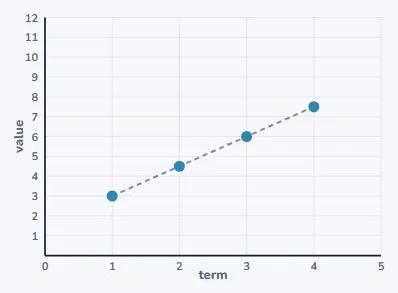
- 3, 4.5, 6, 7.5 and so on.
- Each term is 1.5 more than the one before it.
- Plot it and the points sit on a straight line.
A pattern that multiplies
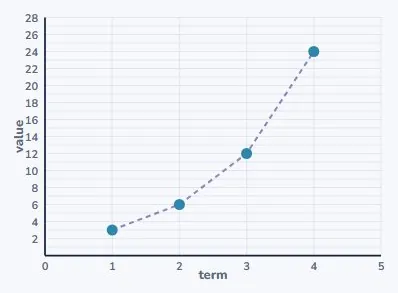
- 3, 6, 12, 24 and so on.
- Each term is double the one before, not 3 more.
- Plot that and it curves, getting steeper as it goes.
Both kinds run downhill too
- A pattern can shrink by a constant: subtract 3 each time.
- Or shrink by a constant multiple: halve it each time.
- To describe any pattern, give the first term and the rule.
| pattern | the rule |
|---|---|
| 20, 17, 14, 11 ... | subtract 3 |
| 80, 40, 20, 10 ... | divide by 2 |
Your turn
- 1. Put in <, > or =: 4,000 + 500 and 4,500 + 1.
- 2. Put in <, > or =: 6 × 8 and 12 × 4.
- 3. Fill the box: 450 + ⬚ = 1,000.
- 4. Continue and describe: 2, 5, 8, 11 ... and 1, 3, 9, 27 ...
Show answer
1. < (the right is one more). 2. = (halve 12 and double 4 gives 6 and 8, so both are 48). 3. 550. 4. 14, 17: start at 2, add 3. Then 81, 243: start at 1, multiply by 3.
What to take away
- Equals means balance, and it reads in both directions.
- Often you can decide a sentence by comparing, not calculating.
- Describe a pattern with its first term and its rule.
| job | the move |
|---|---|
| = | both sides the same |
| > or < | the point aims at the smaller side |
| a hidden number | ask what keeps it balanced |
| a growing pattern | find what is done each time |
Is your child on track?
Take the free placement test