Money: totals, change and rounding
What this lesson covers
- Money uses our decimal place-value system to two decimal places.
You already know this one
- A cent is one hundredth of a dollar. Exactly one hundredth.
- So money is decimals to two places, with a $ in front.
- Everything from the last three lessons was money all along.
| money | is really |
|---|---|
| $4.75 + $12.30 | adding decimals to 2 places |
| change from $30 | subtracting across zeros |
| about $5 | rounding |
The two places are cents
- 100 cents make a dollar, so 1c is 1/100 of a dollar.
- First place after the point: ten-cent pieces.
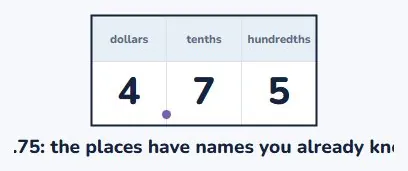
- Second place: single cents. $4.75 is 4 dollars, 7 tens, 5 ones.
Always two places
- Money never gets written with one decimal place.
- $4.7 is not wrong by a little. It is unreadable.
- Fill the second place, even when it is a zero.
| not this | this | why |
|---|---|---|
| $4.7 | $4.70 | that is 70c, not 7c |
| $4.5 | $4.50 | fifty cents needs both places |
| $.05 | $0.05 | five cents, and keep the 0 |
| $4.75c | $4.75 | a dollar sign or a c, never both |
Read the place, not the digit
- If you did write $4.7, the 7 sits in the tenths place.
- Tenths of a dollar are ten-cent pieces. So that is 70c.
- Seven cents is $0.07. One place apart, ten times apart.
| written | the 7 is in | means |
|---|---|---|
| $4.70 | tenths | 70 cents |
| $4.07 | hundredths | 7 cents |
Cents into dollars
- Going from cents to dollars is dividing by 100.
- Which means the digits move two places right.
- So 475c is $4.75, and 8c is $0.08.
| cents | dollars |
|---|---|
| 475c | $4.75 |
| 60c | $0.60 |
| 8c | $0.08 |
So why two places, with no 1c coin?
- New Zealand dropped 1c and 2c in 1990, and 5c in 2006.
- The smallest coin is 10c, so cash rounds to the nearest 10c.
- But prices and card payments are still exact to the cent.
| paying | what happens to $4.78 |
|---|---|
| by card | exactly $4.78 |
| with cash | rounded to $4.80 |
Totalling a basket
- Three things: a book, a drink and a sandwich.
- Write the prices with the points underneath each other.
- That lines up dollars with dollars and cents with cents.
| item | price |
|---|---|
| book | $12.30 |
| drink | $4.75 |
| sandwich | $6.35 |
Add the columns
- Cents: 0 + 5 + 5 = 10. Write 0, carry 1.
- Ten-cents: 3 + 7 + 3 + 1 = 14. Write 4, carry 1.
- Dollars: 12 + 4 + 6 + 1 = 23. So $23.40.
| column | add | write | carry |
|---|---|---|---|
| cents | 0 + 5 + 5 = 10 | 0 | 1 |
| ten-cents | 3 + 7 + 3 + 1 = 14 | 4 | 1 |
| dollars | 12 + 4 + 6 + 1 | 23 | 0 |
Check it before you believe it
- Round each price to the nearest dollar first.
- $12 and $5 and $6 is $23.
- We got $23.40. Close enough to trust.
| price | to the nearest dollar |
|---|---|
| $12.30 | $12 |
| $4.75 | $5 |
| $6.35 | $6 |
Rounding to the nearest dollar
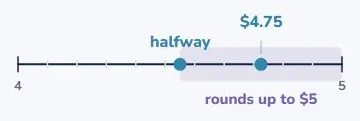
- Look only at the cents. Under 50c rounds down.
- 50c or more rounds up. Exactly 50c goes up.
- So $4.75 is about $5, and $12.30 is about $12.
Change from the nearest ten dollars
- The basket is $23.40. The next ten dollars up is $30.00.
- So you hand over thirty dollars.
- The change is $30.00 take away $23.40.
| amount | |
|---|---|
| to pay | $23.40 |
| handed over | $30.00 |
| change | ? |
Two ways, one answer
- In columns: $30.00 − $23.40 needs borrowing across both zeros.
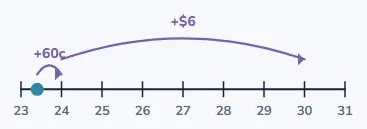
- Or count up: 60c gets you to $24, then $6 more to $30.
- Either way the change is $6.60.
Your turn
- 1. Write 6c, then 60c, then 615c, in dollars.
- 2. Total $8.45, $3.20 and $11.90.
- 3. Round each of those three to the nearest dollar.
- 4. Find the change from $30 for your total in question 2.
Show answer
1. $0.06, $0.60, $6.15. 2. $23.55. 3. $8, $3, $12, which totals $23, so question 2 looks right. 4. $30.00 − $23.55 = $6.45.
What to take away
- A cent is a hundredth, so money is just two-place decimals.
- Write both places, and line the points up before adding.
- For change, count up to the next ten dollars.
| job | the move |
|---|---|
| write money | two decimal places, always |
| total a basket | points under points, then add |
| check a total | round each price and add those |
| find change | count up to the next $10 |
Is your child on track?
Take the free placement test