Parallel and perpendicular lines, and prisms
What this lesson covers
- Parallel lines are always the same distance apart and never meet.
- Perpendicular lines intersect at right angles (90°).
- A prism is a 3D shape with two identical, parallel ends and flat faces.
Neither word describes one line
- A single line is not parallel. Parallel to what?
- Both words say how two lines sit next to each other.
- So you always mark them in pairs.
| word | what it says about a pair |
|---|---|
| parallel | always the same distance apart |
| perpendicular | they cross at a right angle |
Parallel: the same distance apart
- Measure the gap anywhere along them. It never changes.
- Because of that, they never meet, however far you extend them.
- The arrows mark which sides are parallel to which.
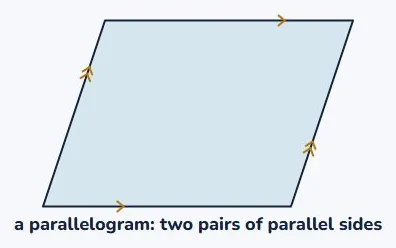
"Never meet" is not enough
- Two lines drifting slowly together also never meet on the page.
- They are not parallel. The page just ran out.
- The test is the gap, not whether you can see them touch.
| gap along the lines | parallel? |
|---|---|
| 3 cm, 3 cm, 3 cm | yes |
| 3 cm, 2 cm, 1 cm | no, they are closing |
Perpendicular: crossing at 90°
- Perpendicular lines meet at a right angle. Exactly 90°.
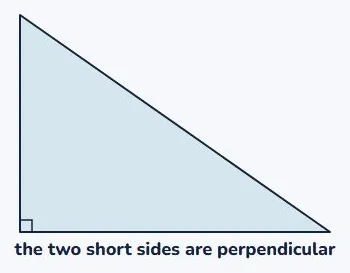
- The little square at the corner is how you show it.
- These two sides are perpendicular to each other.
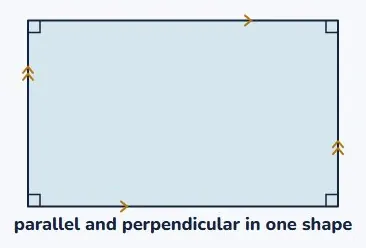
A rectangle has both
- Two pairs of parallel sides: top with bottom, left with right.
- And every corner is a right angle.
- So each side is parallel to one side and perpendicular to two.
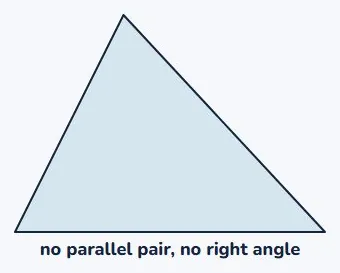
And a shape with neither
- This triangle has three different side lengths.
- No two sides are parallel, and no corner is a right angle.
- Plenty of shapes have neither. That is a real answer.
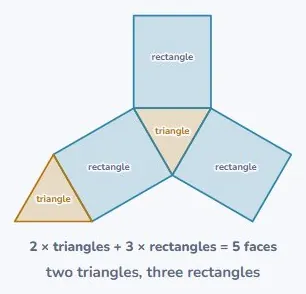
What makes a prism a prism
- Two ends that are identical to each other and parallel.
- And every other face flat: rectangles joining the ends.
- Unfold one and you can see both conditions at once.
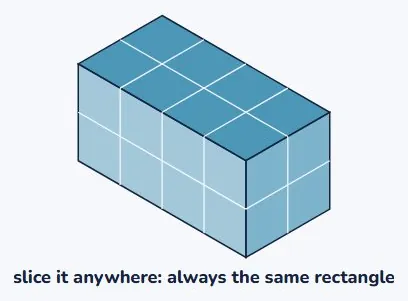
The cross section never changes
- Slice a prism anywhere between its two ends.
- You always get the same shape as the ends.
- That constant shape is called the cross section.
The cross section gives the name
- A triangle cross section makes a triangular prism.
- A hexagon makes a hexagonal prism. No exceptions.
- A cube is a prism too; its cross section is a square.
| cross section | the solid is called |
|---|---|
| triangle | triangular prism |
| square | cube, or square prism |
| rectangle | rectangular prism (a cuboid) |
| pentagon | pentagonal prism |
| hexagon | hexagonal prism |
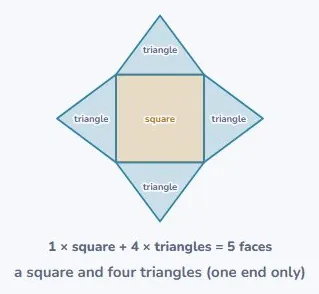
Two ways to fail the test
- A pyramid fails: one end is a point, not a copy of the other.
- A cylinder has a constant cross section, but no flat sides.
- Both conditions have to hold, not just one.
Faces, edges and vertices
- A face is a flat surface. An edge is where two faces meet.
- A vertex is a corner, where edges meet.
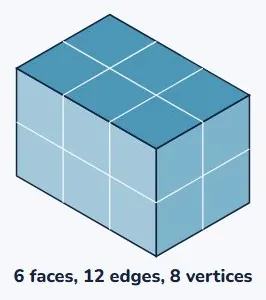
- This cuboid has 6 faces, 12 edges and 8 vertices.
Count them from the cross section
- Do not memorise three numbers per solid. Count from n.
- n sides plus 2 ends. n edges round each end plus n joining.
- And n corners at each end. So n + 2, 3n and 2n.
| part | how many | why |
|---|---|---|
| faces | n + 2 | n sides, plus the two ends |
| edges | 3n | n round each end, n joining them |
| vertices | 2n | n corners at each end |
It works on every prism
- A hexagonal prism: n is 6, so 8 faces and 18 edges.
- And 12 vertices. You never had to look at one.
- Notice each column grows by a constant: a pattern, as last lesson.
| n | prism | faces | edges | vertices |
|---|---|---|---|---|
| 3 | triangular | 5 | 9 | 6 |
| 4 | rectangular | 6 | 12 | 8 |
| 5 | pentagonal | 7 | 15 | 10 |
| 6 | hexagonal | 8 | 18 | 12 |
Your turn
- 1. How many pairs of parallel sides has a square? Right angles?
- 2. Two lines are 4 cm apart, then 4 cm, then 3 cm. Parallel?
- 3. An octagonal prism: faces, edges and vertices?
- 4. Why is a cone not a prism? Give both reasons.
Show answer
1. Two pairs, and four right angles. 2. No, the gap changes, so they are closing. 3. n = 8, so 10 faces, 24 edges, 16 vertices. 4. Its two ends are not identical (one is a point) and its side is curved, not flat.
What to take away
- Parallel means the same distance apart, always, both ways.
- Perpendicular means crossing at exactly 90°.
- A prism is named by its cross section, and counted from it.
| job | the move |
|---|---|
| parallel? | measure the gap in two places |
| perpendicular? | look for exactly 90° |
| is it a prism? | identical parallel ends, all faces flat |
| count the parts | n + 2 faces, 3n edges, 2n vertices |
Is your child on track?
Take the free placement test