Nets, reflections, rotations and grid maps
What this lesson covers
- A net is a 2D representation of the surfaces of a 3D unfolded shape.
- A reflection is when a shape is flipped over a line, creating a mirror image.
- A translation is when a shape is slid from one place to another without being turned.
- A rotation is when a shape is turned around a fixed point.
- An alphanumeric grid reference is a system that divides a map into labelled rows (letters) and columns (numbers), so that each square can be identified by combining a letter and a number (e.g. A1, B2).
"Rotate it 90°" is not an instruction
- Rotate it about which point? And which way round?
- Saying what happened to a shape needs more than a word.
- This lesson is about saying exactly where, and exactly how.
| what someone says | what is missing |
|---|---|
| "reflect it" | in which line? |
| "rotate it 90°" | about which point, and which way? |
| "move it 4 squares" | in which direction? |
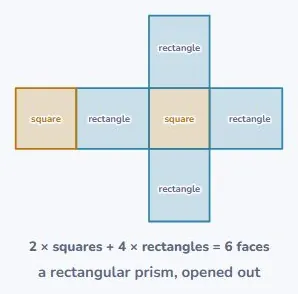
A net is a solid, laid flat
- Cut along enough edges and a 3D shape opens out flat.
- What you get is a net: every surface, in one piece.
- Fold it back up and you have the solid again.
Try it: fold the net
Count the faces first
- To match a solid to its net, count faces before anything else.
- A cube needs 6 squares. Four squares cannot be a cube.
- Then check the shapes of the pieces, and only then the folding.
| solid | faces | so the net has |
|---|---|---|
| cube | 6 | 6 squares |
| triangular prism | 5 | 2 triangles, 3 rectangles |
| square pyramid | 5 | 1 square, 4 triangles |
| tetrahedron | 4 | 4 triangles |
Same pieces, different solid
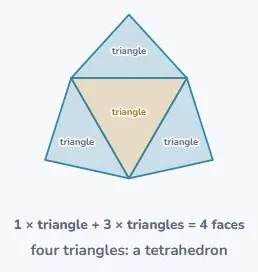
- Four triangles fold into a tetrahedron.
- But a square pyramid also uses triangles, four of them.
- The difference is the base. So count, then look.
A translation is a slide
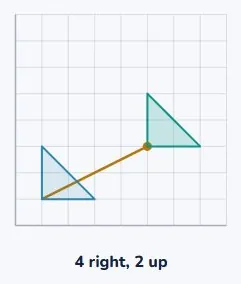
- The shape slides. It does not turn and it does not flip.
- Every point moves the same distance in the same direction.
- To describe it: how far, and which way. 4 right and 2 up.
A reflection is a flip
- The shape flips over a line and becomes a mirror image.
- You must say which line, or the instruction means nothing.
- Here the mirror is the vertical line through 4.
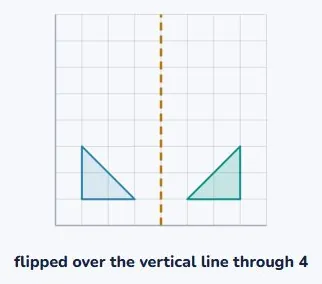
How to check a reflection
- Every point ends up as far from the line as it started.
- On the other side of it. So measure, do not eyeball.
- And a point sitting on the line does not move at all.
| point | distance from the line | image |
|---|---|---|
| 3 squares left | 3 | 3 squares right |
| 1 square left | 1 | 1 square right |
| on the line | 0 | stays put |
A rotation is a turn
- The shape turns around a fixed point, called the centre.
- The centre can be on the shape, or off it entirely.
- Here: 90° anticlockwise about the corner of the triangle.
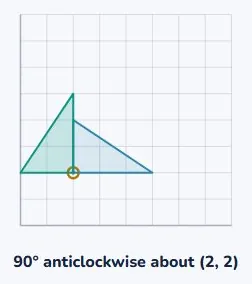
A rotation needs three things
- The centre it turns about. The angle. And the direction.
- Clockwise and anticlockwise land in different places.
- Miss any one of the three and nobody can follow you.
| transformation | in plain words | you must also say |
|---|---|---|
| translation | a slide | how far, and which way |
| reflection | a flip | where the mirror line is |
| rotation | a turn | the centre, the angle, the direction |
Try it: flip, slide and turn
What none of them change
- All three move a shape without resizing it.
- So the side lengths and the angles are untouched.
- If your image is a different size, something went wrong.
| does it change? | answer |
|---|---|
| size | never |
| shape | never |
| position | always |
| which way it faces | only for a flip or a turn |
Two moves, one after the other
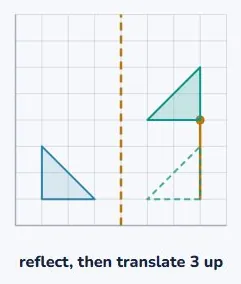
- First flip it over the line through 4.
- Then slide that image 3 squares up.
- Here the order does not matter, because the slide goes the same way as the mirror line. A sideways slide would change the answer.
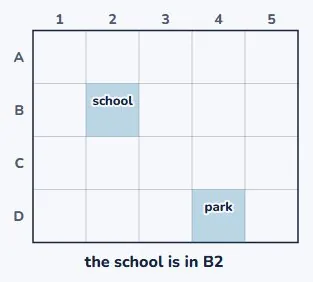
Naming a square on a map
- The rows get letters and the columns get numbers.
- So a reference is a letter then a number: B2.
- And it names a whole square, not a single point.
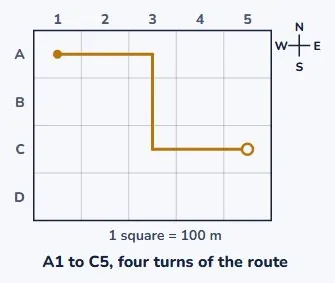
Describing a route
- Give the squares in order, or give the directions.
- From A1: go east 2, then south 2, then east 2.
- North, south, east and west beat "left" and "right" on a map.
Common mistakes
- The triangle was rotated 90°.Give all three: the centre, the angle and the direction, e.g. 90° anticlockwise about the corner of the triangle.
- These 5 squares fold into a cube.Count the faces first: a cube has 6 square faces, so a net with only 5 squares cannot be a cube.
- The point 3 squares left of the mirror line lands 1 square right of it.Every point ends up as far from the mirror line as it started, so it lands 3 squares right.
- From A1, go left 2, then down 2.On a map use compass points, east 2 then south 2, because left and right change with the way you face.
Your turn
1
How many squares in the net of a cube? And of a cuboid?
2
What is missing from "reflect the triangle"?
3
A shape slides 3 left and 1 down. Name the transformation.
4
On a 5-column grid, which square is two east of B1?
Show answer
1. Six squares for a cube; a cuboid also needs 6 rectangles. 2. The mirror line. 3. A translation, and "3 left, 1 down" is the description. 4. B3.
What to take away
- A net is every face of a solid, laid out flat.
- Slide, flip, turn. And each needs its own extra detail.
- A grid reference is a letter and a number, naming a square.
| job | the move |
|---|---|
| match a net | count the faces first |
| translation | say how far and which way |
| reflection | say where the mirror line is |
| rotation | say centre, angle and direction |
Practise this
Worksheet with answersWithout answersDownload PDF
Report a mistake
More in Geometry
Is your child on track?
Take the free placement test