Collecting data: rounding rules and paired variables

What this lesson covers
- Measurements for continuous numerical data need to have the place value for rounding specified (e.g. to the nearest centimetre).
- Bivariate data is data in a set that has two variables for each subject (e.g. dislikes and gender for each student).
Data does not arrive. Somebody collects it.
- And the choices made while collecting decide what you can find out.
- There are two of them, and neither can be fixed later.
- How precisely you measure, and whether you record the pairing.
| decision | if you get it wrong |
|---|---|
| how precisely to measure | the set does not agree with itself |
| what to pair together | a question becomes unanswerable |
Continuous data comes from measuring
- Counting gives whole numbers: 12 children, 3 dogs.
- Measuring does not. A height can be any value in a range.
- Here are seven real heights, in centimetres.
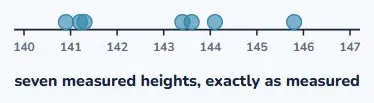
The rounding is agreed first
- The curriculum says the place value must be specified.
- Specified, not just done. That is a claim about the order.
- You agree the rule before anybody picks up a tape measure.
| who measures | their rule | what they write down |
|---|---|---|
| first | nearest cm | 144 cm |
| second | nearest mm | 143.6 cm |
| third | nearest 10 cm | 140 cm |
Why afterwards is too late
- You can always round a fine measurement more coarsely.
- You can never get back millimetres you did not write down.
- So the rule goes in the plan, and next to the data.
| you recorded | can you get | to the nearest cm? |
|---|---|---|
| 143.6 cm | yes | 144 cm |
| 140 cm | no | it could be 136 to 144 |
Applying the rule
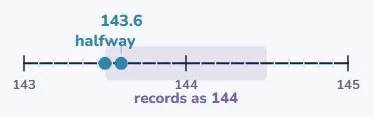
- To the nearest centimetre: look at the millimetres.
- 143.6 is past halfway between 143 and 144.
- So it is recorded as 144 cm.
What the rule does to the whole set
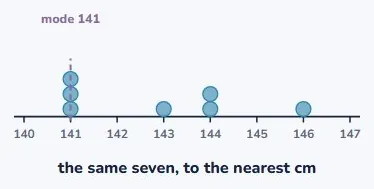
- Apply it to all seven, and the dots land on whole numbers.
- Three of them are now the same value: 141.
- You lost detail. You gained a set you can work with.
Too precise is also wrong
- Measuring a field to the nearest millimetre is not careful.
- It is a lie about how well you measured. The tape sags.
- Match the precision to what you can actually do.
| measuring | round to | why |
|---|---|---|
| a pencil | nearest mm | a ruler can do it |
| your height | nearest cm | you move more than a mm |
| a sports field | nearest m | the tape sags anyway |
Two things about each person
- Bivariate data has two variables for every subject.
- Here: what each student does at lunchtime, and their gender.
- One row per student, with both values on that row.
| student | at lunchtime | gender |
|---|---|---|
| Aroha | sport | girl |
| Ben | library | boy |
| Mele | sport | girl |
| Tane | sport | boy |
The mistake that cannot be undone
- Tally lunchtime activities. Then tally boys and girls.
- You have collected both variables, and lost the link.
- "Do more boys than girls play sport?" is now unanswerable.
| what you have | what you can ask |
|---|---|
| 12 play sport | how many play sport |
| 12 boys, 15 girls | how many boys there are |
| both, separately | nothing about the two together |
Recorded properly, you can ask
- With the pairing kept, the tally has rows and columns.
- Now: 7 boys play sport and 5 girls do.
- And the library is the other way round: 2 boys, 6 girls.
| at lunchtime | boys | girls | total |
|---|---|---|---|
| sport | 7 | 5 | 12 |
| library | 2 | 6 | 8 |
| talking | 3 | 4 | 7 |
Both variables here are categories
- Lunchtime activity is a category, not a number.
- So is gender. Neither can be averaged or measured.
- Paired categories are what you count into a two-way table.
| variable | kind | you can |
|---|---|---|
| height | continuous number | measure and round it |
| lunchtime activity | category | count how many |
| gender | category | count how many |
Check it adds up
- Every subject appears exactly once, in exactly one cell.
- So the cells must total the number of people you asked.
- 12 + 8 + 7 is 27. If your class is 27, the table is complete.
| check | value |
|---|---|
| sport + library + talking | 12 + 8 + 7 = 27 |
| boys + girls | 12 + 15 = 27 |
| people in the class | 27 |
Your turn
- 1. Round 156.4 cm and 156.5 cm to the nearest centimetre.
- 2. What precision would you use for the length of a room?
- 3. Name the two variables in "pets owned, and year level".
- 4. A two-way table totals 24 across and 26 down. What is wrong?
Show answer
1. 156 cm and 157 cm: exactly halfway rounds up. 2. Nearest centimetre, or nearest 10 cm. Millimetres would be pretending. 3. Number of pets (a count) and year level (a category). 4. Someone has been counted twice, or missed. Both totals must match.
What to take away
- Agree the rounding before you measure, and record the rule.
- Bivariate means both values on one row, per subject.
- A pairing you did not write down cannot be recovered.
| job | the move |
|---|---|
| continuous data | specify the place value first |
| choosing precision | match what you can actually measure |
| two variables | one row per subject, both values |
| checking a table | totals must agree both ways |
Is your child on track?
Take the free placement test