Adding fractions and decimals, and fractions of amounts
What this lesson covers
- Fractions should have the same denominator before using them in addition or subtraction.
- Multiplication, division, fractions, decimals, and percentages can be used to solve problems involving relative quantities and measures.
Pieces have to be the same size
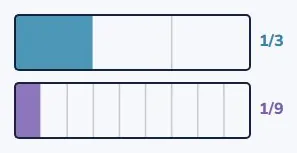
- You cannot add thirds to ninths as they stand.
- The pieces are different sizes, so counting them means nothing.
- Make them match, and then it is only counting.
Match the bottom number first
- Fractions need the same denominator before you add them.
- The bottom says how big the pieces are.
- Same bottom, same size pieces, and the tops can be added.
| this | not this |
|---|---|
| 6/9 + 1/9 | 2/3 + 1/9 |
| add the tops | nothing to add yet |
Rewrite one of them
- 2/3 + 1/9. Nine is a multiple of three.
- So multiply top and bottom of the thirds by 3.
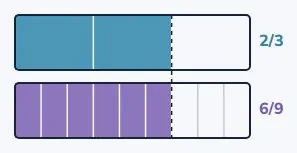
- 2/3 becomes 6/9. Same amount, new name.
Now add the tops
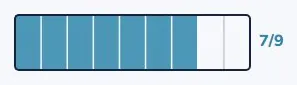
- 6/9 + 1/9. Six ninths and one more ninth.
- That is 7/9.
- The bottom never changes. You are counting pieces, not making them.
Subtraction is the same job
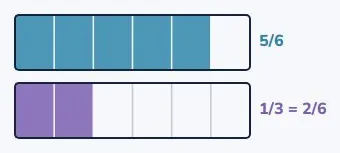
- 5/6 − 1/3. Sixths and thirds.
- 6 is a multiple of 3, so 1/3 becomes 2/6.
- 5/6 − 2/6 = 3/6, which is a half.
Decimals need exactly the same thing
- You cannot add tenths to hundredths as they stand either.
- Lining up the decimal points lines up the places.
- It is not a second rule. It is the same rule.
| fractions | decimals |
|---|---|
| match the denominators | line up the points |
| then add the tops | then add each column |
Adding to two places
- 1.31 + 0.22. Points under points.
- Hundredths: 1 + 2 = 3. Tenths: 3 + 2 = 5.
- Ones: 1 + 0 = 1. So 1.53.
| ones | tenths | hundredths | |
|---|---|---|---|
| 1.31 | 1 | 3 | 1 |
| 0.22 | 0 | 2 | 2 |
| 1.53 | 1 | 5 | 3 |
When the lengths do not match
- 4.6 − 1.25. One has a hundredths digit, one does not.
- Write 4.6 as 4.60. That free zero again.
- Now every column subtracts: 3.35.
| ones | tenths | hundredths | |
|---|---|---|---|
| 4.60 | 4 | 6 | 0 |
| 1.25 | 1 | 2 | 5 |
| 3.35 | 3 | 3 | 5 |
A fraction of an amount
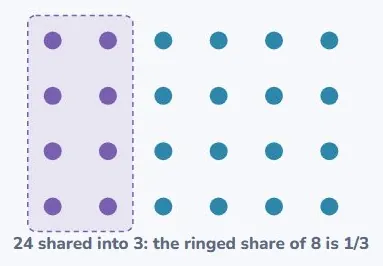
- 2/3 of 24. The bottom tells you to share into 3.
- 24 shared into 3 is 8. That is one third.
- The top tells you how many of those you want.
Divide by the bottom, times by the top
- One third of 24 is 8.
- Two thirds is two lots of that, so 16.
- Down to one piece, then up to as many as you need.
| step | working | result |
|---|---|---|
| share into 3 | 24 ÷ 3 | 8 |
| take 2 of them | 8 × 2 | 16 |
Backwards: the part is given
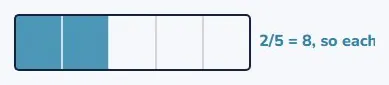
- 8 is 2/5 of a set. How big is the set?
- Two fifths is 8, so one fifth is 4.
- Five fifths is five lots of 4, so the set is 20.
Percentages of a number
- 10% of 340: move the digits one place right, so 34.
- 50% is just half, so 170.
- 25% is half of that half, so 85. No written working needed.
| find | of 340 | how |
|---|---|---|
| 10% | 34 | digits one place right |
| 50% | 170 | halve it |
| 25% | 85 | halve it twice |
Backwards again: finding 100%
- If 25% is 15, then 100% is four lots of 15, so 60.
- If 50% is 15, then 100% is two lots of 15, so 30.
- Same move as the fractions. Get to one piece, then build up.
| given | reasoning | 100% |
|---|---|---|
| 25% is 15 | so 100% is 4 lots of 15 | 60 |
| 50% is 15 | so 100% is 2 lots of 15 | 30 |
Your turn
- 1. 3/4 + 1/8, and then 7/10 − 1/5.
- 2. 2.45 + 1.3, and then 5.2 − 0.86.
- 3. 3/5 of 45.
- 4. If 12 is 3/4 of a set, how big is the set? And 25% of 80?
Show answer
1. 6/8 + 1/8 = 7/8, and 7/10 − 2/10 = 5/10 which is a half. 2. 2.45 + 1.30 = 3.75, and 5.20 − 0.86 = 4.34. 3. 45 ÷ 5 = 9, and 9 × 3 = 27. 4. One quarter is 4, so the set is 16. And 25% of 80 is 20.
What to take away
- Same size pieces before you add. Fractions and decimals both.
- For a fraction of an amount: divide by the bottom, times the top.
- Working backwards, get to one piece first, then build up.
| job | the move |
|---|---|
| add fractions | match the bottoms, add the tops |
| add decimals | line up the points, pad with a zero |
| fraction of an amount | divide by the bottom, times the top |
| find the whole | down to one piece, then up to all |
Is your child on track?
Take the free placement test