Adding and subtracting big numbers
What this lesson covers
- Addition and subtraction can be carried out mentally, using known facts, place value and partitioning, or column methods.
- Standard written algorithms (e.g. column addition, column subtraction) rely on place value, regrouping, and renaming.
Four ways, not one
- There is more than one way to add two numbers.
- The curriculum names four of them.
- The skill is choosing, not memorising one method.
| method | use it when |
|---|---|
| known facts | you already know the answer |
| place value | the numbers are round |
| partitioning | you can split one of them up |
| columns | it is too awkward to hold in your head |
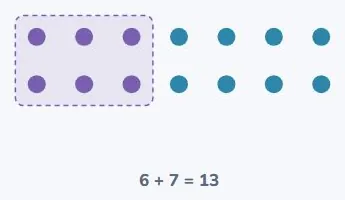
Known facts come free
- 6 + 7 = 13. You do not work that out.
- You remember it, and that is the fastest method there is.
- Every other method leans on facts like this one.
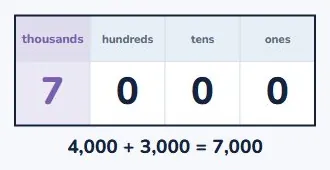
Round numbers use place value
- 4,000 + 3,000. Do not reach for a pencil.
- 4 thousands plus 3 thousands is 7 thousands.
- The same fact, 4 + 3, moved up a place.
Split one of them up
- 2,350 + 1,400 looks awkward.
- Split the 1,400 into 1,000 and 400.
- 2,350 + 1,000 is 3,350. Then + 400 is 3,750.
| step | running total |
|---|---|
| start | 2,350 |
| add 1,000 | 3,350 |
| add 400 | 3,750 |
When to give up and write it down
- Those three work when the numbers are kind.
- 4,678 + 2,565 is not kind. Too much to hold.
- That is what the column method is for.
| sum | how | answer |
|---|---|---|
| 6 + 7 | known fact | 13 |
| 4,000 + 3,000 | place value: 4 + 3 thousands | 7,000 |
| 2,350 + 1,400 | partition: 2,350 + 1,000 + 400 | 3,750 |
Columns line up place value
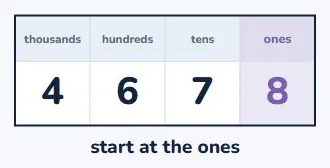
- Write one number above the other, ones under ones.
- The columns are not tidiness. They are place value.
- Then add one column at a time, starting from the right.
A carry is a rename
- 8 + 5 = 13. That will not fit in the ones column.
- 13 ones is 1 ten and 3 ones. Write 3, carry the 1.
- Nothing was invented. Ten ones were renamed as one ten.
| column | add | write | carry |
|---|---|---|---|
| ones | 8 + 5 = 13 | 3 | 1 |
| tens | 7 + 6 + 1 = 14 | 4 | 1 |
| hundreds | 6 + 5 + 1 = 12 | 2 | 1 |
| thousands | 4 + 2 + 1 = 7 | 7 | 0 |
Check it roughly
- Round both numbers before you trust the answer.
- 4,678 is about 5,000. 2,565 is about 2,500.
- About 7,500. Our answer was 7,243, so it is believable.
| exact | rounded |
|---|---|
| 4,678 | 5,000 |
| 2,565 | 2,500 |
| 7,243 | about 7,500 |
Subtraction renames too
- 5,003 − 1,476. Start at the ones: 3 − 6 will not go.
- So borrow. But the tens are 0, and so are the hundreds.
- Go to the thousands, and rename all the way down.
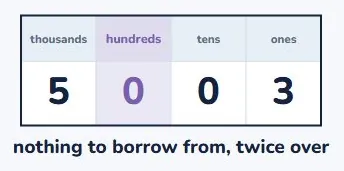
Rename across the zeros
- 5,003 is 4 thousands, 9 hundreds, 9 tens and 13 ones.
- The number did not change. Only its name did.
- Now every column subtracts: 3,527.
| column | take away | left |
|---|---|---|
| ones | 13 − 6 | 7 |
| tens | 9 − 7 | 2 |
| hundreds | 9 − 4 | 5 |
| thousands | 4 − 1 | 3 |
Add it back to be sure
- A subtraction can always be checked by adding.
- 3,527 + 1,476 should give 5,003.
- If it does not, the borrowing went wrong somewhere.
| check | result |
|---|---|
| 3,527 + 1,476 | 5,003 |
| matches the start? | yes |
Your turn
- 1. In your head: 5,000 + 2,000, then 3,240 + 1,500.
- 2. In columns: 3,847 + 1,976.
- 3. In columns: 6,002 − 2,438.
- 4. Check your answer to question 3 by adding.
Show answer
1. 7,000 and 4,740. 2. 5,823. 3. 3,564. 4. 3,564 + 2,438 = 6,002, so it is right.
What to take away
- Four methods. Pick the one the numbers suit.
- A carry or a borrow is a rename, not a trick.
- Round to check an addition, add to check a subtraction.
| method | use it when |
|---|---|
| known facts | you already know the answer |
| place value | the numbers are round |
| partitioning | you can split one of them up |
| columns | it is too awkward to hold in your head |
Is your child on track?
Take the free placement test