Multiplying and dividing by 10 and 100
What this lesson covers
- Percentages are decimal fractions with denominators of 100; they are represented using the percent (%) symbol.
The point does not move
- 7 ÷ 10 = 0.7. And 0.36 × 100 = 36.
- You were probably told to move the decimal point.
- It does not move. The digits do. Here is why that matters.
| what you were told | what actually happens |
|---|---|
| move the point | move the digits |
Divide by 10: one place right
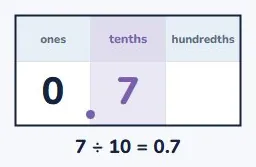
- 7 ÷ 10. The 7 is worth ten times less than it was.
- So it moves out of the ones and into the tenths.
- The answer is 0.7. Seven ones became seven tenths.
Divide by 100: two places right
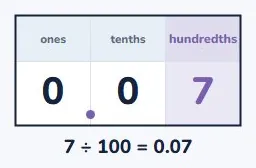
- 7 ÷ 100 moves the 7 two columns instead of one.
- Out of the ones, past the tenths, into the hundredths.
- So 7 ÷ 100 = 0.07, and 45 ÷ 100 = 0.45.
Why the point is nailed down
- The point marks where ones stop and tenths start.
- That boundary is a fact about the number system.
- It is not a thing that slides about. The digits travel.
| calculation | answer | what moved |
|---|---|---|
| 7 ÷ 10 | 0.7 | 7 ones become 7 tenths |
| 7 ÷ 100 | 0.07 | 7 ones become 7 hundredths |
| 45 ÷ 100 | 0.45 | each digit moves two places |
Multiply: the same rule, leftwards
- × 10 makes every digit worth ten times more.
- So each digit shifts one column left. 0.36 × 10 = 3.6.
- × 100 shifts them two. 0.36 × 100 = 36.
| calculation | answer | shift |
|---|---|---|
| 0.36 × 10 | 3.6 | one place left |
| 0.36 × 100 | 36 | two places left |
| 2.05 × 10 | 20.5 | one place left |
This is where "add a zero" breaks
- 36 × 10 = 360, and a zero appears. That is luck.
- 0.36 × 10 = 3.6, and no zero appears anywhere.
- Both are one shift left. Only one grows a zero.
| start | × 10 | a zero? |
|---|---|---|
| 36 | 360 | yes |
| 0.36 | 3.6 | no |
| 2.05 | 20.5 | no |
A percentage is a hundredth
- Percentages are decimal fractions with denominator 100.
- The % symbol is shorthand for "out of a hundred".
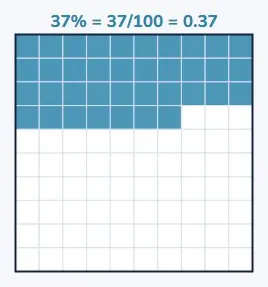
- So 37% = 37/100 = 0.37. Any number works, not just the tidy ones.
Watch the small ones
- 7% is 7 hundredths, so it is 0.07.
- Not 0.7. That would be 70%, ten times bigger.
- Count the places, do not count the digits.
| percent | fraction | decimal |
|---|---|---|
| 7% | 7/100 | 0.07 |
| 70% | 70/100 | 0.7 |
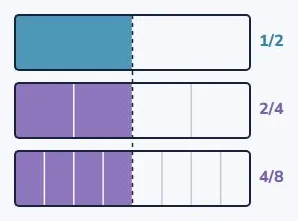
Families of equivalent fractions
- Multiply the top and the bottom by the same number.
- The fraction looks different and the amount does not change.
- 1/2 = 2/4 = 3/6 = 4/8 = 5/10. One family, one amount.
Comparing when one bottom is a multiple
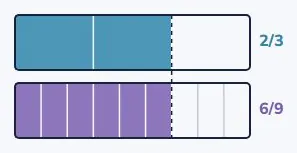
- 2/3 against 5/9. Thirds and ninths.
- 9 is a multiple of 3, so rewrite the thirds as ninths.
- Multiply top and bottom by 3: 2/3 = 6/9.
Now it is just counting
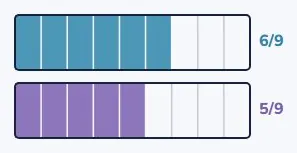
- 6/9 against 5/9.
- Same size pieces, so count them: 6 beats 5.
- So 2/3 is bigger than 5/9.
More than a whole
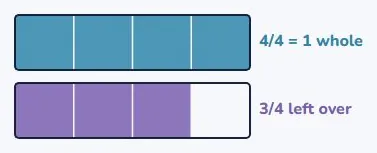
- 7/4 means seven quarters. But four make a whole.
- So it is one whole bar and three quarters of a second.
- 7/4 and 1 3/4 are the same number.
Converting, both directions
- 7/4: how many 4s in 7? One, with 3 left. So 1 3/4.
- Back again: 1 whole is 4 quarters, plus 3 more is 7.
- Multiply the whole by the bottom, then add the top.
| improper | working | mixed |
|---|---|---|
| 7/4 | 7 ÷ 4 = 1 r 3 | 1 3/4 |
| 11/3 | 11 ÷ 3 = 3 r 2 | 3 2/3 |
| 9/2 | 9 ÷ 2 = 4 r 1 | 4 1/2 |
Your turn
- 1. Work out 8 ÷ 10, then 8 ÷ 100, then 62 ÷ 100.
- 2. Work out 0.42 × 10, then 0.42 × 100.
- 3. Which is bigger, 3/4 or 5/8?
- 4. Write 13/5 as a mixed number.
Show answer
1. 0.8, 0.08, 0.62. 2. 4.2 and 42. 3. 3/4 = 6/8, and 6 beats 5, so 3/4. 4. 13 ÷ 5 = 2 r 3, so 2 3/5.
What to take away
- Digits move, the point stays. Left for ×, right for ÷.
- A percentage is a number of hundredths, and % says so.
- Match the bottoms before comparing. Then just count.
| job | what to do |
|---|---|
| ÷ 10 or ÷ 100 | digits right 1 or 2 places |
| × 10 or × 100 | digits left 1 or 2 places |
| compare fractions | rewrite so the bottoms match |
| improper to mixed | divide, keep the remainder |
Is your child on track?
Take the free placement test