Patterns, rules and the coordinate plane
What this lesson covers
- Inequalities can also include 'or equal to' (≤, ≥) to show a relationship that allows for the possibility of equality.
- Tables provide a way of organising the positions and elements of a pattern to reveal relationships or rules.
- A coordinate plane is formed when two perpendicular number lines intersect at (0, 0); usually the coordinate plane consists of a horizontal x-axis and a vertical y-axis.
- Coordinates are represented as (x,y), where the x-value represents horizontal movement and the y-value represents vertical movement. Plotting points on a coordinate plane can help to visualise numeric patterns.
Square tables pushed into a row
- One table on its own seats four people.
- Push a second one against it and the row seats six.
- Not eight: two seats get lost where they join.
- So how many does a row of twenty-five tables seat?
Keep going and watch what happens
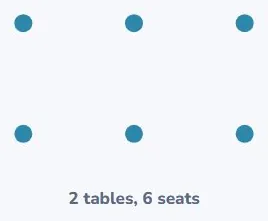
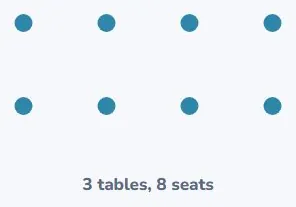
- Three tables seat eight. Four seat ten.
- Every extra table adds exactly two more seats.
- One along each side, and none on the joins.
Put it in a table to see it
- One column for the position, one for the answer.
- Now the pattern is lined up instead of remembered.
- A table is how you make a rule findable.
| Tables | Seats |
|---|---|
| 1 | 4 |
| 2 | 6 |
| 3 | 8 |
| 4 | 10 |
The gap is always two
- 4, 6, 8, 10, 12: up two every time.
- A constant difference means a simple rule exists.
- And the two is the two side seats per table.
| Tables | Seats | Gap |
|---|---|---|
| 1 | 4 | |
| 2 | 6 | +2 |
| 3 | 8 | +2 |
| 4 | 10 | +2 |
The rule, in words
- Two seats for every table: that is the "up two each time".
- Plus two more, one at each end of the row.
- So: double the number of tables, then add two.
- Those two end seats are the "plus two". You can point at them.
| Tables | Double it | Add 2 | Seats |
|---|---|---|---|
| 3 | 6 | +2 | 8 |
| 5 | 10 | +2 | 12 |
Now answer the original question
- Twenty-five tables. Double it: fifty.
- Add two: fifty-two seats.
- We never drew twenty-five tables. The rule did it.
- That is a conjecture: a prediction the rule lets you make.
| Tables | Working | Seats |
|---|---|---|
| 10 | 20 + 2 | 22 |
| 25 | 50 + 2 | 52 |
Always test a rule on a case you know
- Try the rule on 2 tables: double is 4, plus 2 is 6.
- And we counted 6 at the start. It agrees.
- A rule that fails a case you already know is wrong.
| Tables | Rule says | We counted |
|---|---|---|
| 1 | 4 | 4 |
| 2 | 6 | 6 |
| 3 | 8 | 8 |
Less than, and less than or equal to
- You know < and >. They mean strictly smaller and strictly bigger.
- ≤ and ≥ add three words: "or equal to".
- The little line underneath is the "or equal to".
| Symbol | Means |
|---|---|
| < | smaller than |
| ≤ | smaller than, or the same |
| > | bigger than |
| ≥ | bigger than, or the same |
Why those three words matter
- Is 5 < 5? No. Five is not smaller than five.
- Is 5 ≤ 5? Yes, because "or equal to" allows it.
- Same two numbers, opposite answers.
- So the symbol has to be read carefully, not skimmed.
| Sentence | True? |
|---|---|
| 5 < 5 | false |
| 5 ≤ 5 | true |
Is 8 × 7 ≤ 8 × 5 + 4² true?
- Work out each side, respecting the order of operations.
- Left: 8 × 7 = 56.
- Right: the square first, 4² = 16. Then 8 × 5 = 40. So 40 + 16 = 56.
- 56 ≤ 56 is true, and only because of the "or equal to".
| Side | Working | Value |
|---|---|---|
| Left | 8 × 7 | 56 |
| Right | 40 + 16 | 56 |
One symbol, opposite answers
- Is 3 × 6 > 2 × 9? Both sides are 18.
- 18 > 18 is false. Eighteen is not bigger than itself.
- But 3 × 6 ≥ 2 × 9 is true.
- Same six numbers. One extra line. Different answer.
| Sentence | Becomes | True? |
|---|---|---|
| 8 × 7 ≤ 8 × 5 + 4² | 56 ≤ 56 | true |
| 3 × 6 > 2 × 9 | 18 > 18 | false |
| 3 × 6 ≥ 2 × 9 | 18 ≥ 18 | true |
Completing an open sentence
- Fill the gap: 5 × ? = 45 − 5.
- Do the side you can first: 45 − 5 = 40.
- So 5 × ? = 40, which means ? is 8.
- Simplify one side, then the gap is obvious.
| Step | Sentence |
|---|---|
| Given | 5 × ? = 45 − 5 |
| Simplify the right | 5 × ? = 40 |
| Answer | ? = 8 |
Two number lines, crossed
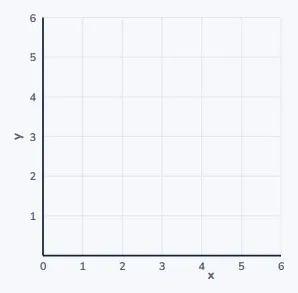
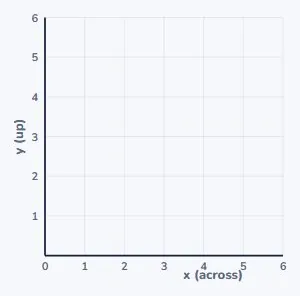
- Take a horizontal number line and a vertical one.
- Cross them at zero, at right angles.
- That is a coordinate plane, and the crossing point is (0, 0).
The x-axis and the y-axis
- The horizontal one is the x-axis.
- The vertical one is the y-axis.
- x goes across. y goes up. That order never changes.
Along the corridor, then up the stairs
- A point is written (x, y), always in that order.
- The first number is how far across.
- The second is how far up.
- Along the corridor, then up the stairs.
Plotting (3, 5)
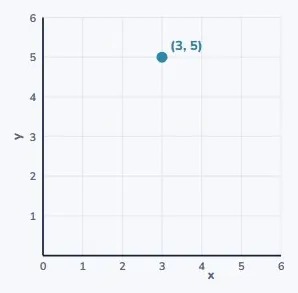
- Start at (0, 0). Count 3 across.
- Then count 5 up from there.
- Mark the point. That is (3, 5).
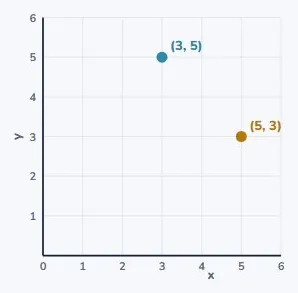
- Get the order wrong and you land on (5, 3), somewhere else entirely.
Points that sit on an axis
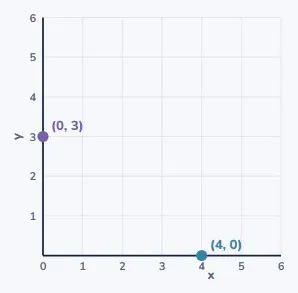
- (4, 0) means 4 across and none up: it sits on the x-axis.
- (0, 3) means none across and 3 up (on the y-axis).
- A zero does not mean the point is missing.
- It means no movement in that direction.
Now plot the tables
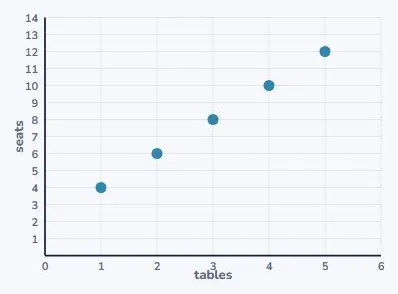
- Tables across, seats up. Each row of the table is one point.
- 1 table and 4 seats is the point (1, 4).
- Then (2, 6), (3, 8), (4, 10), (5, 12).
They make a straight line
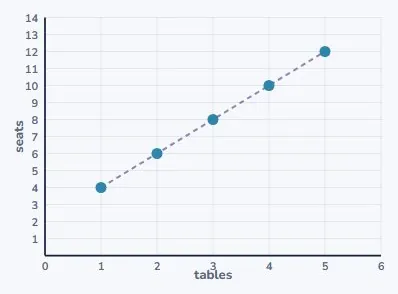
- Every point lies on one straight line.
- That is what a constant difference looks like when you plot it.
- And it means you could read off 6 tables without calculating.
- This is why plotting a pattern is worth doing.
Four to try
- 1. A pattern goes 5, 8, 11, 14. What is the rule in words?
- 2. Is 6 × 4 ≥ 5 × 5 true or false?
- 3. Fill the gap: 7 × ? = 30 + 5.
- 4. Which point is on the y-axis: (0, 6) or (6, 0)?
Show answer
Answers: 1. Three times the position, plus two: 3, 6, 9, 12 plus 2 gives 5, 8, 11, 14. Accept "add 3 each time" but push for the position rule. 2. False: 24 ≥ 25 is not true, and the ≥ does not rescue it because they are not equal. 3. 5, since 30 + 5 is 35. 4. (0, 6): no movement across, so it stays on the y-axis. If they pick (6, 0) they have the axes swapped, and beat 15 is the one to revisit.
Pattern, table, rule, plot
- A table reveals the rule. The rule makes predictions.
- Plotting turns the pattern into a picture.
- And the little line under < means "or equal to".
| Step | What it gives you |
|---|---|
| Draw the pattern | the first few answers |
| Put it in a table | the constant difference |
| Write the rule | any answer you like |
| Plot the points | a straight line |
Is your child on track?
Take the free placement test