Money, discounts and having enough
What this lesson covers
- Money uses our decimal place-value system to two decimal places.
A $280 bike, 25% off, and you have $220
- Can you buy it?
- Not "how much is the discount": can you actually pay.
- That takes three steps, and only one is a percentage.
Money always uses two decimal places
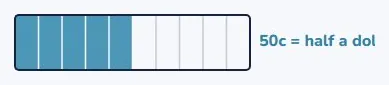
- A dollar splits into 100 cents.
- So one cent is one hundredth of a dollar.
- Hundredths is the second decimal place, hence exactly two.
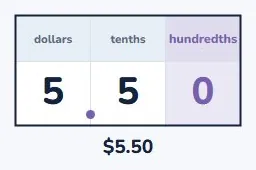
The second place is the cents
- In $5.50, the 5 after the point is 5 tenths (50 cents).
- The 0 is 0 hundredths: no single cents.
- Money is just decimals with a dollar sign in front.
$5.50 and $5.05 are not the same
- $5.50 is five dollars and fifty cents.
- $5.05 is five dollars and five cents.
- And $5.5 is unfinished; always write both places.
- That zero is holding a place, exactly as in any decimal.
| Written | Means | Verdict |
|---|---|---|
| $5.50 | five dollars fifty | correct |
| $5.05 | five dollars five cents | a different amount |
| $5.5 | incomplete | always write both places |
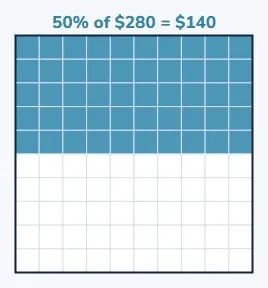
50% of $280
- 50% is half.
- Half of $280 is $140.00.
- Halving a whole dollar amount is the easiest one there is.
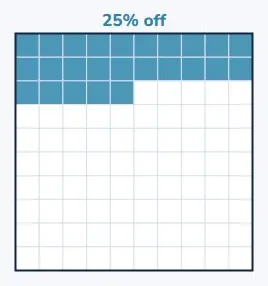
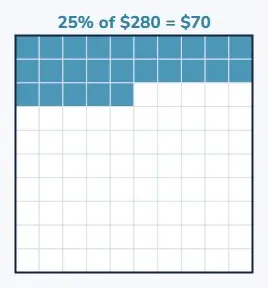
25% of $280
- 25% is half of a half.
- Half of $280 is $140. Half again is $70.00.
- So a quarter off this bike is $70.
10% of $280
- 10% is dividing by 10.
- $280 ÷ 10 = $28.00.
- These three cover most of the signs in any shop window.
| Percent | How | Of $280 |
|---|---|---|
| 10% | $280 ÷ 10 | $28.00 |
| 25% | half of half | $70.00 |
| 50% | half of $280 | $140.00 |
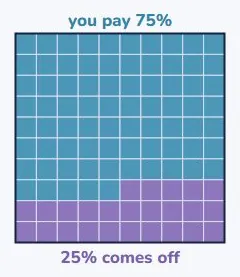
25% off means you pay 75%
- The sign says 25% off. That is what comes off, not what you pay.
- If a quarter comes off, three quarters stays on.
- So the price you pay is 75% of $280.
Taking the discount off
- $280 − $70 = $210.00.
- That is what the bike actually costs today.
- Step two of three, and now there is a real price to compare.
| Amount | |
|---|---|
| Ticket price | $280.00 |
| Less 25% | −$70.00 |
| You pay | $210.00 |
And the actual question
- You have $220. The bike costs $210.
- $220 is more than $210, so yes, you can buy it.
- And $220 − $210 leaves $10.00 change.
- That is the answer: yes, with ten dollars over.
| Step | Working | Result |
|---|---|---|
| Work out 25% off | $280 ÷ 4 | $70.00 |
| Take it off the price | $280 − $70 | $210.00 |
| Compare with what you have | $220 vs $210 | enough |
Checking it the other way
- Instead of taking 25% off, find 75% directly.
- 50% is $140 and 25% is $70, so 75% is $210.
- Same answer by a different route, which is a real check.
| Route | Working | Answer |
|---|---|---|
| Take off 25% | $280 − $70 | $210.00 |
| Find 75% | $140 + $70 | $210.00 |
A $45 top at 20% off
- 10% of $45 is $4.50.
- 20% is double that: $9.00.
- $45 − $9 = $36.00.
- Notice 10% of $45 needed both decimal places.
| Step | Amount |
|---|---|
| 10% of $45 | $4.50 |
| 20% of $45 | $9.00 |
| You pay | $36.00 |
The discount was never the question
- School questions ask how much comes off.
- Real ones ask whether you can pay for it.
- That needs the percentage, then a subtraction, then a comparison.
- And the answer is yes or no, not a number.
Estimate before you get to the counter
- You do not need the exact total to know if you have enough.
- Round everything up and add the rounded numbers.
- If the rounded-up total fits, the real one certainly does.
| Item | Rounded up |
|---|---|
| $12.50 | $13 |
| $8.99 | $9 |
| $4.25 | $5 |
| Estimate | $27 |
Adding up a basket
- Now the exact total: $12.50 + $8.99 + $4.25.
- Line the decimal points up, then add the cents column first.
- The total is $25.74.
- Under the $27 estimate, as it had to be.
| Item | Price |
|---|---|
| Drink bottle | $12.50 |
| Notebook | $8.99 |
| Pens | $4.25 |
| Total | $25.74 |
Line up the points, not the edges
- Money always has two places, so the columns always match.
- That is the one genuinely easy thing about adding money.
- Dollars under dollars, cents under cents.
| Dollars | Tenths | Hundredths | |
|---|---|---|---|
| 12 | 5 | 0 | |
| + | 8 | 9 | 9 |
| + | 4 | 2 | 5 |
| = | 25 | 7 | 4 |
Four to try
- 1. What is 25% of $60?
- 2. A $90 jacket is 10% off. What do you pay?
- 3. You have $50. Can you buy items at $19.99, $12.50 and $16.75?
- 4. Write four dollars and five cents properly.
Show answer
Answers: 1. $15.00 (half of $60 is $30, half again is $15). 2. 10% is $9, so you pay $81.00. 3. Estimate first: $20 + $13 + $17 is $50, so it is close; the exact total is $49.24, so yes, with 76c over. 4. $4.05, not $4.5 or $4.50. Question 3 is the whole lesson: they need all three steps and a yes-or-no answer.
Three steps, then yes or no
- Find the percentage. Take it off. Compare with what you have.
- And write money with both decimal places, every time.
| Step | Working | Result |
|---|---|---|
| Work out 25% off | $280 ÷ 4 | $70.00 |
| Take it off the price | $280 − $70 | $210.00 |
| Compare with what you have | $220 vs $210 | enough |
Is your child on track?
Take the free placement test