Quadrilaterals, angles and symmetry
What this lesson covers
- Quadrilaterals can be categorised into one or more of the following categories: a trapezium, which has one pair of parallel sides a parallelogram, which has two pairs of parallel sides a kite, which has two pairs of equal-length adjacent sides a rectangle, which has four right angles a rhombus, which has four equal-length sides a square, which has four right-angles and four equal-length sides.
- The order of rotational symmetry for a given shape is the number of times it appears in an identical orientation when completing a full turn (360°).
- The order of rotational symmetry for a circle is infinite.
Is a square a rectangle?
- Most people say no: a square is a square.
- The answer is yes.
- And the reason matters more than the answer.
The definition decides, not the look
- A shape is in a category if it fits the definition.
- There are six categories for four-sided shapes.
- And a shape can be in more than one at once.
| Category | Needs |
|---|---|
| Trapezium | one pair of parallel sides |
| Parallelogram | two pairs of parallel sides |
| Kite | two pairs of equal-length adjacent sides |
| Rectangle | four right angles |
| Rhombus | four equal-length sides |
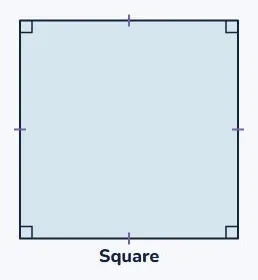
| Square | four right angles and four equal sides |
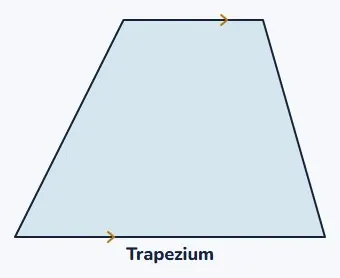
Trapezium: one pair of parallel sides
- The arrows mark the pair that is parallel.
- The other two sides can be anything at all.
- Here they are different lengths, still a trapezium.
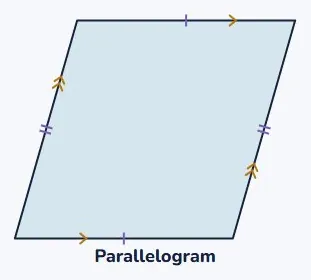
Parallelogram: two pairs of parallel sides
- Two sets of arrows, one for each parallel pair.
- The opposite sides came out equal as well.
- That follows from being parallel; it is not a second rule.
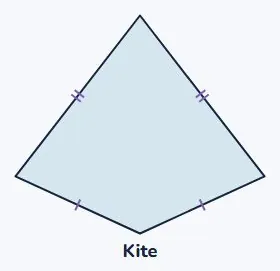
Kite: two pairs of equal adjacent sides
- Two short sides, two long sides.
- The equal ones sit next to each other, not opposite.
- "Adjacent" is the whole difference from a parallelogram.
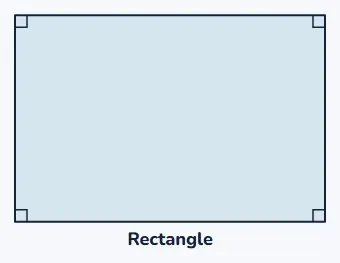
Rectangle: four right angles
- That is the entire definition.
- Nothing at all about how long the sides are.
- Long and thin counts. So does something that looks square.
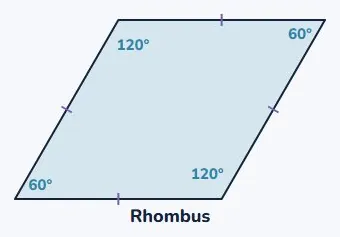
Rhombus: four equal-length sides
- Again, that is all of it.
- Nothing about the angles.
- These are 60° and 120°, and it is still a rhombus.
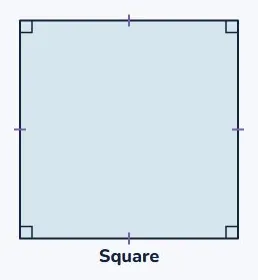
Square: both conditions at once
- Four right angles, like a rectangle.
- And four equal sides, like a rhombus.
- Which is why the opening question has the answer it does.
So a square is both
- Four right angles, so it is a rectangle.
- Four equal sides, so it is a rhombus.
- It ticks both boxes, so it is both.
- And a parallelogram too: both pairs come out parallel.
| Shape | 4 right angles | 4 equal sides | Also is a… |
|---|---|---|---|
| Square | yes | yes | rectangle, rhombus |
| Rectangle | yes | no | parallelogram |
| Rhombus | no | yes | parallelogram |
| Kite | no | no | None |
But it only works one way
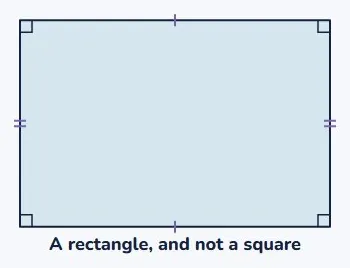
- Every square is a rectangle.
- Most rectangles are not squares.
- This one has four right angles but two side lengths.
Triangles get sorted twice over
- By sides: equilateral, isosceles, scalene.
- By angles: right-angled, and the rest.
- A triangle can take a name from each list.
| Triangle | Sides | Angles |
|---|---|---|
| Equilateral | all three equal | all 60° |
| Isosceles | two equal | two equal |
| Scalene | all different | all different |
| Right-angled | any | one is 90° |
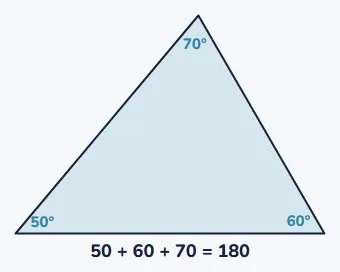
Angles in a triangle make 180°
- 50 + 60 + 70 = 180.
- True for every triangle there is.
- Stretch it however you like; the total does not move.
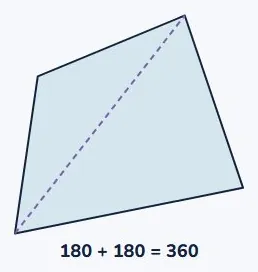
And in a quadrilateral, 360°
- Not a separate fact to remember.
- Draw one diagonal and you have two triangles.
- 180 in each.
- So 180 + 180 = 360, every time.
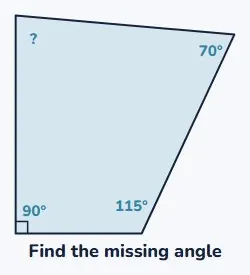
Finding a missing angle
- Three angles known: 90°, 115° and 70°.
- Add them: 90 + 115 + 70 = 275.
- The four must make 360.
- 360 − 275 = 85°.
Rotational symmetry
- Turn a shape all the way round: a full 360°.
- Count how many times it looks exactly as it did at the start.
- That count is called the order.
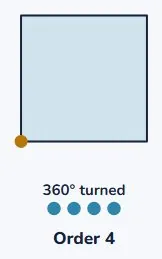
A square has order 4
- The gold dot marks one corner, so you can see it move.
- A quarter turn, and the outline matches again.
- Another quarter. And another. And home.
- Four matches in a full turn.
Every shape has an order
- Square 4. Equilateral triangle 3.
- Rectangle 2: only the half turn works.
- Rhombus and parallelogram, 2 as well.
| Shape | Order |
|---|---|
| Square | 4 |
| Equilateral triangle | 3 |
| Rectangle | 2 |
| Rhombus | 2 |
| Parallelogram | 2 |
| Trapezium | 1 |
| Kite | 1 |
| Circle | infinite |
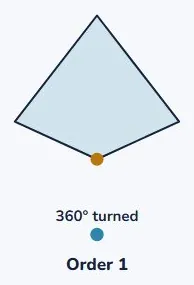
Order 1 means none at all
- The kite matches nowhere until it is all the way home.
- One match in a full turn, so order 1.
- Which is how we say it has no rotational symmetry.
- A circle is the other extreme: every turn matches. Infinite.
Prisms and pyramids
- A prism has two identical ends, joined by rectangles.
- A pyramid has one base and triangles meeting at a point.
- Both are named after the shape of the base.
| Prism | Pyramid | |
|---|---|---|
| Ends | two identical, parallel | one base |
| Other faces | rectangles | triangles |
| Meet at a point? | no | yes, at the apex |
| Cross-section | the same all along | shrinks to the apex |
Counting faces, edges and vertices
- A triangular prism: 2 triangles and 3 rectangles.
- So 5 faces, 9 edges, 6 vertices.
- Count them; do not try to remember them.
| Solid | Faces | Edges | Vertices |
|---|---|---|---|
| Cube | 6 | 12 | 8 |
| Triangular prism | 5 | 9 | 6 |
| Square-based pyramid | 5 | 8 | 5 |
| Triangular pyramid | 4 | 6 | 4 |
Your turn
- 1. Is a rhombus always a parallelogram?
- 2. A triangle has angles 40° and 75°. Find the third.
- 3. What is the order of rotational symmetry of a rectangle?
- 4. How many faces has a square-based pyramid?
Show answer
1. Yes. Four equal sides forces both pairs of opposite sides parallel, which is the definition of a parallelogram. 2. 180 − 40 − 75 = 65°. 3. 2: only the half turn brings it back onto itself. 4. Five: one square base and four triangles.
What to take away
- Definitions decide, not appearances.
- A square is a rectangle and a rhombus at the same time.
- Triangle 180°, quadrilateral 360°; a diagonal shows why.
- Order counts the matches in one full turn.
Is your child on track?
Take the free placement test