Transformations, tessellation and maps
What this lesson covers
- A tessellation is a pattern made from a repeated shape or combination of shapes that can be rotated or reflected to fit together with no gaps or overlaps.
- A reflection is when a shape is flipped over a line, creating a mirror image.
- A translation is when a shape is slid from one place to another without being turned.
- A rotation is when a shape is turned around a fixed point.
- An alphanumeric grid reference is a system that divides a map into labelled rows (letters) and columns (numbers), so that each square can be identified by combining a letter and a number (e.g. A1, B2).
Three ways to move a shape
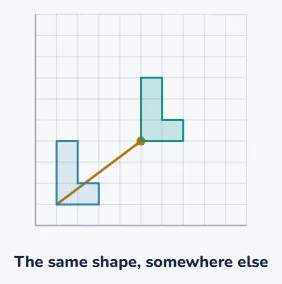
- Slide it, flip it, or turn it.
- Afterwards every side is the same length.
- And every angle is the same size.
- Only where it sits has changed.
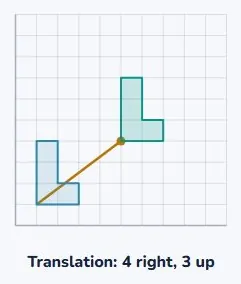
Translation: a slide
- Every corner moves the same way by the same amount.
- Here: 4 squares right and 3 squares up.
- Nothing turns. It faces exactly the way it did.
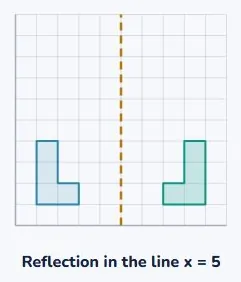
Reflection: a flip over a line
- The gold dashes are the mirror line.
- Each corner lands the same distance the other side of it.
- The shape is a mirror image: it faces the other way.
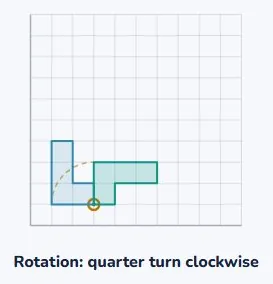
Rotation: a turn about a point
- The ringed dot is the fixed point.
- A quarter turn clockwise (90°).
- The dashed curve is the path one corner travels.
What never changes
- Lengths, angles and area survive all three moves.
- The shape is congruent: identical, just relocated.
- This is the reason tiles fit together.
| Property | Under a slide, flip or turn |
|---|---|
| Side lengths | never change |
| Angles | never change |
| Area | never changes |
| Position | changes |
| Which way it faces | changes, except in a slide |
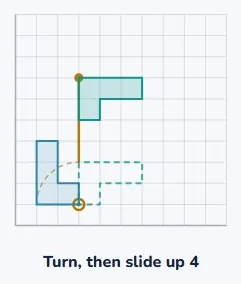
Two steps: turn, then slide
- Quarter turn clockwise first: the dashed shape.
- Then slide that one up 4 squares.
- It ends up at x 3 to 6, y 5 to 7.
- Worked out, not tried out.
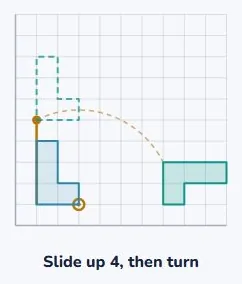
The other way round lands elsewhere
- The same two moves. Slide up 4 first, then turn.
- This time it ends up at x 7 to 10, y 1 to 3.
- A completely different place.
- So the order is part of the instruction.
Tessellation
- A repeated shape that fits with no gaps and no overlaps.
- The copies may be slid, flipped or turned.
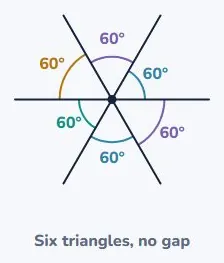
- Six equilateral triangles round one point: 6 × 60 = 360.
It is an angle question
- The shapes meeting at a point must total exactly 360°.
- So the interior angle has to divide into 360.
- 60 goes 6 times, 90 goes 4, 120 goes 3.
| Regular shape | Interior angle | 360 ÷ angle | Tiles? |
|---|---|---|---|
| Equilateral triangle | 60° | 6 | yes |
| Square | 90° | 4 | yes |
| Regular pentagon | 108° | 3.33… | no |
| Regular hexagon | 120° | 3 | yes |
| Regular octagon | 135° | 2.67… | no |
Why a pentagon cannot
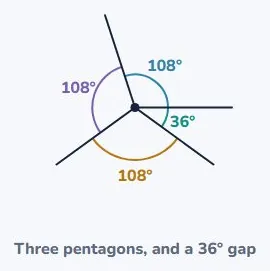
- A regular pentagon has 108° corners.
- Three of them make 324°.
- That leaves a 36° gap, and a fourth will not fit.
But every triangle and quadrilateral does
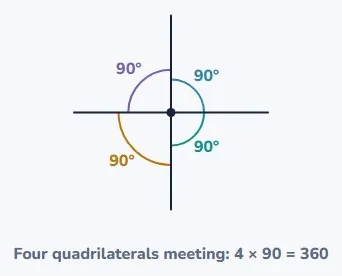
- Any triangle at all tessellates. So does any quadrilateral.
- A triangle holds 180°, so six fit round a point.
- A quadrilateral holds 360°, so four do.
- That is last lesson’s angle sum, doing work.
Grid references
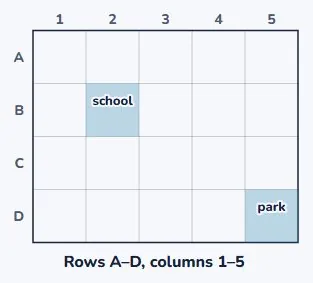
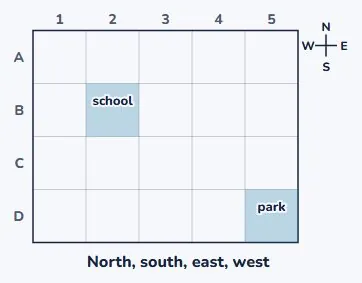
- Rows get letters. Columns get numbers.
- Combine them and you have named one square.
- The school is at B2. The park is at D5.
A reference names a square
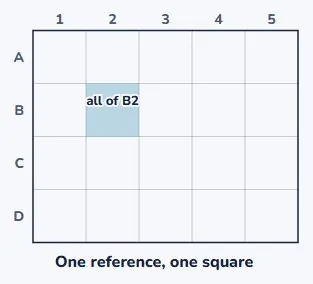
- Not a point, a whole square.
- B2 is everything inside that one cell.
- Which is why a map reference is enough to find a building.
The four compass points
- North is up the map, south is down.
- East is right, west is left.
- Going up a letter is north. Up a number is east.
Turns, in degrees
- A quarter turn is 90°. A half turn is 180°.
- Face east, turn 90° clockwise, and you face south.
- The same 90° as the rotation earlier.
| Turn | Degrees |
|---|---|
| Quarter turn | 90° |
| Half turn | 180° |
| Three-quarter turn | 270° |
| Full turn | 360° |
Scale turns squares into metres
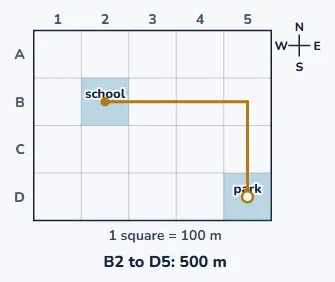
- On this map, one square is 100 m.
- So three squares is 300 m.
- Ten squares is 1000 m: a kilometre.
| On the map | On the ground |
|---|---|
| 1 square | 100 m |
| 3 squares | 300 m |
| 10 squares | 1000 m, which is 1 km |
| 1 km | 1000 m |
School to park
- From B2, go east 3 squares to B5.
- Turn 90° clockwise, then south 2 squares to D5.
- 300 m then 200 m.
- 500 m altogether.
And the way home
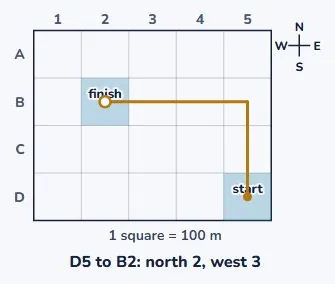
- Same distance: 500 m.
- But every direction is the opposite one.
- And in the opposite order: north 2, then west 3.
Describing a route properly
- A direction. A distance. In order.
- "East 300 m, then south 200 m" is complete.
- "Towards the park" is not; it needs the map.
| A route needs | Example |
|---|---|
| A starting point | B2, the school |
| A direction | east |
| A distance | 300 m |
| Then the next leg | south 200 m |
Your turn
- 1. A shape is reflected in a line, then reflected in it again. Where is it?
- 2. Which square is directly north of D5?
- 3. A shape slides 3 right and 2 up. What slide undoes it?
- 4. If one square is 100 m, how far is 7 squares?
Show answer
1. Exactly where it started: reflecting twice in the same line undoes itself. 2. C5; north is up the map, so the row letter goes back one. 3. Three left and two down. 4. 700 m.
What to take away
- Slide, flip, turn: lengths and angles never change.
- Two steps in the other order can land somewhere else.
- Shapes tile when their angles make 360° at a point.
- A route is a direction and a distance, in order.
Is your child on track?
Take the free placement test