Area, volume and angles
What this lesson covers
- The volumes of rectangular prisms can be calculated by multiplication of side lengths.
- Angles at a point sum to 360°.
- Angles on a straight line sum to 180°.
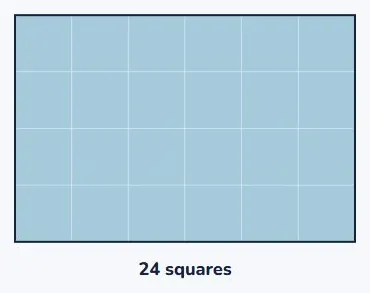
Area is how many squares fit inside
- This rectangle is 6 cm across and 4 cm down.
- You could count the centimetre squares one at a time.
- There are 24. But nobody wants to count 24 squares.
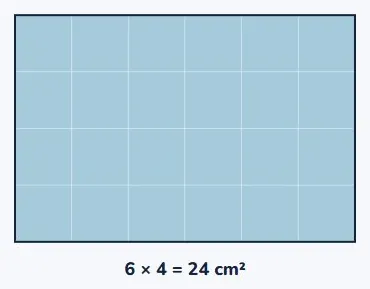
So multiply instead
- Each row has 6 squares, and there are 4 rows.
- 6 × 4 = 24.
- Area of a rectangle is length times width. That is all.
Why cm² and not cm
- cm measures a length: one direction.
- cm² measures an area: two directions multiplied.
- The little 2 says two lengths went into it.
- An area written in cm has lost the point of the answer.
| Written | Measures | Lengths used |
|---|---|---|
| cm | length | 1 |
| cm² | area | 2 |
| cm³ | volume | 3 |
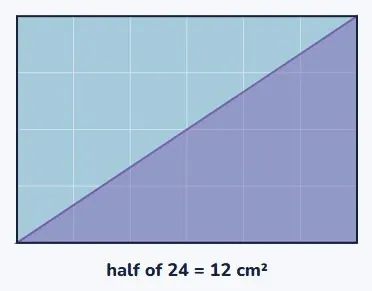
A right-angled triangle is half of it
- Cut the rectangle corner to corner.
- Two identical right-angled triangles.
- So each one is half of 24, which is 12 cm².
- You never work out a triangle from scratch.
Base times height, then halve
- Find the rectangle it came out of: base × height.
- Then halve it.
- 6 × 4 = 24, and half of that is 12 cm².
- Halve at the end, not the start; the numbers stay whole longer.
| Step | Working | Answer |
|---|---|---|
| Whole rectangle | 6 × 4 | 24 cm² |
| Halve it | 24 ÷ 2 | 12 cm² |
And volume is three lengths
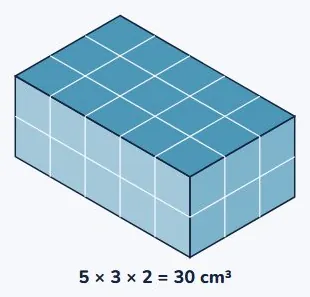
- A box 5 cm by 3 cm by 2 cm.
- The bottom layer is 5 × 3 = 15 cubes.
- Two layers, so 15 × 2 = 30.
- 30 cm³: cubic, because three lengths were multiplied.
An angle is an amount of turn
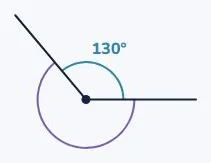
- Not a length, and not how long the arms are drawn.
- It is how far you turn to get from one arm to the other.
- Measured in degrees, and a full turn is 360 of them.
The five kinds, by size
- Under 90° is acute. Exactly 90° is a right angle.
- Between 90° and 180° is obtuse.
- Exactly 180° is straight, and over 180° is reflex.
- Classifying one is just reading its size.
| Kind | Size | Looks like |
|---|---|---|
| Acute | less than 90° | a sharp corner |
| Right | exactly 90° | a square corner |
| Obtuse | between 90° and 180° | a wide corner |
| Straight | exactly 180° | a straight line |
| Reflex | more than 180° | more than half a turn |
Reading a protractor without getting caught
- Line the centre on the corner and one arm on zero.
- A protractor has two scales, running opposite ways.
- Read the one that starts at zero on your arm.
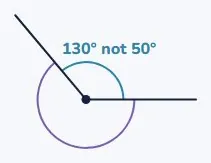
- Check the answer against the kind: an obtuse angle cannot be 50°.
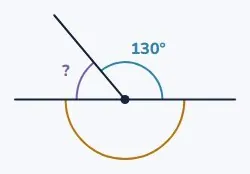
Angles on a straight line add to 180°
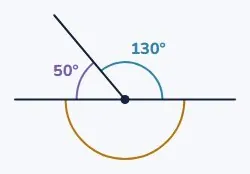
- A straight line is half a full turn.
- Half of 360 is 180.
- So any angles sitting on one side of a line add to 180°.
Which finds you a missing angle
- One angle on the line is marked 130°.
- The other is not marked. Call it the unknown.
- The two must add to 180, so subtract: 180 − 130.
- The unknown angle is 50°.
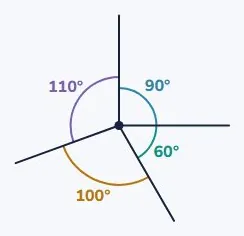
Angles at a point add to 360°
- All the way round is a full turn.
- So every angle meeting at one point adds to 360°.
- Here: 90 and 110 and 100 and 60. Add them up.
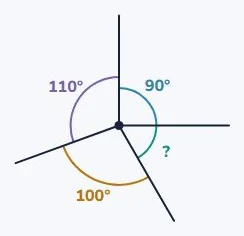
And finds a missing one the same way
- Three are marked: 90°, 110° and 100°.
- Those three add to 300.
- A full turn is 360, so the last one is 360 − 300.
- 60°.
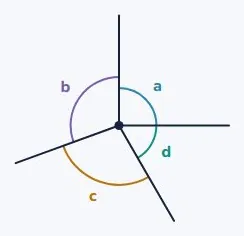
Naming an angle
- An angle sits between two arms, at a corner.
- Name it by the corner, or mark it with a letter.
- Saying "the angle at the point" is not enough when four meet there.
Two crossing lines make equal pairs
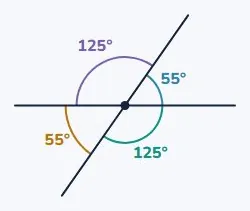
- Cross two straight lines. Four angles appear.
- The pairs facing each other are called vertically opposite.
- And vertically opposite angles are always equal.
- Here: 55° opposite 55°, and 125° opposite 125°.
Why they have to be equal
- The 55° and the 125° sit on a straight line, so they make 180.
- The 125° and the other 55° sit on a line too (also 180).
- Both 55s are "180 minus the same 125".
- So they cannot be anything but equal.
| Pair on a line | Adds to |
|---|---|
| 55° and 125° | 180° |
| 125° and 55° | 180° |
Using it
- One angle where two lines cross is marked 55°.
- The one directly opposite is vertically opposite it.
- So it is 55° too; no subtracting needed.
- Copy it straight across.
A problem needing two facts
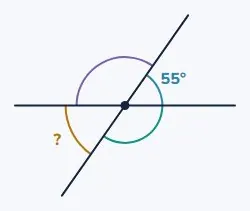
- Two lines cross. One angle is 55°.
- Find the angle next to it: on a line, so 180 − 55 = 125°.
- Now find the one opposite that: vertically opposite, so 125°.
- Two facts, two steps, all four angles known.
| Angle | Fact used | Size |
|---|---|---|
| Given | None | 55° |
| Next to it | line = 180° | 125° |
| Opposite the given | vertically opposite | 55° |
| The fourth | vertically opposite | 125° |
Four to try
- 1. What is the area of a rectangle 8 cm by 5 cm?
- 2. What is the area of a right-angled triangle with base 8 and height 5?
- 3. Two angles on a straight line: one is 72°. What is the other?
- 4. Two lines cross and one angle is 40°. What are the other three?
Show answer
Answers: 1. 40 cm², and the units must be squared. 2. 20 cm², half of 40; if they halve first and get 20 by another route that is fine. 3. 108°, because 180 − 72. 4. 140°, 40°, 140°: the opposite one is 40° by vertically opposite, and the two next to it are 180 − 40. Watch for an answer of 320° on question 4, which is 360 minus 40 and means they used the wrong fact.
Three facts, and what each is for
- A line is 180°. A point is 360°. Opposites are equal.
- Each one turns a marked angle into an unmarked one.
- And areas are squared units, volumes cubic.
| Where | Fact | Use it to |
|---|---|---|
| On a straight line | add to 180° | find one from the other |
| At a point | add to 360° | find one from the rest |
| Vertically opposite | are equal | copy it straight across |
Is your child on track?
Take the free placement test