Comparing and adding fractions
What this lesson covers
- Percentages can be used to compare quantities to a value or whole.
- Fractions should have the same denominator before using them in addition or subtraction.
What is 1/2 + 1/4?
- A very common answer is 2/6.
- Add the tops: 1 + 1 = 2. Add the bottoms: 2 + 4 = 6.
- It looks tidy. It is completely wrong.
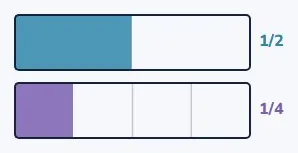
You can prove it is wrong without any rules
- 2/6 is the same as 1/3, which is about 0.33.
- But we started with 1/2, which is 0.5.
- So adding a quarter supposedly made it smaller.
- That cannot happen. The method is broken.
| Stage | Fraction | Value |
|---|---|---|
| We started with | 1/2 | 0.5 |
| We added | 1/4 | 0.25 |
| Tops-and-bottoms says | 2/6 | 0.33 |
You can only add pieces of the same size
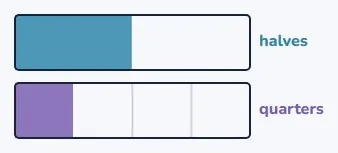
- Halves and quarters are different-sized pieces.
- Adding 1 half to 1 quarter is like adding 1 cat to 1 dog.
- You get 2 animals, not 2 of either one.
- First make the pieces match.
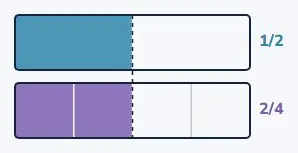
One half is also two quarters
- Cut each half in two and you have quarters.
- The shading has not moved: 1/2 = 2/4.
- Same amount, smaller pieces, more of them.
Maths blocks
Now the addition is easy
- Rewrite 1/2 as 2/4. Leave the 1/4 alone.
- Now both are quarters, so just add the tops.
- 2/4 + 1/4 = 3/4.
- And 3/4 is bigger than 1/2, as it has to be.
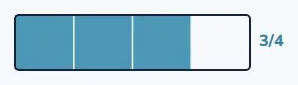
Try it: make the pieces match
The rule, now that you can see why
- Fractions must share a denominator before you add them.
- When one bottom is a multiple of the other, use the bigger.
- 4 is a multiple of 2, so quarters were the right choice.
- Rewrite only the one that needs it.
| Sum | Rewritten | Answer |
|---|---|---|
| 1/2 + 1/4 | 2/4 + 1/4 | 3/4 |
| 1/3 + 1/6 | 2/6 + 1/6 | 3/6 = 1/2 |
| 3/4 − 1/8 | 6/8 − 1/8 | 5/8 |
Adding 1/3 and 1/6
- 6 is a multiple of 3, so work in sixths.
- 1/3 is 2/6. The 1/6 stays as it is.
- 2/6 + 1/6 = 3/6.
- And 3/6 simplifies to 1/2. Always tidy the answer.
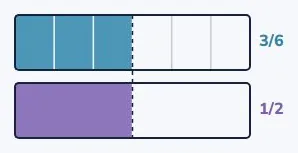
Subtracting works the same way
- 3/4 − 1/8. Eighths are the smaller pieces, so use eighths.
- 3/4 is 6/8.
- 6/8 − 1/8 = 5/8.
- Same first step every time: make the pieces match.
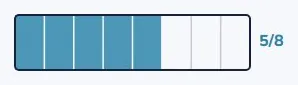
Which is bigger, 2/3 or 5/6?
- You cannot tell by looking at the numbers.
- 6 is a multiple of 3, so put both over sixths.
- 2/3 is 4/6. And 4/6 is less than 5/6.
- So 5/6 is the bigger fraction.
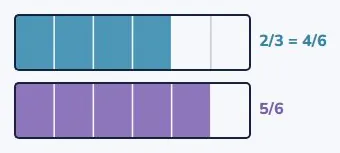
Try it: which is bigger?
Ordering 1/2, 3/8 and 3/4
- 8 is a multiple of both 2 and 4, so use eighths.
- 1/2 is 4/8. 3/4 is 6/8. The 3/8 is already eighths.
- Now compare the tops: 3, 4, 6.
- So the order is 3/8, then 1/2, then 3/4.
| Fraction | In eighths |
|---|---|
| 1/2 | 4/8 |
| 3/8 | 3/8 |
| 3/4 | 6/8 |
When the top is bigger than the bottom
- 7/4 means seven quarters.
- Four quarters make a whole, so there is more than one whole here.
- A fraction like that is called improper, which just means top-heavy.
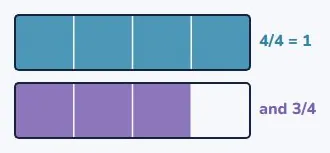
Turning 7/4 into a mixed number
- Ask how many whole fours fit into 7. One.
- That leaves 3 quarters over.
- So 7/4 = 1 3/4.
- It is a division, and you already know how to do those.
| Improper | Divide | Mixed |
|---|---|---|
| 7/4 | 7 ÷ 4 = 1 r 3 | 1 3/4 |
| 9/2 | 9 ÷ 2 = 4 r 1 | 4 1/2 |
| 7/3 | 7 ÷ 3 = 2 r 1 | 2 1/3 |
A fraction bar is a division sign
- 7/4 and 7 ÷ 4 are the same thing written differently.
- 7 ÷ 4 is 1 remainder 3, which is 1 and 3/4.
- The remainder becomes the top of the fraction.
- That is why the two methods always agree.
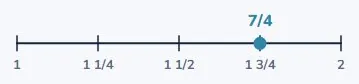
And back the other way
- Turn 2 1/3 into thirds.
- Each whole is 3 thirds, and there are 2 wholes: 6 thirds.
- Plus the 1 third already there makes 7.
- So 2 1/3 = 7/3.
| Step | Working |
|---|---|
| 2 wholes | 2 × 3 = 6 thirds |
| plus the third | 6 + 1 = 7 |
| Answer | 7/3 |
Adding mixed numbers
- 1 1/2 + 2 1/4. Deal with the wholes first: 1 + 2 = 3.
- Now the fractions: 1/2 + 1/4, which we know is 3/4.
- Put them back together: 3 3/4.
- Wholes with wholes, fractions with fractions.
| Part | Sum |
|---|---|
| Wholes | 1 + 2 = 3 |
| Fractions | 2/4 + 1/4 = 3/4 |
| Answer | 3 3/4 |
3 3/4 is also 3.75
- 3/4 is 0.75, so 3 3/4 is 3.75.
- Fractions and decimals are the same numbers, differently written.
- Which means adding decimals needs the same first step.
- Make the pieces match before you add.
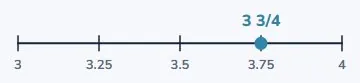
Adding 2.35 and 1.4
- A common answer is 3.39 (adding 4 onto 35).
- But 1.4 is 1.40, not 1.04.
- Write it as 1.40 so the places line up, then add.
- 2.35 + 1.40 = 3.75.
| Ones | Tenths | Hundredths | |
|---|---|---|---|
| 2 | 3 | 5 | |
| + | 1 | 4 | 0 |
| = | 3 | 7 | 5 |
The same with thousandths
- 1.256 + 2.4. Line up the decimal points, not the right edges.
- Write 2.4 as 2.400 and every column has a digit.
- 1.256 + 2.400 = 3.656.
- The zeros do nothing except hold the places open.
| Ones | Tenths | Hundredths | Thousandths | |
|---|---|---|---|---|
| 1 | 2 | 5 | 6 | |
| + | 2 | 4 | 0 | 0 |
| = | 3 | 6 | 5 | 6 |
Common mistakes
- 1/2 + 1/4 = 2/6Make the pieces match first: 1/2 = 2/4, so 2/4 + 1/4 = 3/4. Adding the bottoms changes the size of the pieces.
- 2.35 + 1.4 = 3.391.4 is 1.40, not 1.04. Line up the points: 2.35 + 1.40 = 3.75.
- 3/5 is bigger than 7/10, because fifths are bigger pieces than tenths.Put both in tenths: 3/5 = 6/10, and 6/10 is less than 7/10, so 7/10 is bigger.
- 11/4 = 3 2/411 ÷ 4 is 2 remainder 3, so 11/4 = 2 3/4. Check: 2 wholes is 8 quarters, plus 3 makes 11.
Four to try
1
Work out 1/3 + 1/9.
2
Which is bigger, 3/5 or 7/10?
3
Write 11/4 as a mixed number.
4
Work out 4.7 + 3.25.
Show answer
Answers: 1. 3/9 + 1/9 = 4/9: ninths, because 9 is a multiple of 3. 2. 7/10, since 3/5 is 6/10. 3. 11 ÷ 4 = 2 remainder 3, so 2 3/4. 4. 7.95; write 4.7 as 4.70 first; 7.32 or 7.12 means they aligned the right-hand edges. On question 1 a "2/12" answer is the tops-and-bottoms method again, and the beat to revisit is 2.
Fractions: Equality
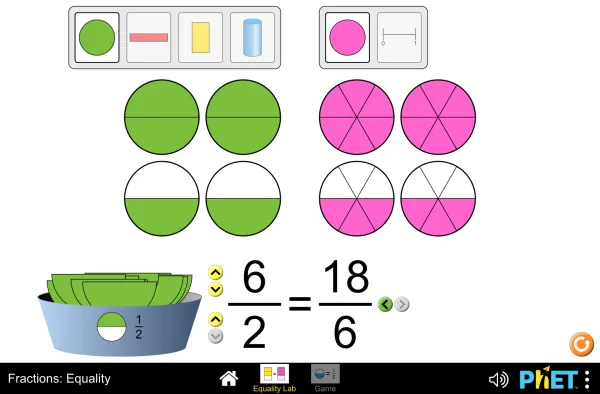
Full screen · PhET Interactive Simulations, University of Colorado Boulder, CC BY 4.0
Make the pieces match first
- Fractions: find a common denominator.
- Decimals: line up the points and fill the gaps with zeros.
- It is the same instruction twice.
| Sum | Rewritten | Answer |
|---|---|---|
| 1/2 + 1/4 | 2/4 + 1/4 | 3/4 |
| 1/3 + 1/6 | 2/6 + 1/6 | 1/2 |
| 2.35 + 1.4 | 2.35 + 1.40 | 3.75 |
| 1.256 + 2.4 | 1.256 + 2.400 | 3.656 |
Practise this
Worksheet with answersWithout answersDownload PDF
Report a mistake
More in Number
 Big numbers and rounding7 min
 Negative numbers, squares and cubes7 min
 Order of operations and column methods7 min
 Division and what to do with the remainder6 min
 Tenths, hundredths and thousandths7 minComparing and adding fractions7 min
 Fractions and percentages of amounts7 min
 Money, discounts and having enough6 min
Is your child on track?
Take the free placement test