Solving equations with a balance
What this lesson covers
- A variable can be used to represent an unknown number, often in formulae, or a quantity that can vary or change.
- The solution to an equation satisfies that equation.
- Equations can be rearranged using inverse operations (e.g. addition and subtraction, multiplication and division).
- Solutions to equations can be checked using substitution.
- Equations can be solved through trial and error, but this can be an inefficient method.
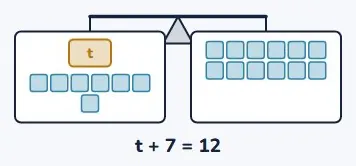
A number, plus 7, makes 12
- You already know the number is 5.
- Now write it the way algebra writes it.
- t + 7 = 12.
What the letter is doing
- Sometimes it is one unknown number waiting to be found.
- Sometimes it is a quantity that changes.
- And 3b is just shorthand for 3 × b.
| Written | The letter is | Meaning |
|---|---|---|
| t + 7 = 12 | one unknown number | t is 5, and only 5 |
| A = lw | a formula | l and w can be anything |
| 3b | shorthand | means 3 × b |
What the equals sign really says
- Not "here comes the answer".
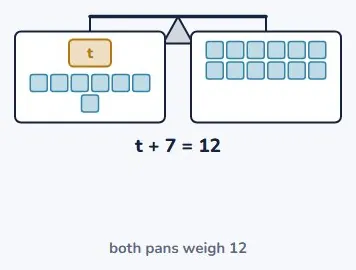
- It says these two sides weigh the same.
- An equation is a balance that is level.
The solution is the value that fits
- Put 5 in place of t and both sides come to 12.
- Put 4 in and the left side is only 11.
- Only 5 keeps it level.
| Try t = | Left side | Balanced? |
|---|---|---|
| 4 | 11 | no |
| 5 | 12 | yes |
| 6 | 13 | no |
You could just guess
- On t + 7 = 12 that works fine.
- On 5s + 3 = 18 it is slower.
- And on harder ones it stops working entirely.
| Equation | Guess | Gets |
|---|---|---|
| t + 7 = 12 | try 4 | 11, too small |
| try 5 | 12, got it | |
| 5s + 3 = 18 | try 4 | 23, too big |
| try 2 | 13, too small | |
| try 3 | 18, eventually |
The one move that always works
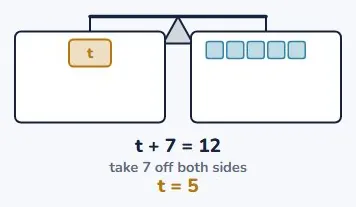
- Take something off one pan and it tips.
- Take the same off both and it stays level.
- That is the whole method.
Which move to make
- Whatever is happening to the letter, undo it.
- Adding is undone by subtracting.
- Multiplying is undone by dividing.
| Operation | Its inverse | |
|---|---|---|
| + | undone by | − |
| − | undone by | + |
| × | undone by | ÷ |
| ÷ | undone by | × |
t + 7 = 12
- 7 is being added, so subtract 7.
- From both sides, so it stays level.
- t = 5.
| Step | Equation | Why |
|---|---|---|
| Start | t + 7 = 12 | |
| Take 7 off both | t = 5 | inverse of + 7 |
| Check | 5 + 7 = 12 | true |
Always check
- Put your answer back into the original.
- 5 + 7 = 12. True.
- Thirty seconds, and it catches nearly everything.
| Step | Equation | Why |
|---|---|---|
| Start | t + 7 = 12 | |
| Take 7 off both | t = 5 | inverse of + 7 |
| Check | 5 + 7 = 12 | true |
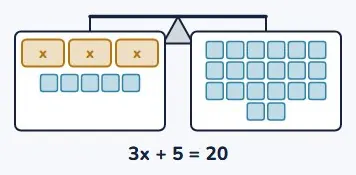
Now two things at once: 3x + 5 = 20
- Three x blocks and five ones on the left.
- Twenty ones on the right.
- Still level. Still the same rule.
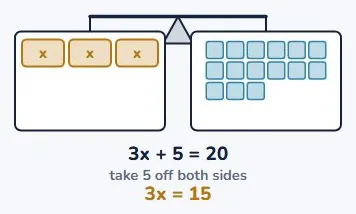
Take the 5 off both sides
- Five ones go from the left. Five from the right.
- Left has three x blocks. Right has fifteen.
- 3x = 15.
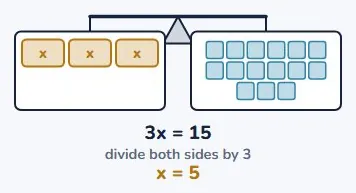
Now divide both sides by 3
- Three blocks weigh fifteen.
- So one block weighs five.
- x = 5.
Why the 5 came off first
- To build 3x + 5 you multiply, then add.
- To undo it you go backwards: subtract, then divide.
- Same steps, reverse order.
| Direction | First | Then |
|---|---|---|
| To build 3x + 5 | multiply by 3 | then add 5 |
| To undo it | subtract 5 | then divide by 3 |
| Which is | the same steps | backwards |
Written out without the picture
- 3x + 5 = 20.
- Subtract 5: 3x = 15. Divide by 3: x = 5.
- Check: 3 × 5 + 5 = 20. True.
| Step | Equation | Why |
|---|---|---|
| Start | 3x + 5 = 20 | |
| Take 5 off both | 3x = 15 | undo the adding |
| Divide both by 3 | x = 5 | undo the multiplying |
| Check | 3 × 5 + 5 = 20 | true |
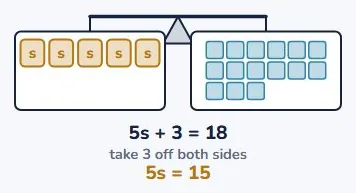
5s + 3 = 18
- The one guessing struggled with.
- Subtract 3: 5s = 15. Divide by 5: s = 3.
- Check: 5 × 3 + 3 = 18. True.
Substitution: the other direction
- Sometimes you are told the letter and asked for the value.
- Just put the number in and work it out.
- Order of operations still applies.
| Expression | Becomes | Value |
|---|---|---|
| 3w + 5, w = 4 | 3 × 4 + 5 | 17 |
| A = lw, l = 7, w = 4 | 7 × 4 | 28 |
| s², s = 6 | 6 × 6 | 36 |
Is this sentence true?
- Work out both sides separately.
- Then compare them.
- The sign has to be right, not just close.
| Sentence | Both sides | True? |
|---|---|---|
| 0.8 × 12 ≤ 8 + 2 | 9.6 ≤ 10 | true |
| 7 × 6 > 40 + 3 | 42 > 43 | false |
| 100 ÷ 4 = 5² | 25 = 25 | true |
Your turn: four questions
- Pause here and try all four.
- Question 2 has a subtraction, so add to undo it.
- Check every answer by putting it back in.
| Question | |
|---|---|
| 1 | Solve t + 9 = 17. |
| 2 | Solve 4m − 3 = 21. |
| 3 | If w = 4, what is 3w + 5? |
| 4 | True or false: 0.8 × 12 ≤ 8 + 2 |
Show answer
1. t = 8. Take 9 off both sides. Check: 8 + 9 = 17. 2. m = 6. Add 3 to both sides to get 4m = 24, then divide by 4. Check: 4 × 6 − 3 = 21. 3. 17. Multiply first: 3 × 4 = 12, then add 5. 4. True. 0.8 × 12 = 9.6, and 8 + 2 = 10, and 9.6 is less than 10.
The answers
- t = 8. And m = 6: add 3, then divide by 4.
- 3w + 5 with w = 4 is 17.
- 9.6 is less than 10, so the last one is true.
| Answer | |
|---|---|
| 1 | t = 8 |
| 2 | m = 6 |
| 3 | 17 |
| 4 | true: 9.6 ≤ 10 |
What to take away
- An equation is two sides that weigh the same.
- Whatever you do, do it to both sides.
- Undo two steps in reverse order, then check.
| Remember | |
|---|---|
| An equation | two sides that weigh the same |
| Whatever you do | do it to both sides |
| Inverse operations | + undoes −, × undoes ÷ |
| Two steps | undo them in reverse order |
| Always check | put your answer back in |
Is your child on track?
Take the free placement test