Money, cash rounding and discounts
What this lesson covers
- Solutions to problems involving New Zealand currency are rounded to two decimal places.
- Cash payments in New Zealand are rounded up or down to the nearest 10 cents.
The same shopping, two different prices
- A basket comes to $23.47.
- Pay by card and it is $23.47.
- Pay in cash and it is $23.50. Both are correct.
| How you pay | What it costs |
|---|---|
| On the shelf | $23.47 |
| Paid by card | $23.47 |
| Paid in cash | $23.50 |
Because of the coins we have
- New Zealand dropped 1c and 2c coins in 1990.
- And the 5c coin in 2006.
- The smallest coin now is 10 cents.
| Coin | Status |
|---|---|
| 10c, 20c, 50c | in circulation |
| $1, $2 | in circulation |
| 5c | withdrawn in 2006 |
| 1c, 2c | withdrawn in 1990 |
So a cash total has to fit the coins
- You cannot hand over 7 cents. There is no coin.
- So cash totals round to the nearest 10 cents.
- Card payments do not; they take the exact cent.
| How you pay | What it costs |
|---|---|
| On the shelf | $23.47 |
| Paid by card | $23.47 |
| Paid in cash | $23.50 |
Which ten cents is nearer?
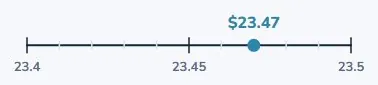
- $23.47 sits between $23.40 and $23.50.
- It is closer to $23.50.
- So that is what you pay.
The quick way to decide
- Look at the last digit: the cents.
- 1, 2, 3 or 4 rounds down.
- 6, 7, 8 or 9 rounds up.
| Total | To the | You pay |
|---|---|---|
| $23.42 | nearest 10c | $23.40 |
| $23.44 | nearest 10c | $23.40 |
| $23.47 | nearest 10c | $23.50 |
| $23.49 | nearest 10c | $23.50 |
Money always has two decimal places
- Write $8.50, never $8.5.
- And $12.00, not just $12.
- The second place is cents, even when it is zero.
| Wrong | Right |
|---|---|
| $8.5 | $8.50 |
| $12 | $12.00 |
| $0.9 | $0.90 |
Working out a total
- Add the exact prices first.
- $8.95 + $6.40 + $8.12 = $23.47.
- Round only at the very end, and only for cash.
| Item | Price |
|---|---|
| Bread | $8.95 |
| Milk | $6.40 |
| Apples | $8.12 |
| Total | $23.47 |
Round once, at the end
- Do not round each item as you go.
- Three small roundings can drift a few cents.
- One rounding on the total is the rule.
| Method | Gets |
|---|---|
| Round each item | $9.00 + $6.40 + $8.10 = $23.50 |
| Round the total | $23.47 → $23.50 |
| Here | the same, but not always |
Change from $50
- The cash total is $23.50.
- Count up: 50c to $24, then $6 to $30.
- Then $20 to $50. Change is $26.50.
| Step | Add | Running |
|---|---|---|
| Cash total | $23.50 | |
| To $24 | + 50c | |
| To $30 | + $6 | |
| To $50 | + $20 | |
| Change | 50c + $6 + $20 | $26.50 |
Why count up instead of subtract
- Subtracting $23.50 from $50 needs borrowing.
- Counting up needs none.
- It is also how a shopkeeper hands it to you.
| Step | Add | Running |
|---|---|---|
| Cash total | $23.50 | |
| To $24 | + 50c | |
| To $30 | + $6 | |
| To $50 | + $20 | |
| Change | 50c + $6 + $20 | $26.50 |
Now a sale: 20% off
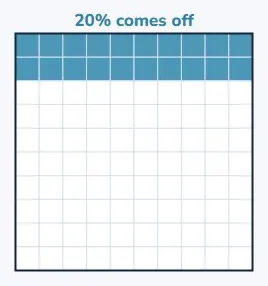
- A jacket is $45. The sign says 20% off.
- 20% off means 20% is taken away.
- So work out 20%, then subtract it.
20% off $45
- 10% of $45 is $4.50.
- 20% is two lots: $9.00.
- $45 − $9 = $36.00.
| Step | Working | Answer |
|---|---|---|
| 10% of $45 | $45 ÷ 10 | $4.50 |
| 20% is | two lots | $9.00 |
| Sale price | $45 − $9 | $36.00 |
The mistake to avoid
- $9 is the discount, not the price.
- Nobody sells a $45 jacket for $9.
- Always ask: does the answer look like a price?
| Number | What it is |
|---|---|
| $9.00 | how much you save |
| $36.00 | what you pay |
The one-step way
- If 20% comes off, you pay the other 80%.
- So find 80% and stop.
- 30% off means pay 70%. 15% off means pay 85%.
| Step | Working | Answer |
|---|---|---|
| 20% off | means you pay | 80% |
| 80% of $45 | 10% is $4.50, × 8 | $36.00 |
| Same answer | one step instead of two |
30% off $90, both ways
- Long way: 10% is $9, so 30% is $27. $90 − $27 = $63.
- Short way: pay 70%. That is seven lots of $9.
- $63 either way.
| Method | Working | Answer |
|---|---|---|
| Discount then subtract | $90 − $27 | $63 |
| Pay 70% | $9 × 7 | $63 |
Your turn: four questions
- Pause here and try all four.
- Question 4 needs the rounding before the change.
- Do it in that order or the answer is out by 4 cents.
| Question | |
|---|---|
| 1 | A total is $17.63. What do you pay in cash? |
| 2 | A jacket is $90 with 30% off. What is the sale price? |
| 3 | You pay for a $12.80 item with $20. What is the change? |
| 4 | A cash total is $8.86, paid with $10. What is the change? |
Show answer
1. $17.60. The 3 rounds down. 2. $63. 10% is $9, so 30% is $27, and $90 − $27 = $63. Or 70% of $90 straight off. 3. $7.20. No rounding needed: $12.80 is already a multiple of 10 cents. 4. $1.10. The total rounds up to $8.90 first, then $10 − $8.90.
The answers
- $17.63 rounds down to $17.60.
- 30% off $90 is $63. And $20 − $12.80 is $7.20.
- $8.86 rounds to $8.90, so the change is $1.10.
| Answer | |
|---|---|
| 1 | $17.60 |
| 2 | $63.00 |
| 3 | $7.20 |
| 4 | $1.10 |
What to take away
- Cash rounds to the nearest 10 cents. Card does not.
- Round once, on the total, at the very end.
- 30% off means pay 70%: one step, not two.
| Remember | |
|---|---|
| Money | always two decimal places |
| Cash | rounded to the nearest 10 cents |
| Card | charged to the exact cent |
| Change | count up from the total |
| 30% off | means you pay 70% |
Is your child on track?
Take the free placement test