Patterns, rules and the coordinate plane
What this lesson covers
- Algebra has its own specialised notation to express relationships and operations concisely, including 3b in place of b + b + b.
- A coordinate plane extends to 4 quadrants that meet at the origin (0, 0).
- Linear patterns have a constant increase or decrease, can be described by the rule t = a × n + d, and can be graphed as a straight line on a coordinate plane.
What is the 50th number in this pattern?
- 3, 5, 7, 9, 11...
- You could keep going. It would take a while.
- Or you could find the rule and jump straight there.
| Position n | Value t |
|---|---|
| 1 | 3 |
| 2 | 5 |
| 3 | 7 |
| 4 | 9 |
| 5 | 11 |
Put it in a table first
- Position on the left, value on the right.
- Position is called n. Value is called t.
- Now the pattern is easier to interrogate.
| Position n | Value t |
|---|---|
| 1 | 3 |
| 2 | 5 |
| 3 | 7 |
| 4 | 9 |
| 5 | 11 |
Find the step
- How much does it go up each time?
- Every single gap is 2.
- That constant step is what makes it linear.
| From | Step |
|---|---|
| 3 to 5 | + 2 |
| 5 to 7 | + 2 |
| 7 to 9 | + 2 |
| 9 to 11 | + 2 |
The shape of the rule
- Every linear pattern fits t = a × n + d.
- a is the step.
- d is the bit that shifts it up or down.
| Part | What it is |
|---|---|
| n | the position |
| a | the step |
| d | the starting adjustment |
| t | the value you get |
a is the easy one
- The step is 2, so a is 2.
- So far the rule is t = 2n + something.
- Now for the something.
| From | Step |
|---|---|
| 3 to 5 | + 2 |
| 5 to 7 | + 2 |
| 7 to 9 | + 2 |
| 9 to 11 | + 2 |
Go back one more step
- Position 1 holds 3. What would position 0 hold?
- One step back: 3 − 2 = 1.
- That is d. The rule is t = 2n + 1.
| Step | Working | Result |
|---|---|---|
| The step | is 2 | so a = 2 |
| Go back to n = 0 | 3 − 2 | so d = 1 |
| The rule | t = 2n + 1 |
Test it before you trust it
- n = 1 gives 2 × 1 + 1 = 3. Correct.
- n = 5 gives 2 × 5 + 1 = 11. Correct.
- Two checks is enough to be confident.
| Position | Working | Value |
|---|---|---|
| n = 1 | 2 × 1 + 1 | 3 |
| n = 3 | 2 × 3 + 1 | 7 |
| n = 5 | 2 × 5 + 1 | 11 |
So the 50th number is...
- n = 50, so 2 × 50 + 1.
- 101.
- No counting. That is what a rule is for.
| Position | Working | Value |
|---|---|---|
| n = 1 | 2 × 1 + 1 | 3 |
| n = 3 | 2 × 3 + 1 | 7 |
| n = 5 | 2 × 5 + 1 | 11 |
| n = 50 | 2 × 50 + 1 | 101 |
Algebra writes things short
- b + b + b is written 3b.
- 3 × b is also 3b; the times sign is dropped.
- And b × b is b².
| Long | Short | |
|---|---|---|
| b + b + b | written as | 3b |
| 3 × b | written as | 3b |
| a × b | written as | ab |
| b × b | written as | b² |
Why drop the times sign
- Because × looks far too much like the letter x.
- 3 × x + 2 is a nightmare to read.
- 3x + 2 is not.
| With the sign | Without |
|---|---|
| 3 × x + 2 | 3x + 2 |
| a × b × c | abc |
Like terms
- Terms with the same letter can be added together.
- 3a + a + a is 5a: five lots of a.
- Different letters cannot join.
| Expression | Why | Simplifies to |
|---|---|---|
| 3a + a + a | all a terms | 5a |
| 3b − 2b | all b terms | b |
4x + 3y + 2x
- The x terms go together: 4x + 2x = 6x.
- 3y has nothing to join.
- 6x + 3y. That is as simple as it gets.
| Expression | Why | Simplifies to |
|---|---|---|
| 3a + a + a | all a terms | 5a |
| 3b − 2b | all b terms | b |
| 4x + 3y + 2x | x with x only | 6x + 3y |
| 2a + 3a² | different powers | cannot join |
Rearranging a formula
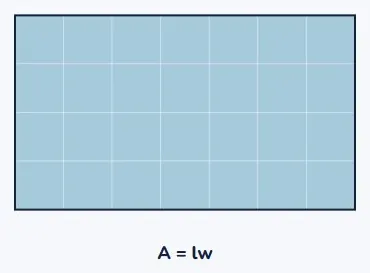
- A = lw gives the area from length and width.
- What if you know the area and want the width?
- Same balance rule as last lesson.
Making w the subject
- w is being multiplied by l.
- So divide both sides by l.
- w = A ÷ l.
| Step | Working | Result |
|---|---|---|
| A = lw | l is multiplying w | |
| Divide both by l | A ÷ l = w | |
| So | w = A ÷ l |
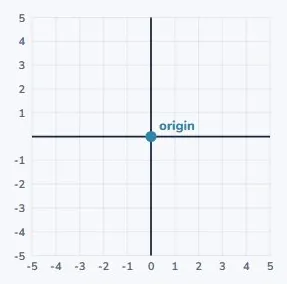
The plane goes four ways
- You have used the top-right corner for years.
- The axes carry on the other way too.
- Four regions, meeting at the origin, (0, 0).
Which quadrant is which
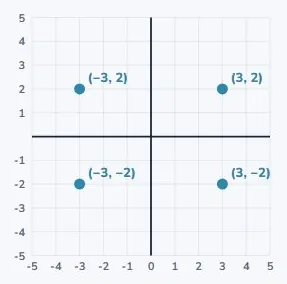
- The signs of the two numbers tell you.
- Both positive is the first, top right.
- Then anticlockwise from there.
The four, in order
- First: both positive.
- Second: x negative, y positive.
- Third: both negative. Fourth: x positive, y negative.
| Quadrant | Signs | Example |
|---|---|---|
| First | x positive, y positive | (3, 2) |
| Second | x negative, y positive | (−3, 2) |
| Third | x negative, y negative | (−3, −2) |
| Fourth | x positive, y negative | (3, −2) |
Now plot the pattern
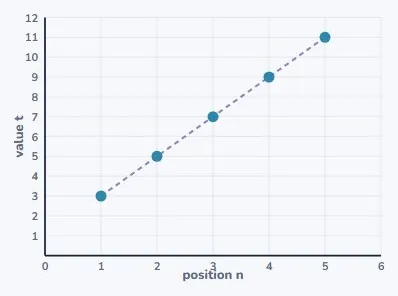
- Position across, value up. (1, 3), (2, 5), (3, 7)...
- Join them.
- A straight line, which is why it is called linear.
Four views of one thing
- The pattern, the table, the rule, the line.
- The step of 2 is in all four of them.
- It is the gap, the a, and how steep the line is.
| View | Where the 2 shows up |
|---|---|
| The numbers | each gap is 2 |
| The table | each row goes up 2 |
| The rule | t = 2n + 1 |
| The graph | up 2 for every 1 across |
Your turn: four questions
- Pause here and try all four.
- On question 2, find the step first, then go back to zero.
- On question 4, look at the signs.
| Question | |
|---|---|
| 1 | Simplify 5a + 3a − 2a. |
| 2 | A pattern goes 4, 7, 10, 13. What is the rule? |
| 3 | Make l the subject of A = lw. |
| 4 | Which quadrant is (−2, 3) in? |
Show answer
1. 6a. All three are a terms: 5 + 3 − 2 = 6. 2. t = 3n + 1. The step is 3, and going back one step from 4 gives 1 at position zero. 3. l = A ÷ w. Divide both sides by w. 4. The second quadrant: x is negative and y is positive, so it is top left.
The answers
- 5a + 3a − 2a is 6a. And the rule is t = 3n + 1.
- l = A ÷ w. Divide both sides by w.
- (−2, 3) is the second quadrant, top left.
| Answer | |
|---|---|
| 1 | 6a |
| 2 | t = 3n + 1 |
| 3 | l = A ÷ w |
| 4 | second quadrant |
What to take away
- The step is the number in front of n.
- d is what would sit at position zero.
- Only terms with the same letter can be collected.
| Remember | |
|---|---|
| A linear pattern | goes up by the same amount each time |
| That step | is the number in front of n |
| d | is what would sit at position zero |
| Like terms | same letter, same power; only those join |
| Four quadrants | the signs of x and y tell you which |
Is your child on track?
Take the free placement test