Metric units, and formulae run backwards
What this lesson covers
- Area is a two-dimensional measure, so its units are squared (e.g. cm²).
- Volume is a three-dimensional measure, so its units are cubed (e.g. cm³).
- Formulae represent the relationship between measurements and can be used to determine unknown measurements from known measurements.
- Shapes can be decomposed or recomposed to help find their measurements (e.g. their perimeters, areas, and volumes).
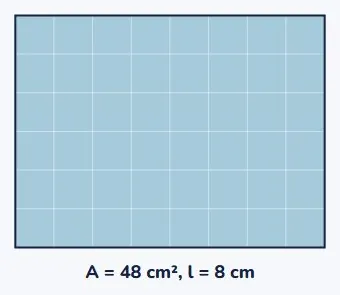
Area 48. One side is 8. What is the other?
- You know the formula: area is length times width.
- But you have the answer and want one of the inputs.
- Formulae run both ways, and this is how.
Three base measures
- The metre for length.
- The gram for mass.
- The litre for how much a container holds.
| Unit | Measures | Short |
|---|---|---|
| metre | length | m |
| gram | mass | g |
| litre | capacity | L |
Prefixes resize them
- Kilo means a thousand of them.
- Centi means a hundredth.
- Milli means a thousandth.
| Prefix | Means | Example |
|---|---|---|
| kilo– | 1000 of them | 1 km = 1000 m |
| centi– | one hundredth | 100 cm = 1 m |
| milli– | one thousandth | 1000 mm = 1 m |
Picking a sensible one
- A pencil in kilometres is a silly number.
- So is a road trip in millimetres.
- Choose the unit that gives a number you can say.
| Measuring | Use | Looks like |
|---|---|---|
| A pencil | centimetres | 18 cm |
| A rugby field | metres | 100 m |
| Wellington to Auckland | kilometres | 640 km |
| A grain of rice | millimetres | 6 mm |
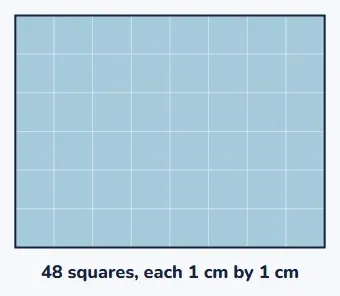
What cm² actually says
- It is not a decoration meaning "this is an area".
- It says centimetres times centimetres.
- The little 2 counts the directions.
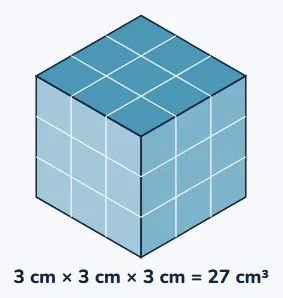
And cm³ counts three
- Length, width and height.
- Three directions multiplied, so a little 3.
- Each unit is a cube 1 cm on every edge.
One, two or three directions
- Length has one. Area has two. Volume has three.
- The exponent tells you which you are looking at.
- An area answered in cm is simply wrong.
| Measure | Units | Because |
|---|---|---|
| Length | cm | one direction |
| Area | cm² | cm × cm |
| Volume | cm³ | cm × cm × cm |
The perimeter formulae
- A square has four equal sides, so P = 4l.
- A rectangle has two of each, so P = 2(l + w).
- Both just add up the way round.
| Shape | Perimeter |
|---|---|
| Square | P = 4l |
| Rectangle | P = 2(l + w) |
A square has perimeter 36. Find a side.
- P = 4l, and P is 36. So 36 = 4l.
- Divide both sides by 4.
- l = 9 cm.
| Step | Working | Answer |
|---|---|---|
| Formula | P = 4l | |
| Known | 36 = 4l | |
| Divide both by 4 | l = 9 | 9 cm |
That was an equation
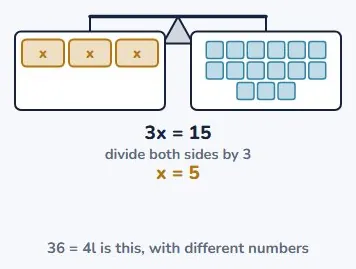
- 36 = 4l is exactly like 3x = 15.
- Divide both sides. Same rule as the balance.
- Nothing new to learn here at all.
Perimeter 30, one side 9
- 30 = 2(9 + w). Divide both sides by 2.
- 15 = 9 + w. Take 9 off both sides.
- w = 6 cm.
| Step | Working | Answer |
|---|---|---|
| Formula | P = 2(l + w) | |
| Known | 30 = 2(9 + w) | |
| Divide both by 2 | 15 = 9 + w | |
| Take 9 off both | w = 6 | 6 cm |
Back to the opening question
- A = lw, so 48 = 8 × w.
- Divide both sides by 8.
- w = 6 cm.
| Step | Working | Answer |
|---|---|---|
| Formula | A = lw | |
| Known | 48 = 8 × w | |
| Divide both by 8 | w = 6 | 6 cm |
Where the triangle formula comes from
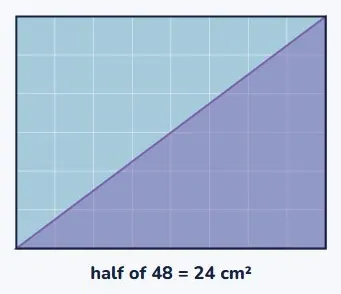
- A triangle is exactly half its rectangle.
- So A = bh, then halved.
- A = bh ÷ 2.
Area 24, height 6. Find the base.
- 24 = b × 6 ÷ 2. Multiply both sides by 2.
- 48 = 6b. Divide both sides by 6.
- b = 8 cm.
| Step | Working | Answer |
|---|---|---|
| Formula | A = bh ÷ 2 | |
| Known | 24 = b × 6 ÷ 2 | |
| Times both by 2 | 48 = 6b | |
| Divide both by 6 | b = 8 | 8 cm |
Shapes that are not rectangles
- An L-shape has no formula of its own.
- But it is made of rectangles.
- Cut it up, do each piece, add them.
| Method | Working | |
|---|---|---|
| Split it | 4 × 7 = 28 | plus 6 × 3 = 18 |
| Total | 46 cm² |
The other way: subtract the bite
- Treat it as a full 10 by 7 rectangle: 70.
- Then take off the missing 6 by 4 corner: 24.
- 70 − 24 = 46 cm². The same answer.
| Method | Working | |
|---|---|---|
| Split it | 4 × 7 = 28 | plus 6 × 3 = 18 |
| Total | 46 cm² | |
| Or subtract | 10 × 7 = 70 | minus 6 × 4 = 24 |
| Total | 46 cm² |
Two methods agreeing is the check
- There is no single right way to cut it up.
- So do it twice, differently.
- If they match, you are almost certainly right.
| Method | Answer |
|---|---|
| Split into two | 46 cm² |
| Subtract the bite | 46 cm² |
Your turn: four questions
- Pause here and try all four.
- Write each one as an equation first.
- Then solve it the way you would in algebra.
| Question | |
|---|---|
| 1 | A square has perimeter 52 cm. How long is each side? |
| 2 | A rectangle has area 72 cm² and width 6 cm. Find its length. |
| 3 | A triangle has area 30 cm² and base 10 cm. Find its height. |
| 4 | Convert 2.5 km to metres. |
Show answer
1. 13 cm. 52 = 4l, so divide both sides by 4. 2. 12 cm. 72 = 6 × l, so divide both sides by 6. 3. 6 cm. 30 = 10h ÷ 2, so 60 = 10h, so h = 6. 4. 2500 m. Kilo means a thousand, so multiply by 1000.
The answers
- 52 ÷ 4 = 13 cm. And 72 ÷ 6 = 12 cm.
- For the triangle, double first: 60 = 10h, so h = 6 cm.
- 2.5 km is 2500 m.
| Answer | |
|---|---|
| 1 | 13 cm |
| 2 | 12 cm |
| 3 | 6 cm |
| 4 | 2500 m |
What to take away
- cm² means cm × cm. The exponent counts directions.
- A formula runs backwards as well as forwards.
- Backwards is just solving an equation.
| Remember | |
|---|---|
| cm² | means cm × cm; it is not decoration |
| A formula | works forwards and backwards |
| Backwards | is just solving an equation |
| Compound shapes | split them, or subtract a bite |
| Two methods agreeing | is your check |
Is your child on track?
Take the free placement test