Classifying triangles by angles and sides
What this lesson covers
- Triangles can be categorised by their angles. An acute triangle has three acute angles. A right triangle has one right angle. An obtuse triangle has one obtuse angle.
- Triangles can also be categorised by their sides. An equilateral triangle has three equal-length sides. An isosceles triangle has at least two equal-length sides. A scalene triangle has different measures for each side length.
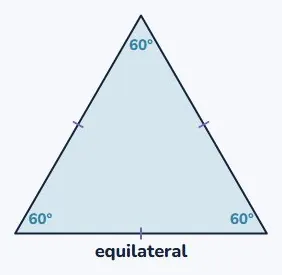
- All angles in an equilateral triangle are 60°.
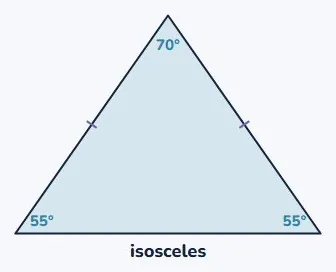
- The base angles (opposite the equal sides) of an isosceles triangle are equal.
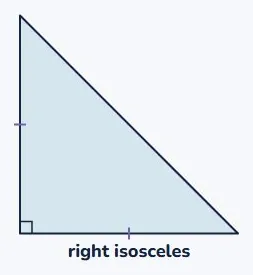
This triangle has two names
- One right angle, so it is a right triangle.
- Two equal sides, so it is also isosceles.
- Both at once, and neither one cancels the other.
Two separate questions
- What are its angles like?
- What are its sides like?
- You answer both, every time.
| Question | Possible answers |
|---|---|
| About the angles | acute, right, obtuse |
| About the sides | equilateral, isosceles, scalene |
The three angle names
- Acute: every angle under 90°.
- Right: exactly one angle of 90°.
- Obtuse: one angle over 90°.
| Name | Means |
|---|---|
| Acute | all three angles under 90° |
| Right | exactly one angle of 90° |
| Obtuse | one angle over 90° |
Only one angle can be 90 or more
- The three angles have to total 180°.
- Two 90s would use all of it, leaving nothing.
- So right and obtuse are never both true.
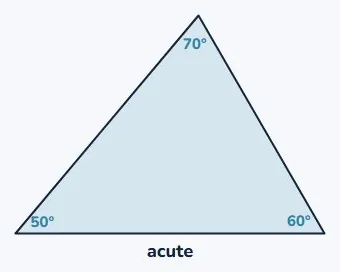
Acute: all three under 90
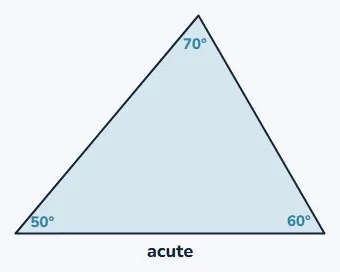
- 50, 60 and 70: every one of them under 90.
- They still add to 180.
- So this is an acute triangle.
The three side names
- Equilateral: all three sides equal.
- Isosceles: at least two equal.
- Scalene: all three different.
| Name | Means |
|---|---|
| Equilateral | all three sides equal |
| Isosceles | at least two sides equal |
| Scalene | all three sides different |
Equilateral
- Three equal sides, marked with matching ticks.
- And every angle is 60°.
- Because 180 shared equally three ways is 60.
Isosceles, and its equal base angles
- Two equal sides, marked with ticks.
- The angles opposite them are equal too.
- 55 and 55, with 70 at the top.
The same triangle, marked for angles
- Here are its angles: 50, 60, 70.
- All under 90, so it is acute.
- That is the angle answer.
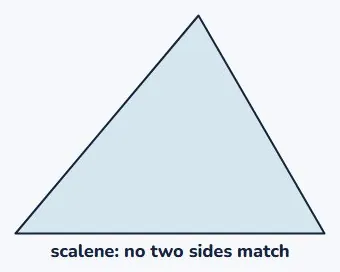
And now marked for sides
- Same triangle. No ticks anywhere.
- Because no two sides are the same length.
- Scalene. So the full name is acute scalene.
Three by three
- Three angle names across, three side names down.
- Nine possible combinations.
- Seven of them exist.
| Equilateral | Isosceles | Scalene | |
|---|---|---|---|
| Acute | yes (60/60/60) | yes (55/55/70) | yes (50/60/70) |
| Right | IMPOSSIBLE | yes (90/45/45) | yes (90/60/30) |
| Obtuse | IMPOSSIBLE | yes (100/40/40) | yes (100/50/30) |
Two boxes are empty
- There is no right equilateral triangle.
- And no obtuse equilateral triangle either.
- Not rare. Impossible.
| Equilateral | Isosceles | Scalene | |
|---|---|---|---|
| Acute | yes (60/60/60) | yes (55/55/70) | yes (50/60/70) |
| Right | IMPOSSIBLE | yes (90/45/45) | yes (90/60/30) |
| Obtuse | IMPOSSIBLE | yes (100/40/40) | yes (100/50/30) |
Why they cannot exist
- Three equal sides force three equal angles.
- They must total 180, so each is 60.
- 60 is under 90, so it is always acute.
| Because | It follows | |
|---|---|---|
| Three equal sides | means three equal angles | |
| They must total | 180° | |
| So each is | 180 ÷ 3 | 60° |
| 60 is under 90 | so always acute |
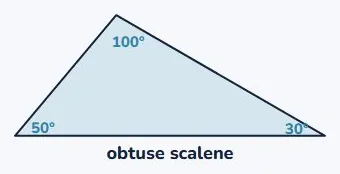
Name this one
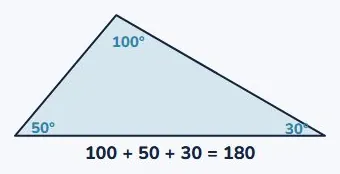
- One angle of 100, over 90, so obtuse.
- Three different angles mean three different sides.
- Obtuse scalene.
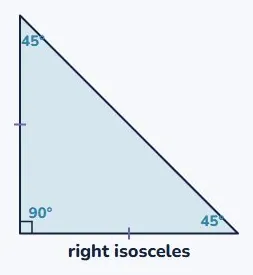
And this one
- A 90° angle, so right.
- Two ticks, so two equal sides. Isosceles.
- Right isosceles, the one we started with.
Your turn: four questions
- Pause here and try all four.
- Give both names wherever the question asks for them.
- Question 3 wants a reason, not just yes or no.
| Question | |
|---|---|
| 1 | A triangle has sides 5, 5 and 8 cm. What is its side name? |
| 2 | A triangle has angles 90°, 45°, 45°. Give both its names. |
| 3 | Can a triangle be obtuse and equilateral? Say why. |
| 4 | A triangle has angles 100°, 50°, 30°. Give both its names. |
Show answer
1. Isosceles. Two of its sides are equal. 2. Right isosceles. One 90° angle, and two equal angles mean two equal sides. 3. No. Equilateral means three equal sides, so three equal angles, so 180 ÷ 3 = 60° each. Every angle is 60, so none can be over 90. 4. Obtuse scalene. One angle over 90, and three different angles mean three different sides.
The answers
- 5, 5, 8 is isosceles. 90, 45, 45 is right isosceles.
- No obtuse equilateral: every angle would have to be 60.
- 100, 50, 30 is obtuse scalene.
| Answer | |
|---|---|
| 1 | isosceles |
| 2 | right isosceles |
| 3 | no, equilateral is always 60/60/60 |
| 4 | obtuse scalene |
What to take away
- Ask two questions: about the angles, about the sides.
- Equal sides always mean equal opposite angles.
- Equilateral is 60/60/60, so it can only ever be acute.
| Remember | |
|---|---|
| Two questions | what are the angles like, what are the sides like |
| By angle | acute, right, or obtuse |
| By side | equilateral, isosceles, or scalene |
| Equilateral | is always 60/60/60, so always acute |
| Isosceles | base angles are equal |
Is your child on track?
Take the free placement test