Exterior angles, transformations and nets
What this lesson covers
- The sum of the exterior angles of a polygon is 360°.
- In a regular polygon, all exterior angles are the same; an exterior angle can be found by subtracting the interior angle from 180° or by dividing 360° by the number of sides.
Walk round any shape and you turn 360°
- Any polygon at all. Three sides or thirty.
- Regular or completely lopsided.
- Always exactly one full circle.
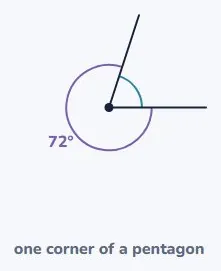
What an exterior angle is
- Stand on a side and walk to the corner.
- How far do you swing round to face the next side?
- That swing is the exterior angle.
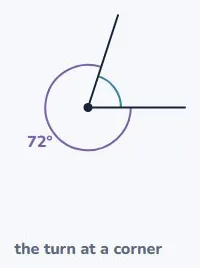
Why they total 360
- Walk the whole way round and come back.
- You end up facing the direction you started.
- So the turns added up to one whole circle.
| Step | What happens | Total |
|---|---|---|
| At each corner | you turn by the exterior angle | |
| Back at the start | you face the original way | |
| So you turned | exactly one full circle | 360° |
The number of sides makes no difference
- More corners means more turns.
- But each one is smaller.
- The total is still one circle. Always 360.
A regular polygon shares them out equally
- All its corners are identical.
- So each exterior angle is 360 divided by the sides.
- A pentagon: 360 ÷ 5 = 72°.
| Shape | Exterior | Interior |
|---|---|---|
| Triangle | 360 ÷ 3 = 120° | 60° |
| Square | 360 ÷ 4 = 90° | 90° |
| Pentagon | 360 ÷ 5 = 72° | 108° |
| Hexagon | 360 ÷ 6 = 60° | 120° |
| Octagon | 360 ÷ 8 = 45° | 135° |
And the interior angle comes free
- The interior and exterior sit on a straight line.
- So they add to 180.
- Pentagon: 180 − 72 = 108°.
| Fact | Working | Answer |
|---|---|---|
| Interior + exterior | they lie on a straight line | 180° |
| Pentagon exterior | 72° | |
| So its interior | 180 − 72 | 108° |
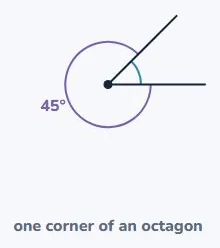
A regular octagon
- Eight sides, so exterior is 360 ÷ 8 = 45°.
- Interior is 180 − 45 = 135°.
- Two divisions and one subtraction. That is all of it.
| Shape | Exterior | Interior |
|---|---|---|
| Triangle | 360 ÷ 3 = 120° | 60° |
| Square | 360 ÷ 4 = 90° | 90° |
| Pentagon | 360 ÷ 5 = 72° | 108° |
| Hexagon | 360 ÷ 6 = 60° | 120° |
| Octagon | 360 ÷ 8 = 45° | 135° |
Now moving shapes about
- Three ways: slide, flip and turn.
- Translation, reflection and rotation.
- Each one needs to be told something different.
| Name | Plain word | Needs |
|---|---|---|
| Translation | a slide | how far across and up |
| Reflection | a flip | the mirror line |
| Rotation | a turn | the centre and the angle |
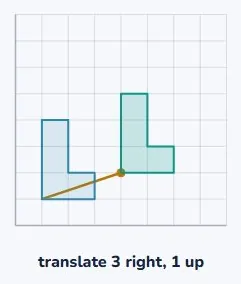
A slide
- Every point moves the same distance the same way.
- Here: 3 across and 1 up.
- The shape arrives exactly as it left.
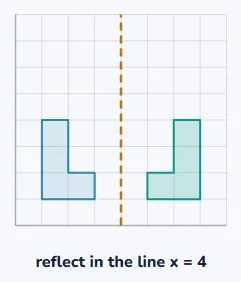
A flip
- Every point crosses the mirror line.
- And lands the same distance on the other side.
- The shape is reversed but not resized.
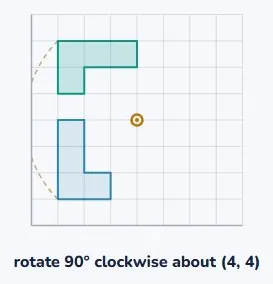
A turn
- Pick a centre point and an angle.
- Here: a quarter turn about (4, 4).
- Multiples of 90 keep it on the grid lines.
What never changes
- The sides are the same length.
- The angles are the same size. The area is the same.
- Only its position moved.
| Property | After the move |
|---|---|
| Side lengths | unchanged |
| Angles | unchanged |
| Area | unchanged |
| Where it is | THIS is what changes |
Solids are made of flat shapes
- A cube is six squares.
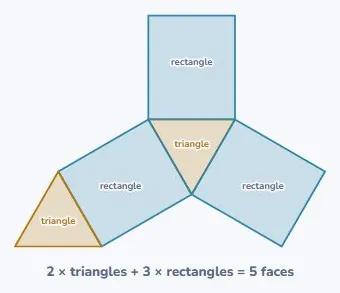
- A triangular prism is two triangles and three rectangles.
- Name the flat shapes and you know the solid.
| Solid | Made of | and |
|---|---|---|
| Cube | 6 squares | |
| Triangular prism | 2 triangles | 3 rectangles |
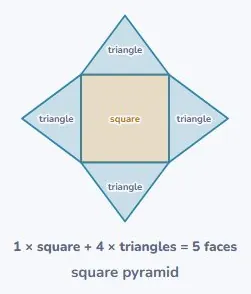
| Square pyramid | 1 square | 4 triangles |
| Hexagonal prism | 2 hexagons | 6 rectangles |
A net is the solid, unfolded
- Cut along some edges and flatten it out.
- Every face is still there.
- None appear, none disappear.
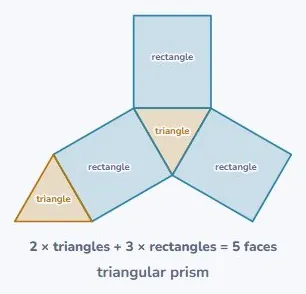
Counting a prism net
- One rectangle for each side of the base.
- Plus the two ends.
- A triangular prism: 3 rectangles and 2 triangles.
And a pyramid
- One triangle for each side of the base.
- Plus the base itself. Only one, not two.
- A square pyramid: 4 triangles and 1 square.
So you can count without drawing
- A prism on an n-sided base has n + 2 faces.
- A pyramid on an n-sided base has n + 1.
- A hexagonal prism: 6 + 2 = 8 faces.
| Solid | Made of | Total |
|---|---|---|
| Prism on an n-gon | n rectangles + 2 ends | n + 2 faces |
| Pyramid on an n-gon | n triangles + 1 base | n + 1 faces |
Your turn: four questions
- Pause here and try all four.
- Question 1 needs one division and nothing else.
- Question 4 wants a reason.
| Question | |
|---|---|
| 1 | A regular polygon has 12 sides. Find one exterior angle. |
| 2 | Find one interior angle of that same polygon. |
| 3 | How many faces does the net of a pentagonal prism have? |
| 4 | A shape is rotated 90° about a point. Does its area change? |
Show answer
1. 30°. The exterior angles total 360 and there are 12 of them, so 360 ÷ 12. 2. 150°. Interior and exterior make a straight line, so 180 − 30. 3. 7. Five rectangles round the sides plus two pentagon ends. 4. No. A rotation changes where a shape is and nothing about the shape itself.
The answers
- 360 ÷ 12 = 30°, and 180 − 30 = 150°.
- A pentagonal prism net has 5 + 2 = 7 faces.
- No. A rotation moves a shape and changes nothing about it.
| Answer | |
|---|---|
| 1 | 30° |
| 2 | 150° |
| 3 | 7 faces |
| 4 | no, area is unchanged |
What to take away
- Exterior angles always total 360, whatever the polygon.
- For a regular one, each is 360 ÷ n, and interior is 180 − that.
- Sliding, flipping and turning change nothing but position.
| Remember | |
|---|---|
| Exterior angles | always total 360°, whatever the polygon |
| Regular polygon | each exterior angle is 360 ÷ n |
| Interior | is 180 − exterior |
| Slide, flip, turn | the shape never changes, only its position |
| A net | has every face the solid has, and no more |
Is your child on track?
Take the free placement test