Integers, and adding below zero
What this lesson covers
- The number system extends infinitely, including into negative numbers, and can be represented with a number line.
- Integers are all the whole numbers, including positive whole numbers, negative whole numbers, and zero.
- Every number has an additive inverse, and their sum is zero (e.g. −5 and 5 are additive inverses; −5 + 5 = 0 and 5 + −5 = 0).
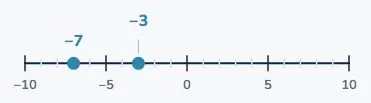
Which is bigger: −7 or −3?
- Most people say −7, because 7 is bigger than 3.
- −3 is bigger.
- One picture makes that obvious and keeps it obvious.
What an integer is
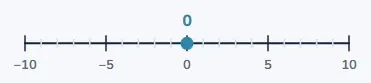
- All the whole numbers, going both ways.
- Negatives, zero, and positives.
- No halves, no fractions, no decimals.
| Number | An integer? |
|---|---|
| −7 | yes, a negative whole number |
| 0 | yes, zero is an integer |
| 12 | yes, a positive whole number |
| 2.5 | no, not a whole number |
| 3/4 | no, not a whole number |
The line runs both ways forever
- Zero is not the end of the line. It is the middle.
- Numbers keep going left, as far as you like.
- And further left always means smaller.
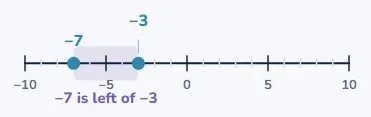
So −7 is smaller than −3
- −7 sits further left than −3.
- Further left, smaller. Same rule as always.
- There is no separate rule for negatives.
Put five numbers in order
- −7, 3, −1, 0, −10.
- Find each one on the line, then read left to right.
- −10, −7, −1, 0, 3.
| Number | Where | |
|---|---|---|
| −10 | furthest left | smallest |
| −7 | left of −1 | |
| −1 | just left of 0 | |
| 0 | the middle | |
| 3 | furthest right | largest |
Every number has a partner
- −5 and 5 are the same distance from zero.
- Add them and you land back on zero.
- That partner is called the additive inverse.
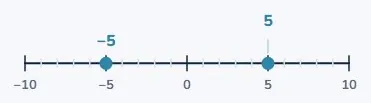
Their sum is always zero
- Start at −5 and add 5. You reach 0.
- It works the other way round too.
- Zero is its own partner.
| Pair | Adds to |
|---|---|
| −5 and 5 | −5 + 5 = 0 |
| 12 and −12 | 12 + −12 = 0 |
| 0 and 0 | 0 + 0 = 0 |
The only rule you need
- Adding moves you right along the line.
- Subtracting moves you left.
- It makes no difference where you start.
| Operation | On the line |
|---|---|
| Adding | move right |
| Subtracting | move left |
| Where you start | makes no difference |
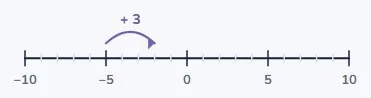
−5 + 3
- Stand on −5.
- Adding, so move 3 to the right.
- You land on −2.
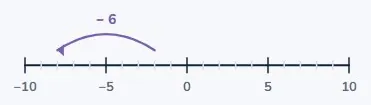
−2 − 6
- Stand on −2.
- Subtracting, so move 6 to the left.
- You land on −8.
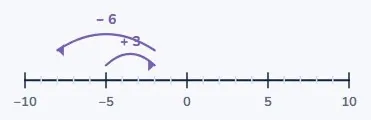
Two jumps in a row
- −5 + 3 − 6.
- Right 3 to −2, then left 6.
- −8. Each jump starts where the last one landed.
Crossing zero changes nothing
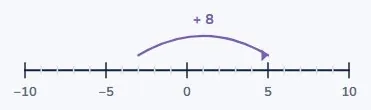
- Start at −3 and add 8. Move 8 right.
- You pass through zero on the way.
- Land on 5. No special rule for the crossing.
The line stood on its end
- A thermometer is a number line turned upright.
- Adding is now up. Subtracting is down.
- Same rule, turned a quarter turn.
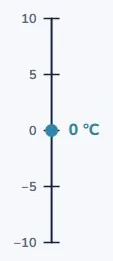
A frosty morning
- Overnight it dropped to −6 °C.
- By midday it had risen 9 degrees.
- −6 + 9 = 3 °C.
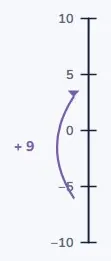
Reading it back
- It went up 9, but it only reached 3.
- Six of those degrees were spent getting to zero.
- Then three more above it.
| Step | Value |
|---|---|
| Overnight low | −6 °C |
| Rose by | 9 degrees |
| By midday | 3 °C |
An account in the red
- A balance of −$40 means owing $40.
- $65 goes in. Move 65 to the right.
- The balance is now $25.
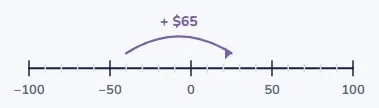
Why it is not $65
- The first $40 cleared what was owed.
- Only the rest is actually yours.
- $65 − $40 = $25.
| Step | Value |
|---|---|
| Balance | −$40 (overdrawn) |
| Paid in | $65 |
| New balance | $25 |
Your turn: four questions
- Pause here and try all four.
- Draw the line for questions 3 and 4.
- It is faster than trying to hold it in your head.
| Question | |
|---|---|
| 1 | Put in order, smallest first: −7, 3, −1, 0, −10 |
| 2 | What is the additive inverse of −12? |
| 3 | Work out −4 − 7. |
| 4 | An account is −$85. A deposit of $130 goes in. What now? |
Show answer
1. −10, −7, −1, 0, 3. Furthest left first. 2. 12, because −12 + 12 = 0. 3. −11. Start at −4 and move 7 further left. 4. $45. Start at −85 and move 130 right, crossing zero at 85.
The answers
- −10, −7, −1, 0, 3. And the inverse of −12 is 12.
- −4 − 7 is −11: start at −4, move 7 further left.
- −85 + 130 is $45; it crosses zero at 85.
| Answer | |
|---|---|
| 1 | −10, −7, −1, 0, 3 |
| 2 | 12, because −12 + 12 = 0 |
| 3 | −11 |
| 4 | $45 |
What to take away
- Further left is smaller. That is why −7 < −3.
- Adding moves right, subtracting moves left, always.
- Every number has a partner that brings you back to zero.
| Remember | |
|---|---|
| Integers | whole numbers, negative, zero and positive |
| Further left | is always smaller, so −7 < −3 |
| Adding | moves right, wherever you start |
| Subtracting | moves left, wherever you start |
| Additive inverse | the partner that brings you back to 0 |
Is your child on track?
Take the free placement test