Multiplying and dividing fractions and decimals
What this lesson covers
- In the simplest form of a fraction, the numerator and denominator do not share a common factor.
- Scaling by powers of 10 and using number facts supports multiplication with decimals.
12 ÷ 1/4 = 48
- Dividing just made the number bigger.
- That is not a typo and it is not a mistake.
- By the end of this it will be obvious.
| Calculation | Answer |
|---|---|
| 12 ÷ 4 | 3 |
| 12 ÷ 1/4 | 48 |
Multiplying by ten shifts the digits
- Every digit moves one column to the left.
- Dividing by ten moves them one to the right.
- The decimal point never actually moves.
| Calculation | What happens | Result |
|---|---|---|
| 3.5 × 10 | each digit moves one column left | 35 |
| 3.5 × 100 | two columns left | 350 |
| 3.5 ÷ 10 | one column right | 0.35 |
| 3.5 ÷ 100 | two columns right | 0.035 |
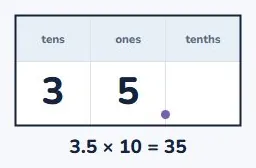
Watch it in the columns
- 3.5 has a 3 in ones and a 5 in tenths.
- × 10 and the 3 becomes tens, the 5 becomes ones.
- Same digits, one column left. 35.
One fact, four answers
- If you know 7 × 5 = 35, you know all of these.
- Work out the easy one, then fix the size.
- 0.7 × 50 is 35; the shifts cancel out.
| Calculation | Reasoning | Answer |
|---|---|---|
| 7 × 5 | the fact you know | 35 |
| 0.7 × 5 | 7 is ten times too big | 3.5 |
| 0.7 × 50 | 7 down ten, 5 up ten | 35 |
| 0.07 × 5 | 7 is a hundred times too big | 0.35 |
0.35 × 6
- Ignore the point: 35 × 6 = 210.
- 0.35 has two decimal places.
- Put two back: 2.10, which is 2.1.
| Step | Working | Result |
|---|---|---|
| Ignore the point | 35 × 6 | 210 |
| Count the places | 0.35 has two | |
| Put them back | 210 with two places | 2.10 |
| Tidy up | drop the trailing zero | 2.1 |
Check the size is right
- 0.35 is about a third. Six thirds is about two.
- The answer was 2.1. That fits.
- 21 or 0.21 would not have.
| Answer | Against "about 2" |
|---|---|
| 2.1 | right size |
| 21 | ten times too big |
| 0.21 | ten times too small |
A fraction of an amount
- Three quarters of 20.
- Divide by the bottom to get one quarter: 5.
- Multiply by the top to get three of them: 15.
| Step | Working | Result |
|---|---|---|
| 3/4 of 20 | divide by the bottom | 20 ÷ 4 = 5 |
| multiply by the top | 5 × 3 = 15 | |
| Answer | 15 |
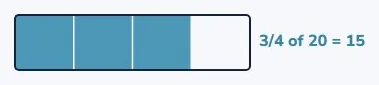
The same thing as a picture
- Twenty, cut into four equal parts of 5.
- Take three of those parts.
- 15 out of 20.
Times a fraction is the same thing
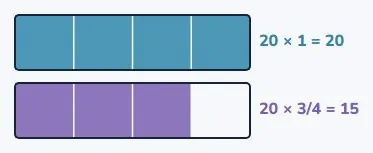
- 3/4 of 20 and 20 × 3/4 are the same question.
- Both give 15.
- And 15 is smaller than 20: multiplying shrank it.
| Written | Answer |
|---|---|
| 3/4 of 20 | 15 |
| 20 × 3/4 | 15 |
Why it shrank
- × 2 means take two of them.
- × 3/4 means take three quarters of one.
- Less than a whole one, so less than you started with.
Always leave it in simplest form
- An answer of 6/21 is correct but not finished.
- 6 and 21 both divide by 3.
- So write 2/7.
| Answer | Shared factor | Simplest |
|---|---|---|
| 6/21 | 3 | 2/7 |
| 2/12 | 2 | 1/6 |
| 15/20 | 5 | 3/4 |
3/4 ÷ 3
- Three quarters, shared between three people.
- One quarter each.
- Dividing made it smaller, as usual.
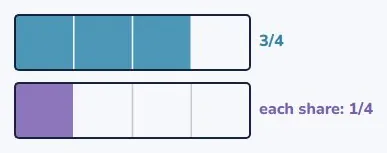
2/3 ÷ 4
- Two thirds shared four ways.
- Cut each third into four: twelfths. 2/12.
- Simplify: 1/6.
| Calculation | Working | Answer |
|---|---|---|
| 3/4 ÷ 3 | three quarters, shared three ways | |
| Each share | one quarter | 1/4 |
| 2/3 ÷ 4 | 2/12, then simplify | 1/6 |
Now the other kind
- 12 ÷ 1/4 is a different question entirely.
- Not "share 12 between a quarter of a person".
- It asks: how many quarters fit into 12?
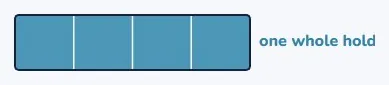
How many quarters in 12?
- Each whole one holds four quarters.
- There are twelve wholes.
- 12 × 4 = 48.
| Step | Working | Answer |
|---|---|---|
| 12 ÷ 1/4 | how many quarters in 12? | |
| Each whole | holds 4 quarters | |
| 12 wholes | 12 × 4 | 48 |
The pattern behind both
- Multiplying by less than 1 shrinks.
- Dividing by less than 1 grows.
- The old rules were only true for numbers above 1.
| Operation | Effect |
|---|---|
| × a number above 1 | grows |
| × a number below 1 | shrinks |
| ÷ a number above 1 | shrinks |
| ÷ a number below 1 | grows |
Your turn: four questions
- Pause here and try all four.
- On question 1, start from 6 × 4.
- On question 4, ask how many thirds fit.
| Question | |
|---|---|
| 1 | Work out 0.6 × 40. |
| 2 | Find 2/5 of 35. |
| 3 | Work out 6/7 ÷ 3 in simplest form. |
| 4 | Work out 5 ÷ 1/3. |
Show answer
1. 24. Use 6 × 4 = 24: the 6 went down ten and the 4 went up ten, so they cancel. 2. 14. 35 ÷ 5 = 7, then 7 × 2 = 14. 3. 2/7. Six sevenths shared three ways is 6/21, and 6 and 21 share a 3. 4. 15. There are three thirds in every whole, and five wholes, so 5 × 3.
The answers
- 0.6 × 40 is 24; the shifts cancel.
- 2/5 of 35 is 14. And 6/7 ÷ 3 is 2/7.
- 5 ÷ 1/3 is 15: three thirds in each of five wholes.
| Answer | |
|---|---|
| 1 | 24 |
| 2 | 14 |
| 3 | 2/7 |
| 4 | 15 |
What to take away
- Do the easy whole-number fact, then fix the size.
- A fraction of an amount: divide by the bottom, times the top.
- Dividing by a fraction asks how many fit, so it grows.
| Remember | |
|---|---|
| × 10, ÷ 10 | the digits shift columns |
| Decimal × whole | do the easy fact, then place the point |
| Fraction of an amount | divide by the bottom, times the top |
| Fraction ÷ whole | the pieces get smaller |
| Whole ÷ unit fraction | how many fit; the answer grows |
Is your child on track?
Take the free placement test