Patterns, rules and the four quadrants

What this lesson covers
- A coordinate plane extends to 4 quadrants that meet at the origin (0, 0).
- Linear patterns have a constant increase or decrease, can be described by the rule t = a × n + d, and can be graphed as a straight line on a coordinate plane.
The grid goes all four ways
- You have used the top right corner for years.
- The axes carry on the other way as well, into negatives.
- That makes four regions, meeting at the origin, (0, 0).
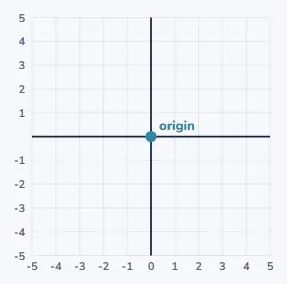
Four quadrants, numbered anticlockwise
- The first is the top right, where both are positive.
- Then you go anticlockwise: second, third, fourth.
- The signs tell you which one a point lands in.
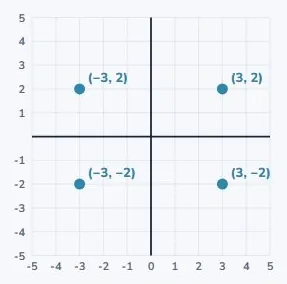
And the order never changes
- x first, then y. Along the corridor, then up the stairs.
- (−3, 2) means 3 to the left and 2 up.
- (2, −3) is a completely different point.
| Quadrant | Signs | Example |
|---|---|---|
| First | x positive, y positive | (3, 2) |
| Second | x negative, y positive | (−3, 2) |
| Third | x negative, y negative | (−3, −2) |
| Fourth | x positive, y negative | (3, −2) |
Now a pattern: 5, 8, 11, 14
- Number the positions: 1st, 2nd, 3rd, 4th. Call that n.
- The value at each position is the term. Call that t.
- We want a rule that turns any n into its t.
| Position n | Term t |
|---|---|
| 1 | 5 |
| 2 | 8 |
| 3 | 11 |
| 4 | 14 |
Find the step between terms
- 5 to 8 is +3. 8 to 11 is +3. 11 to 14 is +3.
- The same every time, which is what makes it linear.
- That constant step is the a in t = a × n + d.
| From | Step | |
|---|---|---|
| 5 to 8 | +3 | |
| 8 to 11 | +3 | |
| 11 to 14 | +3 | |
| Constant | so the pattern is linear | a = 3 |
So is the rule just t = 3n?
- It is the obvious guess, and it is worth testing.
- At n = 1 it gives 3.
- But the first term is 5. The rule is wrong.
| Try | Working | Gives |
|---|---|---|
| Try t = 3n | at n = 1 that gives | 3 |
| But the first term is | 5 |
Wrong by the same amount every time
- It is 2 short at n = 1. And at n = 2. And at n = 3.
- So add 2 to it. t = 3n + 2.
- That 2 is the d, and this is how you find it.
| Try | Working | Gives |
|---|---|---|
| Try t = 3n | at n = 1 that gives | 3 |
| But the first term is | 5 | |
| Short by | 2 | |
| So | t = 3n + 2 |
What d actually is
- Run the table backwards one step, to n = 0.
- 3 times 0 plus 2 is 2.
- So d is what the term before the first one would have been.
| Position | Working | Term |
|---|---|---|
| n = 1 | 3 + 2 | 5 |
| n = 0 | 0 + 2 | 2 |
| So d is | the term before the first one | 2 |
Always test against the first term
- Finding a is easy. Everyone gets that bit.
- Forgetting to check is why t = 3n gets handed in.
- One substitution, five seconds, catches it every time.
| Rule | At n = 1 | Verdict |
|---|---|---|
| t = 3n | 3 | wrong, first term is 5 |
| t = 3n + 2 | 5 | right |
Now the rule earns its keep
- The 10th term: 3 times 10 plus 2, which is 32.
- The 50th: 152. The 100th: 302.
- You never had to write the pattern out to get there.
| Position | Working | Term |
|---|---|---|
| n = 10 | 3(10) + 2 | 32 |
| n = 50 | 3(50) + 2 | 152 |
| n = 100 | 3(100) + 2 | 302 |
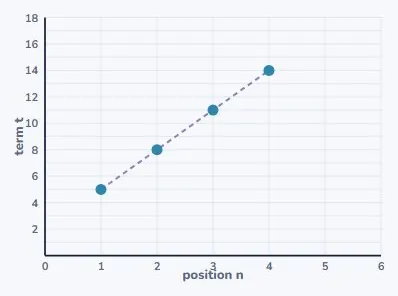
Plotted, it is a straight line
- Position along the bottom, term up the side.
- (1, 5), (2, 8), (3, 11), (4, 14).
- Perfectly straight, because the step never changes.
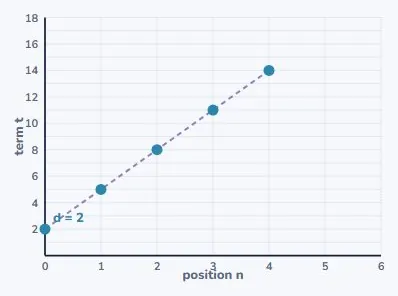
And d is where the line starts
- Follow the line back to position zero.
- It crosses at 2, which is the d we found.
- The step a is how steeply it climbs.
When the pattern goes down
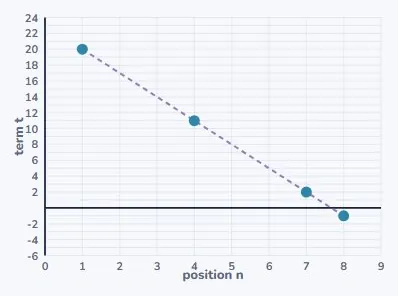
- 20, 17, 14, 11. The step is −3, so a is negative.
- At n = 1, −3 plus d must be 20, so d is 23.
- t = −3n + 23.
| Step | Working | Gives |
|---|---|---|
| 20, 17, 14, 11 | goes down by 3 | a = −3 |
| At n = 1 | −3 + d = 20 | d = 23 |
| So | t = −3n + 23 |
Which eventually goes below zero
- At n = 8: −24 plus 23 is −1.
- The pattern has run past zero into negative terms.
- And the graph drops into the fourth quadrant.
Three patterns worth knowing
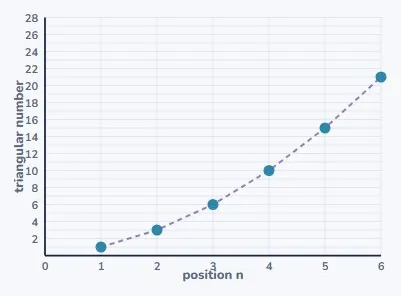
- Triangular: 1, 3, 6, 10, 15. Dots stacked in a triangle.
- Square: 1, 4, 9, 16, 25. And cube: 1, 8, 27, 64, 125.
- All three turn up constantly. Now look at their steps.
| Family | Starts | Steps |
|---|---|---|
| Triangular | 1, 3, 6, 10, 15 | differences 2, 3, 4, 5 |
| Square | 1, 4, 9, 16, 25 | differences 3, 5, 7, 9 |
| Cube | 1, 8, 27, 64, 125 | differences grow fast |
None of them is linear
- Triangular goes up by 2, then 3, then 4, then 5.
- That is not constant, so t = an + d cannot describe it.
- Plotted, they curve. The rules for those come later.
So check the differences first
- Before reaching for t = an + d, take the differences.
- Constant? Then it is linear and the rule applies.
- Not constant? Then it does not, and forcing it gives nonsense.
| Test | Meaning | |
|---|---|---|
| Linear needs | the same difference every time | |
| Triangular gives | 2, then 3, then 4 | not constant |
| So t = an + d | does not apply |
Your turn: four questions
- Pause here and try all four.
- For question 1, test your rule at n = 1 before you write it down.
- Question 4 wants a reason, not just yes or no.
| Question | |
|---|---|
| 1 | Find the rule for 7, 10, 13, 16. |
| 2 | Which quadrant holds the point (−5, 3)? |
| 3 | For t = 4n − 1, what is the 10th term? |
| 4 | Is 1, 3, 6, 10 a linear pattern? How do you know? |
Show answer
1. t = 3n + 4. The difference is 3, and 3n would give 3 at n = 1 when the first term is 7, so it is 4 short. 2. The second. x is negative and y is positive. 3. 39. Substitute n = 10 to get 40 − 1. 4. No. The differences are 2, 3 and 4, which are not constant. These are the triangular numbers, and their rule is not of the form an + d.
The answers
- t = 3n + 4. The step is 3, and 3n is 4 short at n = 1.
- (−5, 3) is in the second quadrant. And 4(10) − 1 is 39.
- 1, 3, 6, 10 is not linear. Its steps are 2, 3, 4.
| Answer | |
|---|---|
| 1 | t = 3n + 4 |
| 2 | second |
| 3 | 39 |
| 4 | no, steps are 2, 3, 4 |
What to take away
- a is the constant step. d is the term before the first one.
- Test every rule at n = 1. That is where t = 3n dies.
- And if the differences are not constant, it is not linear.
| Remember | |
|---|---|
| Four quadrants | numbered anticlockwise from the top right |
| a | is the constant difference |
| d | is what the term before the first one would be |
| Always test | your rule against n = 1 |
| No constant difference | means it is not linear at all |
Is your child on track?
Take the free placement test