The parts of a circle
What this lesson covers
- The radius is the distance from the outside of a circle to the centre.
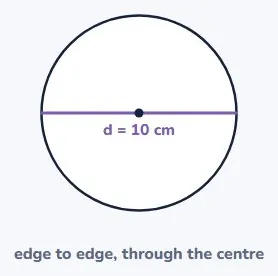
- The diameter is the length of a line through the centre of a circle that touches opposite points on the edge of the circle.
- The circumference is the distance around a circle.
A circle is defined by a distance
- A square is defined by its sides. A triangle by its three.
- A circle has no sides at all.
- It is defined by one distance, from one point.
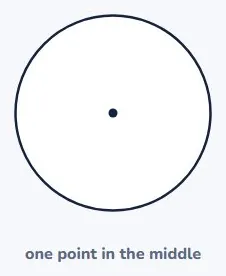
Every point, the same distance out
- Pick a centre. Pick a distance.
- Mark every point that is exactly that far from the centre.
- What you have drawn is a circle. That is the whole definition.
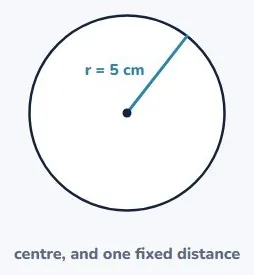
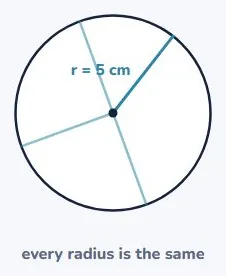
That distance is the radius
- From the centre out to the edge. Always the same.
- Draw three of them and they are equal lengths.
- Not by coincidence. That is what made it a circle.
The four words you need
- Centre, radius, diameter, circumference.
- The centre is the only one not on the circle itself.
- The other three are all lengths.
| Part | What it is | Symbol |
|---|---|---|
| Centre | the point in the middle | not on the circle |
| Radius | centre to the edge | r |
| Diameter | edge to edge, through the centre | d |
| Circumference | the distance all the way round | C |
The diameter goes all the way across
- Edge to edge, passing through the centre.
- It touches the circle at two opposite points.
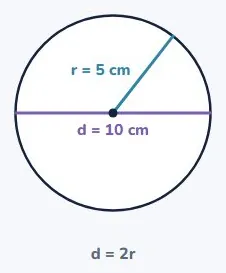
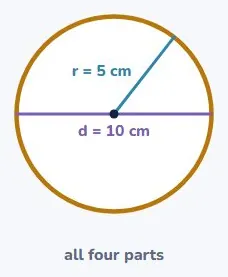
- And it is made of two radii, back to back.
So the diameter is twice the radius
- Two radii laid end to end. d = 2r.
- Radius 5 centimetres means diameter 10.
- Going back, halve it. Diameter 18 means radius 9.
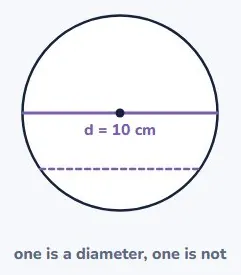
Through the centre, or it does not count
- Here is another line from edge to edge.
- It misses the centre, so it is not a diameter.
- That phrase in the definition is doing real work.
And it is the longest line across
- Slide that other line towards the centre and it gets longer.
- It is longest exactly when it passes through.
- No line across a circle beats its diameter.
| Line | Where | Verdict |
|---|---|---|
| Through the centre | edge to edge | a diameter |
| Not through the centre | edge to edge | just a chord |
| The diameter | is the longest line across |
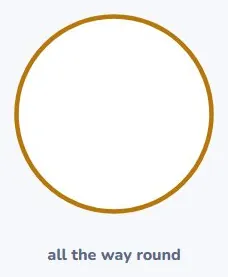
The circumference is the way round
- Not across. Around.
- It is the perimeter of the circle, under a different name.
- If you walked the edge, that is how far you would go.
Three lengths, always in the same order
- The radius is shortest.
- The diameter is exactly twice it.
- And the circumference is longer than both. Always.
| Length | Size | Order |
|---|---|---|
| Radius | r | shortest |
| Diameter | 2r | twice that |
| Circumference | about 3.14 × d | longest |
But how much longer?
- The diameter is twice the radius, exactly.
- So how many diameters is the circumference?
- That is a question you can answer with a piece of string.
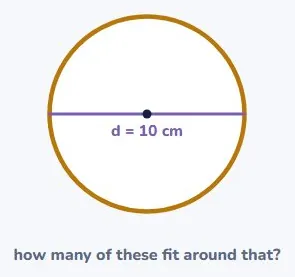
So measure some circles
- A dinner plate, 10 centimetres across, is about 31.4 round.
- A 2 metre trampoline is about 6.3 metres round.
- A bike wheel 70 centimetres across is about 220 round.
| Circle | Across | Around |
|---|---|---|
| A dinner plate | d = 10 cm | C is about 31.4 cm |
| A trampoline | d = 2 m | C is about 6.3 m |
| A bike wheel | d = 70 cm | C is about 220 cm |
Now divide each one by its diameter
- 31.4 divided by 10 is about 3.14.
- 6.3 divided by 2 is about 3.14.
- 220 divided by 70 is about 3.14. Every time.
| Working | Gives | |
|---|---|---|
| 31.4 ÷ 10 | about 3.14 | |
| 6.3 ÷ 2 | about 3.14 | |
| 220 ÷ 70 | about 3.14 | |
| Every circle | ever measured | about 3.14 |
That is not about those three circles
- It happens for a bottle top and for a planet.
- Every circle is a little over three diameters around.
- The size cancels out. Only the shape is left.
| Working | Gives | |
|---|---|---|
| 31.4 ÷ 10 | about 3.14 | |
| 6.3 ÷ 2 | about 3.14 | |
| 220 ÷ 70 | about 3.14 | |
| Every circle | ever measured | about 3.14 |
That number has a name
- It is called pi, written with the Greek letter.
- 3.14159 and onwards, never repeating, never stopping.
- Which is why we say "about 3.14".
| Value | ||
|---|---|---|
| pi | 3.14159265... | never ends |
| Rounded | 3.14 | good enough here |
| C ÷ d | is always pi |
And next year you will use it
- If C ÷ d is pi, then C is pi times d.
- That formula is Year 9 work, and you will meet it properly.
- For now: know the parts, and know they are related.
Your turn: four questions
- Pause here and try all four.
- Questions 1 and 2 go in opposite directions.
- Question 4 does not need a specific circle.
| Question | |
|---|---|
| 1 | A circle has a radius of 6 cm. What is its diameter? |
| 2 | A circle has a diameter of 18 cm. What is its radius? |
| 3 | Which is longest: the radius, the diameter or the circumference? |
| 4 | You measure a circle and divide C by d. Roughly what do you get? |
Show answer
1. 12 cm. The diameter is twice the radius. 2. 9 cm. Halve the diameter. 3. The circumference. It is about 3.14 diameters long, and a diameter is already two radii. 4. About 3.14, whatever circle you measured. That is the whole point of it: the answer does not depend on which circle you picked.
The answers
- Radius 6 gives diameter 12. Diameter 18 gives radius 9.
- The circumference is longest, at about 3.14 diameters.
- And C divided by d is about 3.14 for any circle at all.
| Answer | |
|---|---|
| 1 | 12 cm |
| 2 | 9 cm |
| 3 | the circumference |
| 4 | about 3.14 |
What to take away
- A circle is every point one fixed distance from a centre.
- The diameter is twice the radius, and goes through the centre.
- And the way round is about 3.14 ways across. For every circle.
| Remember | |
|---|---|
| A circle | is every point at one fixed distance from a centre |
| Every radius | in a circle is equal, by definition |
| Diameter | is twice the radius |
| Through the centre | or it is a chord, not a diameter |
| C ÷ d | is about 3.14 for every circle there is |
Is your child on track?
Take the free placement test