Duration, timetables and telling the time properly
What this lesson covers
- Duration questions can involve fractions of time and converting between units of time.
Two and a half hours is not 2 h 50
- Write 2.5 hours on a page and it looks like 2 and a bit.
- The bit is half an hour, and half an hour is 30 minutes.
- So 2 h 30. Not 2 h 50. That gap causes real trouble.
| Written | Because | Means |
|---|---|---|
| 2.5 hours | half of 60 is 30 | 2 h 30 min |
| Not | 2 h 50 min |
Time is the odd one out
- Every other unit you have converted runs in tens.
- 100 centimetres in a metre. 1000 millilitres in a litre.
- But 60 minutes in an hour. And 24 hours in a day.
| Measuring | Converts by | Pattern |
|---|---|---|
| Length | 1 m = 100 cm | tens |
| Volume | 1 L = 1000 mL | tens |
| Time | 1 h = 60 min | sixties |
| And | 1 day = 24 h | neither |
Which is exactly why the trap works
- You have spent two lessons multiplying by powers of ten.
- A decimal point in an hour is a fraction of sixty.
- 2.5 hours is 150 minutes. 2 h 50 would be 170. Different.
| Written | Because | Means |
|---|---|---|
| 2.5 hours | half of 60 is 30 | 2 h 30 min |
| Not | 2 h 50 min | |
| In minutes | 2.5 × 60 | 150 min |
| 2 h 50 would be | 170 min |
Fractions of an hour, through 60
- Half an hour is half of 60, so 30 minutes.
- A quarter is 15. Three quarters is 45.
- A third is 20, so two thirds is 40. Always via 60.
| Fraction | Working | Minutes |
|---|---|---|
| 1/2 hour | half of 60 | 30 min |
| 1/4 hour | a quarter of 60 | 15 min |
| 3/4 hour | three quarters of 60 | 45 min |
| 1/3 hour | 60 ÷ 3 | 20 min |
| 2/3 hour | two lots of 20 | 40 min |
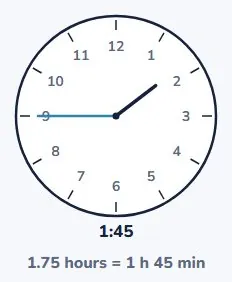
So what is 1.75 hours?
- 0.75 is three quarters.
- Three quarters of 60 minutes is 45.
- So 1 hour 45 minutes. Never 1 h 75.
Hours and minutes into minutes
- Turn the hours into minutes first, then add the rest.
- 2 h 45 is 120 plus 45, which is 165 minutes.
- 3 h 20 is 180 plus 20, so 200 minutes.
| Time | Working | Minutes |
|---|---|---|
| 2 h 45 min | 2 × 60, then + 45 | 165 min |
| 3 h 20 min | 3 × 60, then + 20 | 200 min |
| 1 h 05 min | 60 + 5 | 65 min |
And minutes back into hours
- Ask how many whole 60s fit in.
- 135 minutes: 60 goes in twice, leaving 15.
- So 2 hours 15 minutes.
| Minutes | Working | Gives |
|---|---|---|
| 135 min | how many whole 60s? | 2, with 15 left |
| So | 2 h 15 min | |
| 90 min | 1 whole hour, 30 left | 1 h 30 min |
Now a timetable
- A timetable never prints the number you actually want.
- It gives departure and arrival. You work out the gap.
- These times are made up, but the stations are real enough.
| Station | Morning | Afternoon |
|---|---|---|
| Avondale | 09:45 | 14:50 |
| Mount Albert | 09:58 | 15:03 |
| Kingsland | 10:12 | 15:18 |
| Britomart | 11:20 | 16:05 |
Do not subtract 9:45 from 11:20
- Treat those as decimals and you get 1.75, which means nothing.
- Subtract properly and you have to borrow 60, not 10.
- There is an easier way that never borrows at all.
| Method | Problem | |
|---|---|---|
| 11.20 − 9.45 as decimals | gives 1.75, which is wrong | |
| Column subtraction | borrowing in base 60 | error-prone |
| Counting up | no borrowing at all | use this |
Count up through the whole hours
- 09:45 to 10:00 is 15 minutes.
- 10:00 to 11:00 is a whole hour.
- 11:00 to 11:20 is 20 more. So 1 hour 35 minutes.
| From | Adds | |
|---|---|---|
| 09:45 to 10:00 | 15 min | |
| 10:00 to 11:00 | 1 hour | |
| 11:00 to 11:20 | 20 min | |
| Total | 1 h, 15 + 20 | 1 h 35 min |
You have done this before
- It is how you worked out change from a $50 note.
- Get to the next round number, then jump.
- No borrowing, and it is how people actually do it.
| Situation | Get to | Then |
|---|---|---|
| Change from $50 | the next whole dollar | jump in tens |
| Duration from 09:45 | the next whole hour | jump in hours |
The afternoon service, same method
- 14:50 to 15:00 is 10 minutes.
- 15:00 to 16:00 is an hour.
- Then 5 minutes to 16:05. One hour 15.
| From | Adds | |
|---|---|---|
| 14:50 to 15:00 | 10 min | |
| 15:00 to 16:00 | 1 hour | |
| 16:00 to 16:05 | 5 min | |
| Total | 1 h 15 min |
Comparing two journeys
- The morning trip took 1 h 35. The afternoon took 1 h 15.
- So the afternoon one is 20 minutes quicker.
- Both in the same units before you compare. Always.
| Service | Duration | In minutes |
|---|---|---|
| Morning | 1 h 35 min | 95 |
| Afternoon | 1 h 15 min | 75 |
| Difference | 20 min | 20 |
Adding durations, and carrying 60
- 45 minutes plus 50 minutes is 95 minutes.
- 95 is more than an hour, so it is 1 h 35.
- 2 h 45 plus 1 h 30 gives 3 h 75, which carries to 4 h 15.
| Sum | Working | Gives |
|---|---|---|
| 45 min + 50 min | 95 min | |
| 95 min | 60 into 95 once, 35 left | 1 h 35 min |
| 2 h 45 + 1 h 30 | gives 3 h 75 min | |
| Carry the 60 | 4 h 15 min |
Three answers that are never right
- Anything with 60 or more minutes in it, like 3 h 75.
- 2.5 hours written as 2 h 50.
- A duration got by subtracting clock times as decimals.
| Written | Should be | |
|---|---|---|
| 3 h 75 min | 4 h 15 min | |
| 2.5 h = 2 h 50 | 2 h 30 min | |
| 11.20 − 9.45 = 1.75 | 1 h 35 min |
Your turn: four questions
- Pause here and try all four.
- For question 3, count up through 09:00 and 10:00.
- Question 2 is a fraction of 60, not of 100.
| Question | |
|---|---|
| 1 | How many minutes is 3 hours 20 minutes? |
| 2 | How many minutes is two thirds of an hour? |
| 3 | A train leaves at 08:50 and arrives at 10:15. How long is the trip? |
| 4 | Write 135 minutes in hours and minutes. |
Show answer
1. 200 minutes. Three hours is 180, plus the 20. 2. 40 minutes. A third of 60 is 20, so two thirds is 40. 3. 1 hour 25 minutes. Count up: 10 minutes to 09:00, an hour to 10:00, then 15 more. 4. 2 hours 15 minutes. Sixty goes into 135 twice, leaving 15.
The answers
- 3 h 20 is 180 plus 20, which is 200 minutes.
- Two thirds of an hour is 40 minutes.
- 08:50 to 10:15 is 1 h 25. And 135 minutes is 2 h 15.
| Answer | |
|---|---|
| 1 | 200 min |
| 2 | 40 min |
| 3 | 1 h 25 min |
| 4 | 2 h 15 min |
What to take away
- Time runs in 60s, so a decimal hour is a fraction of 60.
- Count durations up through the whole hour. Never subtract.
- And if your answer has 60 or more minutes in it, carry.
| Remember | |
|---|---|
| Time | runs in 60s and 24s, never in tens |
| 2.5 hours | is 2 h 30 min, because half of 60 is 30 |
| A fraction of an hour | is that fraction of 60 minutes |
| Durations | count up through the whole hour |
| Over 60 minutes | carry an hour, do not write 75 |
Is your child on track?
Take the free placement test