Angles in polygons, transformations and map scales
What this lesson covers
- The sum of the exterior angles of a polygon is 360°.
- In a regular polygon, all exterior angles are the same; an exterior angle can be found by subtracting the interior angle from 180° or by dividing 360° by the number of sides.
- The interior angle sum of a triangle is 180°; for a quadrilateral, it is 360°.
- The interior angle sum of any polygon can be found using the formula 180(n−2)°, where n represents the total number of sides.
- A map's scale is the ratio between a distance on the map and the corresponding distance in the physical world.
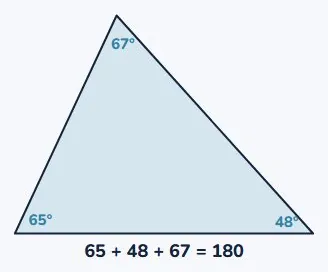
Angles in a triangle add to 180
- You have known this for years. Every triangle, always 180°.
- Tear the three corners off and they make a straight line.
- Now: what happens when the shape has more sides?
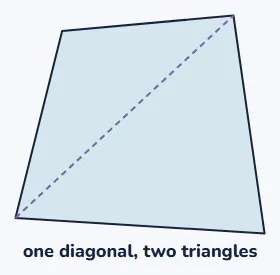
A quadrilateral is two triangles
- Draw one diagonal, corner to opposite corner.
- The shape falls into two triangles, and nothing is left over.
- Two lots of 180° is 360°.
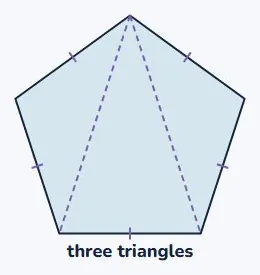
A pentagon is three
- Same trick. Pick a corner and draw to every other one.
- From a pentagon you get three triangles.
- Three lots of 180° is 540°.
The count is always two fewer
- 4 sides gave 2 triangles. 5 sides gave 3. 6 gives 4.
- Always two fewer triangles than sides.
- Because the corner you draw from cannot reach its neighbours.
| Shape | Cuts into | Sum |
|---|---|---|
| Triangle | 1 triangle | 180° |
| Quadrilateral | 2 triangles | 360° |
| Pentagon | 3 triangles | 540° |
| Hexagon | 4 triangles | 720° |
So the formula writes itself
- n sides gives n − 2 triangles.
- Each one is 180°.
- Interior angle sum = 180(n − 2). An octagon: 180 × 6 = 1080°.
| Step | Working | Gives |
|---|---|---|
| n sides | always gives | n − 2 triangles |
| Each triangle | 180° | |
| So the sum is | 180(n − 2)° | |
| Octagon, n = 8 | 180 × 6 | 1080° |
One angle of a regular polygon
- Regular means all sides equal and all angles equal.
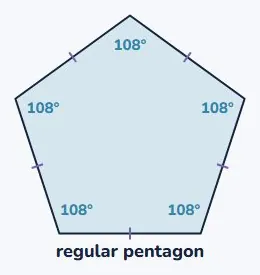
- So share the total out: a pentagon is 540 ÷ 5 = 108°.
- A hexagon is 120°. An octagon is 135°.
Now the angle on the outside
- Extend one side past the corner.
- The angle between that extension and the next side is exterior.
- It sits on a straight line with the interior one.
| Fact | Working | Gives |
|---|---|---|
| They sit on a straight line | so they add to 180° | |
| Pentagon: interior 108° | 180 − 108 | exterior 72° |
| Hexagon: interior 120° | 180 − 120 | exterior 60° |
Walk right round the outside
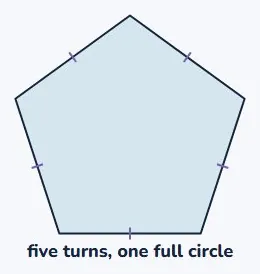
- Set off along one side. At each corner, turn.
- How much you turn is exactly the exterior angle.
- Back at the start, facing the same way: one full turn. 360°.
And that never changes
- A triangle: three turns of 120°. A square: four of 90°.
- A fifty-sided shape: fifty tiny turns. Still 360° in total.
- Interior sums grow without limit. Exterior sums never move.
| Shape | Working | Total |
|---|---|---|
| Triangle | 3 × 120 | 360° |
| Square | 4 × 90 | 360° |
| Pentagon | 5 × 72 | 360° |
| Hexagon | 6 × 60 | 360° |
Which gives a very fast shortcut
- If the polygon is regular, all the turns are equal.
- So one exterior angle is just 360 ÷ n.
- An octagon: 360 ÷ 8 = 45°. Then interior is 180 − 45 = 135°.
| Step | Working | Gives |
|---|---|---|
| Exterior angle | 360 ÷ n | |
| Regular pentagon | 360 ÷ 5 | 72° |
| Regular octagon | 360 ÷ 8 | 45° |
| Then interior | 180 − exterior | 135° |
Finding a missing angle
- Work out the total, then subtract what you were given.
- A triangle with 65° and 48°: 180 − 113 = 67°.
- A quadrilateral with 90°, 90° and 120°: 360 − 300 = 60°.
| Given | Working | Missing |
|---|---|---|
| Triangle, 65° and 48° | 180 − 113 | 67° |
| Quadrilateral, 90° 90° 120° | 360 − 300 | 60° |
| Method | sum, minus what you have |
Now: moving a shape about
- Slide it, and that is a translation.
- Flip it over a line, a reflection. Turn it, a rotation.
- All three leave the shape exactly the same size.
| Transformation | What you do | What survives |
|---|---|---|
| Translation | slide it | size and angles unchanged |
| Reflection | flip it over a line | size and angles unchanged |
| Rotation | turn it about a point | size and angles unchanged |
On the coordinate plane
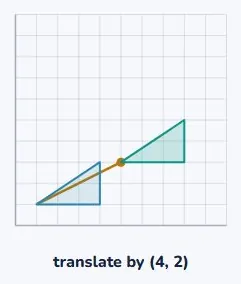
- A translation adds the same amount to every point.
- Here, 4 to the right and 2 up. Every vertex, the same move.
- The shape is identical. Only where it sits has changed.
Scaling is the one that changes size
- Multiply every length by the same factor.
- Factor 2 doubles every side. Factor ½ halves them.
- The angles do not change at all. Same shape, different size.
| Transformation | What you do | What survives |
|---|---|---|
| Translation | slide it | size and angles unchanged |
| Reflection | flip it over a line | size and angles unchanged |
| Rotation | turn it about a point | size and angles unchanged |
| Scaling | resize by a factor | angles unchanged, lengths not |
Last: what a map scale means
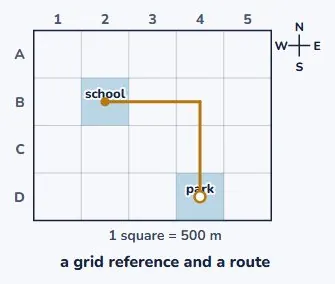
- A scale like 1 : 50 000 is a ratio.
- One of anything on the map is 50 000 of the same thing outside.
- Same units on both sides. That is the bit people miss.
So convert it into something useful
- 1 cm on the map means 50 000 cm on the ground.
- 50 000 cm is 500 m, which is half a kilometre.
- So 4 cm on that map is 2 kilometres.
| Step | Working | Gives |
|---|---|---|
| 1 : 50 000 | 1 cm on the map | 50 000 cm real |
| 50 000 cm | in metres | 500 m |
| So 1 cm | 0.5 km | |
| And 4 cm | 2 km |
Your turn: four questions
- Pause here and try all four.
- Question 2 has two routes. Either is fine.
- Question 4 wants kilometres, so convert twice.
| Question | |
|---|---|
| 1 | What do the interior angles of a pentagon add to? |
| 2 | What is one exterior angle of a regular hexagon? |
| 3 | A triangle has angles of 55° and 70°. Find the third. |
| 4 | On a 1:25 000 map, how far is 6 cm in real life? |
Show answer
1. 540°. It cuts into 3 triangles, or use 180 × (5 − 2). 2. 60°. Either 360 ÷ 6, or 180 − 120 using the interior angle. 3. 55°. The three add to 180, and 55 + 70 = 125. 4. 1.5 km. 1 cm is 25 000 cm, which is 250 m, so 6 cm is 1500 m.
The answers
- A pentagon is 540°, from three triangles.
- A regular hexagon has 60° exterior angles, from 360 ÷ 6.
- The third angle is 55°. And 6 cm at 1:25 000 is 1.5 km.
| Answer | |
|---|---|
| 1 | 540° |
| 2 | 60° |
| 3 | 55° |
| 4 | 1.5 km |
What to take away
- Interior angles: 180(n − 2), because you get n − 2 triangles.
- Exterior angles: 360°, for every polygon, because you walk a circle.
- And a map scale is a ratio, so match the units before you start.
| Remember | |
|---|---|
| Interior sum | 180(n − 2)°, from n − 2 triangles |
| Exterior sum | 360°, for every polygon there is |
| Regular polygon | exterior angle is 360 ÷ n |
| At any corner | interior + exterior = 180° |
| Map scale | a ratio, so the units must match first |
Is your child on track?
Take the free placement test